How Many Amps Does a Small Fridge Draw?
ZacharyWilliamUpdated April 28, 2026 · Small Fridge Amps · 120V Homes · Battery Backup Sizing
A small fridge usually draws about 0.4–1.5 amps while the compressor is running on a standard U.S. 120V outlet. Compact under-counter fridges may run closer to 0.6–2 amps, while older or garage-used units can draw more. The short start-up surge can be several times higher than the normal running draw, which matters if you are using an inverter or a portable power station.
The safest answer is always on your fridge’s nameplate or in a real plug-in meter reading. This guide shows you how to read those numbers, convert amps to watts, and choose a realistic backup power setup without guessing.
Quick Answer
For most small refrigerators in U.S. homes, plan around 0.4–1.5 running amps at 120V, which equals roughly 50–180 running watts. For battery backup, do not size only from running amps. Also check start-up surge and estimate the fridge’s average watts over time. A fridge may run at 80W when the compressor is on, but average much less over several hours because it cycles on and off.

Typical Amp Draw by Small Fridge Type
“Small fridge” can mean a dorm mini fridge, a beverage cooler, a compact apartment refrigerator, a car-style portable fridge, or a narrow under-counter unit. Their amp draw is not identical. Use this table for planning, then verify your own model.
| Fridge type | Common size | Typical running watts | Estimated running amps at 120V | What to watch | Best source to verify |
|---|---|---|---|---|---|
| Very small mini fridge | 1.0–2.0 cu. ft. | 40–80W while compressor is running | 0.3–0.7A | Often easy to run, but still has a compressor start-up spike. | Nameplate or plug-in meter |
| Dorm mini fridge with small freezer | 2.5–4.5 cu. ft. | 60–120W while compressor is running | 0.5–1.0A | Freezer compartment and door openings can raise run time. | ENERGY STAR refrigerator data |
| Compact under-counter fridge | 4–8 cu. ft. | 80–180W while compressor is running | 0.7–1.5A | Built-in units may run warmer if ventilation is poor. | Product manual or EnergyGuide label |
| Beverage cooler | Small to medium | 60–200W depending on design | 0.5–1.7A | Glass doors lose cold air faster than insulated doors. | Nameplate and real meter reading |
| Older compact fridge | Any small size | 100–300W while running | 0.8–2.5A | Dirty coils, worn seals, and hot garages increase draw. | Plug-in meter over several hours |
The range looks wide because a refrigerator is not a steady device. It cools, shuts off, warms slightly, and starts again. That cycling pattern is why battery runtime should be based on average watts over time, not a single instant reading.
Amps vs Watts: The Simple 120V Conversion
Most U.S. small fridges plug into a standard 120V household outlet. The basic conversion is:
Watts = Volts × Amps
Amps = Watts ÷ Volts
If a small fridge says 1.2A on the label, the rough wattage is 120V × 1.2A = 144W. If the label says 90W, the rough amp draw is 90W ÷ 120V = 0.75A. The U.S. Department of Energy also uses the same method for estimating wattage from amps and voltage in appliance energy calculations.
| Running amps at 120V | Approx. running watts | How this looks in real use | Battery sizing note |
|---|---|---|---|
| 0.4A | 48W | Efficient mini fridge or low compressor load | Small batteries may handle short use, but check surge. |
| 0.6A | 72W | Common small fridge running range | Good planning number for compact fridge examples. |
| 1.0A | 120W | Mini fridge with freezer, warmer room, or older unit | Runtime drops quickly if the compressor runs often. |
| 1.5A | 180W | Larger compact fridge or heavier cooling condition | Choose more capacity if outage backup matters. |
| 2.0A | 240W | High draw for many “small” fridges | Could still be fine, but start-up surge matters more. |
How to Find Your Fridge’s Real Amps
1. Read the nameplate
Look inside the fridge cabinet, on the side wall, around the door frame, or on the back near the compressor area. You may see “Amps,” “Rated Current,” “Input Current,” “Watts,” “Voltage,” or “LRA.”
| Label term | What it means | How to use it | Common mistake |
|---|---|---|---|
| Voltage / V | The outlet voltage the fridge is designed for | Most U.S. plug-in fridges are 115–120V. | Using 12V math for a 120V AC fridge. |
| Amps / A | Current draw listed by the manufacturer | Multiply by 120V to estimate watts. | Treating this as all-day average energy use. |
| Watts / W | Power draw | Divide by 120V to estimate amps. | Ignoring that compressor cycling changes the average. |
| LRA | Locked rotor amps, related to motor starting load | Use it as a warning that start-up surge exists. | Confusing LRA with normal running amps. |
| kWh/year | Estimated annual energy use | Useful for average-watt battery estimates. | Using it to judge start-up surge. It does not show surge. |
2. Use a plug-in power meter
A plug-in electricity monitor is often the best tool for a small fridge because it can show real wattage and energy use over time. The Department of Energy notes that usage monitors are useful for devices that do not run constantly, including refrigerators.
For a useful reading, do this:
- Plug the fridge into the meter and let it run for at least a few hours.
- Record the compressor’s steady running watts.
- Record kWh used over time, not just one instant watt reading.
- Repeat the test in the room where you actually use the fridge.
- For battery backup, keep the fridge closed during the test to match emergency use.
3. Use the EnergyGuide label if available
Some refrigerators show an EnergyGuide label with estimated yearly electricity use. The FTC explains that EnergyGuide labels help compare energy use among similar appliances. For backup power, the useful number is estimated yearly electricity use in kWh/year.
Average watts from EnergyGuide:
Average watts ≈ kWh/year × 1000 ÷ 8760
Example: 220 kWh/year × 1000 ÷ 8760 ≈ 25W average over the year.
This average-watt number can be much lower than the compressor’s running watts. That is normal. The fridge is plugged in all day, but the compressor is not running at full power all day.
Running Amps, Start-Up Surge, and Average Draw
A small fridge has three different “power numbers.” Mixing them up is the main reason people buy the wrong inverter or battery.
| Power number | When it happens | Why it matters | Best way to measure |
|---|---|---|---|
| Running amps | When the compressor is actively cooling | Helps estimate normal power draw and circuit load | Nameplate or plug-in meter |
| Start-up surge | For a brief moment when the compressor starts | Determines whether an inverter or power station can start the fridge | Inrush-capable meter or conservative surge headroom |
| Average watts | Over several hours or a full day | Determines how long a battery can keep the fridge running | kWh reading from a meter or EnergyGuide math |
For a normal wall outlet, the brief start-up spike is usually not a problem. For a portable power station, it can be the deciding factor. A fridge that runs at only 80W may still need a much higher surge for a split second. That is why a pure sine wave AC output and enough surge rating are important for compressor appliances.
Battery Runtime Examples for Small Fridges
For portable power station sizing, use average watts whenever possible. If you only know running watts, measure the fridge for a few hours first. The table below uses a practical AC-load planning estimate:
Estimated runtime = Battery capacity × 0.85 ÷ average fridge watts
The 0.85 factor allows room for inverter and conversion losses. Actual runtime changes with room temperature, fridge condition, door openings, thermostat setting, and battery state.
| Power station size | Usable estimate after 15% loss | 40W average fridge | 60W average fridge | 80W average fridge | 100W average fridge | Best fit |
|---|---|---|---|---|---|---|
| 256Wh class | About 218Wh | About 5.4 hrs | About 3.6 hrs | About 2.7 hrs | About 2.2 hrs | Short mini-fridge use, quick cooling window, light emergency backup |
| 596Wh class | About 507Wh | About 12.7 hrs | About 8.4 hrs | About 6.3 hrs | About 5.1 hrs | Mini fridge, compact fridge, camping fridge, overnight partial backup |
| 1,190Wh class | About 1,012Wh | About 25.3 hrs | About 16.9 hrs | About 12.6 hrs | About 10.1 hrs | Longer small-fridge backup and many efficient household refrigerators |
| 2,083Wh class | About 1,771Wh | About 44.3 hrs | About 29.5 hrs | About 22.1 hrs | About 17.7 hrs | Long outage cushion, fridge plus router/lights, heavier compressor starts |
These examples are intentionally practical, not perfect laboratory promises. A small dorm fridge in a cool room can average far less than 60W. A compact fridge in a hot garage can average more. If food safety matters, size for the warmest likely room and keep the door closed as much as possible.
UDPOWER Picks for Small Fridge Backup
For a small fridge, the right UDPOWER model depends on how long you need backup power and whether the fridge has a demanding compressor start. The choices below focus on AC output, surge headroom, battery capacity, and real-life use.

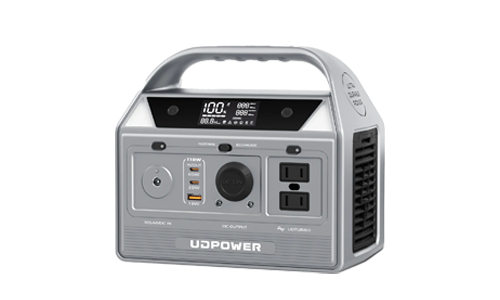
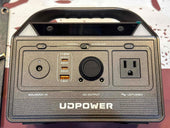
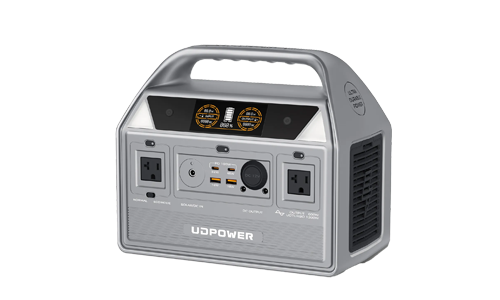
Best compact choice: UDPOWER C600
The UDPOWER C600 is a practical match for many mini fridges, beverage coolers, and compact camping setups when you need more runtime than a small 200–300Wh battery can provide.
- 596Wh LiFePO4 battery
- 600W pure sine wave AC output
- 1200W surge support
- Good fit for mini fridge backup, camping fridge use, phones, lights, routers, and laptops
- Solar input supported within its voltage/current limits
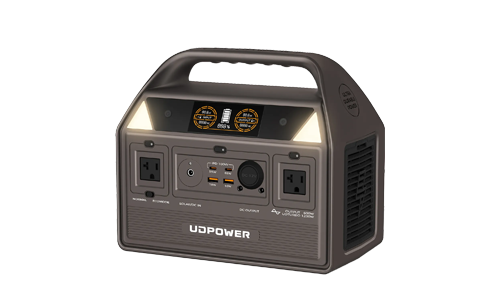
Best all-around backup: UDPOWER S1200
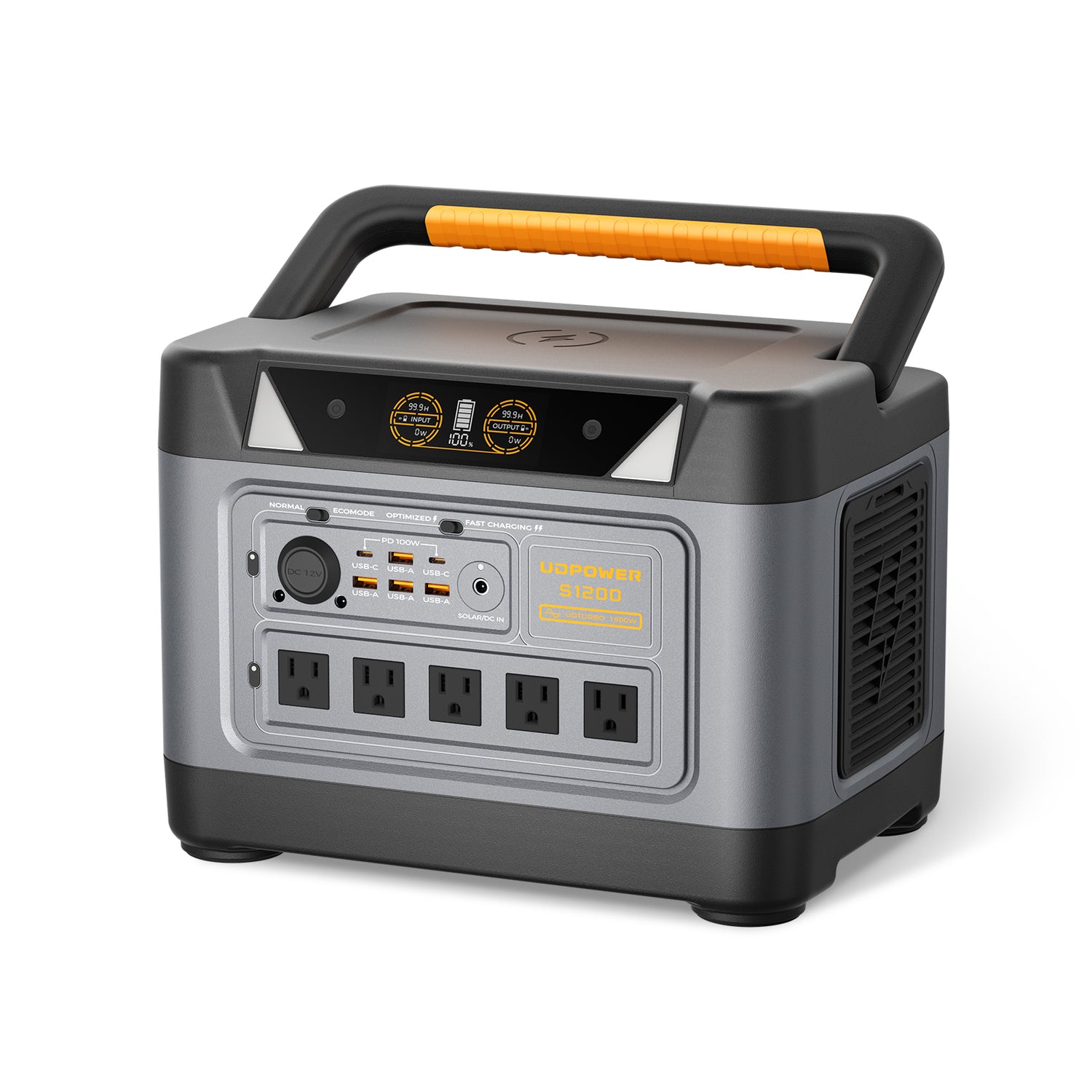
The UDPOWER S1200 is the better choice if your “small fridge” is closer to an under-counter unit, if you want overnight backup, or if you also want to keep a Wi-Fi router, lights, laptop, or CPAP running during an outage.
- 1,190Wh capacity
- 1,200W pure sine wave AC output
- 1,800W surge support
- LiFePO4 battery with long cycle life
- UPS function for short transfer interruptions
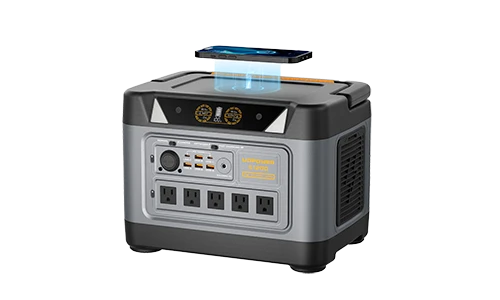
Best long-runtime cushion: UDPOWER S2400
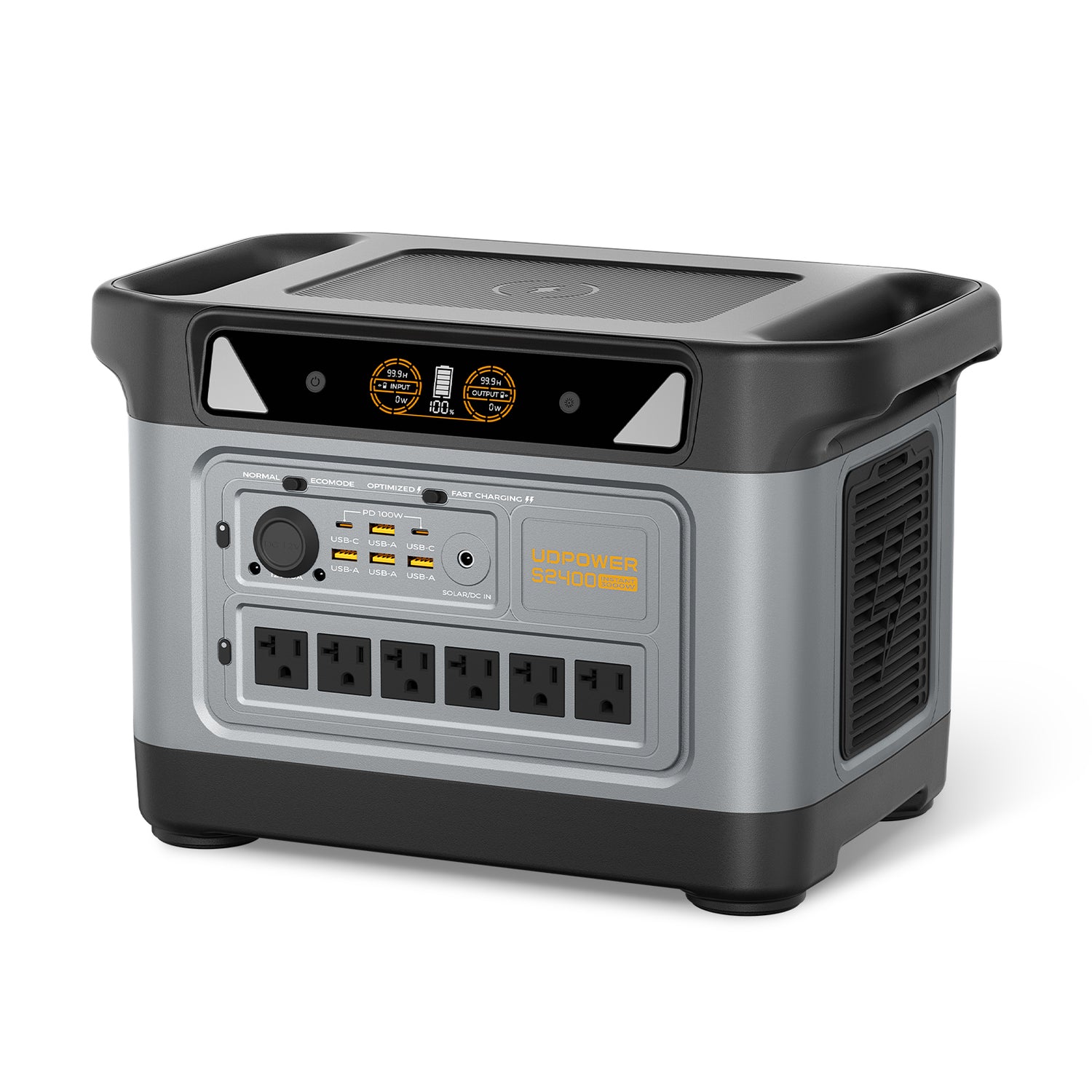
The UDPOWER S2400 is the stronger pick when you want longer outage protection, have a fridge with a heavier start-up load, or plan to run the fridge alongside other essentials.
- 2,083Wh capacity
- 2,400W pure sine wave AC output
- 3,000W surge support
- 6 AC outlets plus DC and USB outputs
- Solar input 12–50V, 10A max, up to 400W via DC7909 input
| UDPOWER model | Capacity | AC output | Surge support | Best small-fridge use case | Official spec link |
|---|---|---|---|---|---|
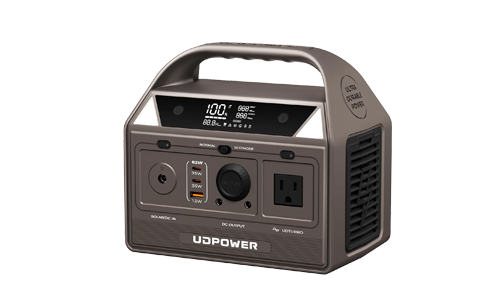
| UDPOWER C400 | 256Wh | 400W | 800W | Short mini-fridge backup or light emergency use | C400 specs |
| UDPOWER C600 | 596Wh | 600W | 1200W | Mini fridge, compact fridge, camping fridge, dorm fridge | C600 specs |
| UDPOWER S1200 | 1,190Wh | 1,200W | 1,800W | Longer backup for compact fridges and many efficient home fridges | S1200 specs |
| UDPOWER S2400 | 2,083Wh | 2,400W | 3,000W | Longer outages, fridge plus essentials, heavier compressor start loads | S2400 specs |
What Changes If You Add Solar Panels?
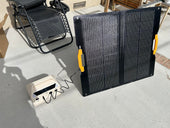
Solar does not remove the need for enough battery capacity. It helps refill the battery during daylight. For a small fridge, solar is most useful when you are camping, living in an RV, or preparing for outages that may last longer than one night.
| Setup goal | What solar helps with | What solar does not solve | Useful UDPOWER link |
|---|---|---|---|
| Mini fridge for a weekend campsite | Recharges part of the daily energy used by the fridge | Clouds, shade, low sun angle, and poor panel placement reduce input | Solar generator kits |
| Small fridge during a home outage | Extends runtime if panels get direct sunlight | Nighttime use still depends on stored battery capacity | How many solar panels to run a refrigerator? |
| Fridge plus router and lights | Offsets daytime energy draw from multiple essentials | Undersized panels may not keep up with total daily load | UDPOWER solar panel pairing guide |
Always check solar input voltage, current, connector type, and panel open-circuit voltage before using third-party panels. Solar panel wattage alone is not enough.
Common Sizing Mistakes
Mistake 1: Buying only from “amps”
Amps tell you electrical current. Battery runtime depends on watt-hours and average watts. A fridge with low running amps can still drain a small battery quickly if it cycles often.
Mistake 2: Ignoring start-up surge
Compressor appliances need a short burst of power at start-up. If the inverter cannot handle that burst, the fridge may fail to start even when the running wattage looks low.
Mistake 3: Using a single instant watt reading
One reading may catch the fridge during a compressor-on or compressor-off moment. For backup planning, leave a meter connected long enough to see real kWh use over time.
Mistake 4: Forgetting room temperature
A fridge in a 72°F kitchen behaves differently from a fridge in a hot garage. Heat, poor ventilation, and frequent door openings make the compressor run longer.
Mistake 5: Treating mini fridges and car fridges the same
A 120V AC mini fridge and a 12V DC car fridge use different power systems. This article focuses mainly on small plug-in AC fridges used in U.S. homes. If you use a DC portable fridge, check its 12V/24V power rating separately.
Simple Buying Rule
If you only need a short backup window for a small mini fridge, a 500–600Wh class power station can be enough if the fridge’s surge is within the inverter rating. If you want overnight backup or you are unsure about the fridge’s compressor behavior, move up to a 1,000Wh+ class unit. If you want a stronger outage cushion or plan to run multiple essentials, a 2,000Wh class unit gives more breathing room.
Before you buy, check these four numbers:
- Your fridge voltage: usually 115–120V for U.S. AC fridges.
- Your fridge running amps or watts.
- Your fridge start-up surge behavior, if available.
- Your target runtime: short outage, overnight, or multi-day with solar recharge.
FAQ
How many amps does a mini fridge draw?
Many mini fridges draw about 0.4–1.0 amps while the compressor is running on a 120V outlet. Larger compact models may draw closer to 1.5–2 amps. Check the nameplate or use a plug-in meter for your exact model.
How many watts is 1 amp on a small fridge?
On a 120V outlet, 1 amp is about 120 watts. Use watts = volts × amps. A fridge labeled 1.2A is roughly 144W while drawing that current.
Does a small fridge use 1 amp all day?
No. A refrigerator cycles on and off. It may draw 1 amp while the compressor is running, then much less when the compressor is off. That is why kWh over time is better for runtime planning.
Can a small fridge run on a 15 amp circuit?
In most cases, yes. A small fridge usually draws far below 15 amps while running. The bigger concern is putting too many high-draw appliances on the same circuit.
What size power station do I need for a small fridge?
For short backup, a 500–600Wh power station may work for many mini fridges. For overnight backup, a 1,000Wh+ unit is more realistic. For longer outages or extra loads, consider a 2,000Wh class power station with solar input.
Why does my fridge trip a small inverter if the amps look low?
The compressor may need a short start-up surge that is much higher than its normal running draw. Choose a pure sine wave inverter or power station with enough surge rating.
Is the EnergyGuide label useful for battery backup?
Yes, but mainly for average energy use. Convert kWh/year into average watts, then use that number for runtime estimates. It does not tell you the fridge’s start-up surge.
Will a fridge in a garage use more amps?
It may not always draw more instant amps, but it will usually run longer in a hot garage. Longer compressor run time means more watt-hours used and shorter battery runtime.
Should I use running watts or average watts for runtime?
Use average watts for runtime. Use running watts and surge information to make sure the fridge can start and run safely.
Can solar panels run a small fridge directly?
It is better to use solar panels to charge a power station, then run the fridge from the power station. Direct solar output changes constantly with clouds, angle, and shade, while the battery gives the fridge steadier power.
Sources and Related Reading
This guide uses standard 120V electrical math, manufacturer nameplate logic, EnergyGuide-style energy estimates, and UDPOWER official product specifications.
Related UDPOWER guides
Keep a Small Fridge Running with the Right Backup Setup
Start with your fridge’s real amps or watts, then size for start-up surge and average watt-hours. If you want a simple path, compare UDPOWER portable power stations by capacity, AC output, and solar compatibility.