

How Much Does It Cost to Charge an E-Bike?
Last updated: August 6, 2026
Charging an electric bike costs far less than most new owners expect. The battery may take several hours to recharge, but charging time is not the same as electricity consumption. What matters is the battery’s watt-hour capacity, how much charge you add, charging losses, and the electricity rate on your utility bill.
Quick Answer
At the May 2026 U.S. residential average electricity price of 18.44 cents per kilowatt-hour, a complete e-bike charge typically costs about $0.06 to $0.21.
A common 500Wh battery costs approximately $0.10 to charge from empty, while a 750Wh battery costs approximately $0.15. These estimates assume about 90% wall-to-battery charging efficiency.
Most riders do not arrive home with a completely empty battery. A 20%-to-80% top-up on a 500Wh battery costs only about $0.06 at the same electricity rate.

How Much Does a Full E-Bike Charge Cost?
The following estimates use the latest U.S. residential electricity price available when this guide was updated: 18.44 cents per kWh for May 2026. The calculations assume that approximately 90% of the electricity drawn from the outlet becomes stored energy in the e-bike battery.
| E-Bike Battery Size | Energy Stored | Estimated Energy From Wall | Estimated Full-Charge Cost | Typical Use Case |
|---|---|---|---|---|
| 300Wh | 0.30kWh | 0.33kWh | $0.06 | Compact folding bike or lightweight commuter |
| 400Wh | 0.40kWh | 0.44kWh | $0.08 | Urban commuter or entry-level trail bike |
| 500Wh | 0.50kWh | 0.56kWh | $0.10 | Common commuter and recreational battery |
| 625Wh | 0.63kWh | 0.69kWh | $0.13 | Longer-range commuter or trekking bike |
| 750Wh | 0.75kWh | 0.83kWh | $0.15 | Cargo bike, trail bike, or extended-range model |
| 960Wh | 0.96kWh | 1.07kWh | $0.20 | High-capacity or dual-battery setup |
| 1,000Wh | 1.00kWh | 1.11kWh | $0.21 | Large cargo, moped-style, or long-range e-bike |
These figures represent the variable electricity used by the charging session. Fixed utility fees, account charges, or unrelated household electricity use are not caused by charging the bike and generally should not be assigned entirely to one battery charge.
How to Calculate Your E-Bike Charging Cost
You need three numbers: battery capacity in watt-hours, estimated charging efficiency, and your electricity price in dollars per kilowatt-hour.
Example: 500Wh Battery
Battery capacity: 500Wh
Charging efficiency: 90%, written as 0.90
Electricity price: $0.1844 per kWh
500 ÷ 1,000 = 0.50kWh stored in the battery
0.50 ÷ 0.90 = 0.556kWh drawn from the outlet
0.556 × $0.1844 = $0.1025
Estimated cost: approximately $0.10
Why Charging Losses Must Be Included
A battery labeled 500Wh stores approximately 500 watt-hours under its rated conditions, but the wall outlet must supply more than 500Wh. Energy is lost as heat in the charger, battery cells, wiring, battery management system, and final charge-balancing stage.
Ninety percent is a practical planning estimate, not a guaranteed efficiency for every charger. A less efficient, older, unusually hot, or unusually cold setup may draw more electricity.
How to Find Your E-Bike Battery Capacity
Look for a label on the battery, bike frame, product page, or owner’s manual. The easiest number to use is watt-hours, shown as Wh.
When Watt-Hours Are Already Listed
A label showing “500Wh” gives you the battery capacity directly. You do not need to calculate it from voltage and amp-hours.
When the Label Shows Volts and Amp-Hours
| Battery Label | Capacity Calculation | Approximate Battery Capacity | Estimated Full-Charge Cost |
|---|---|---|---|
| 36V, 10Ah | 36 × 10 | 360Wh | About $0.07 |
| 36V, 14Ah | 36 × 14 | 504Wh | About $0.10 |
| 48V, 10Ah | 48 × 10 | 480Wh | About $0.10 |
| 48V, 15Ah | 48 × 15 | 720Wh | About $0.15 |
| 52V, 20Ah | 52 × 20 | 1,040Wh | About $0.21 |
How Much Does a Partial E-Bike Charge Cost?
Most riders recharge before the battery reaches zero. To estimate a partial charge, multiply the battery capacity by the percentage being added.
Charging from 20% to 80% adds 60% of the battery’s rated capacity.
| Battery Capacity | Energy Added to Battery | Estimated Wall Energy | Estimated Cost |
|---|---|---|---|
| 400Wh | 240Wh | 0.27kWh | $0.05 |
| 500Wh | 300Wh | 0.33kWh | $0.06 |
| 625Wh | 375Wh | 0.42kWh | $0.08 |
| 750Wh | 450Wh | 0.50kWh | $0.09 |
| 1,000Wh | 600Wh | 0.67kWh | $0.12 |
The battery percentage shown on an e-bike display is an estimate rather than laboratory-grade energy measurement, so actual wall consumption may differ slightly.
How Location Changes the Cost of Charging an E-Bike
Electricity prices vary significantly by state and utility. A large battery in a high-price state may cost several times more to charge than the same battery in a lower-price state, although the total cost remains modest.
| Location | Residential Price | 500Wh Full Charge | 750Wh Full Charge | 1,000Wh Full Charge |
|---|---|---|---|---|
| U.S. average | 18.44¢/kWh | $0.10 | $0.15 | $0.21 |
| California | 33.25¢/kWh | $0.18 | $0.28 | $0.37 |
| New York | 29.93¢/kWh | $0.17 | $0.25 | $0.33 |
| Texas | 16.44¢/kWh | $0.09 | $0.14 | $0.18 |
| Florida | 15.17¢/kWh | $0.08 | $0.13 | $0.17 |
| Washington | 14.95¢/kWh | $0.08 | $0.12 | $0.17 |
| Hawaii | 52.00¢/kWh | $0.29 | $0.43 | $0.58 |
Use the Rate on Your Own Bill When Possible
State averages are useful for comparison, but your utility plan is more accurate. Look for a line showing cents per kWh or dollars per kWh. Customers on time-of-use plans should use the price that applies during the hours when the bike is actually charged.
Marginal Rate vs. All-In Rate
For the cost added by one charging session, the variable energy rate is usually the most useful number. Dividing the entire utility bill by total kWh may produce a higher “all-in” rate because it includes fixed customer charges and taxes that would exist even without the e-bike.
Monthly and Annual E-Bike Charging Cost
Even frequent riders usually spend only a few dollars per month on electricity. The following table assumes complete charges, which makes it conservative for riders who usually perform partial top-ups.
| Full Charges per Month | 500Wh Monthly Cost | 500Wh Annual Cost | 750Wh Monthly Cost | 750Wh Annual Cost |
|---|---|---|---|---|
| 8 charges | $0.82 | $9.83 | $1.23 | $14.75 |
| 12 charges | $1.23 | $14.75 | $1.84 | $22.13 |
| 20 charges | $2.05 | $24.59 | $3.07 | $36.88 |
| 30 charges | $3.07 | $36.88 | $4.61 | $55.32 |
A rider who uses half of a 500Wh battery each day would not pay the same as 30 complete charges. The monthly energy would be closer to 15 full-charge equivalents, or approximately $1.54 at the national rate used here.
How Much Does an E-Bike Cost per Mile in Electricity?
Cost per mile depends on how many watt-hours the bike consumes for each mile traveled. A lightweight rider on flat roads and low assist may use far less energy than a loaded cargo bike climbing hills at high assist.
| Bike Energy Use | Electricity Cost per Mile | Cost per 20 Miles | Cost per 100 Miles | Likely Riding Situation |
|---|---|---|---|---|
| 10Wh/mile | $0.0021 | $0.04 | $0.21 | Efficient riding with meaningful pedaling |
| 15Wh/mile | $0.0031 | $0.06 | $0.31 | Moderate assist on mixed terrain |
| 20Wh/mile | $0.0041 | $0.08 | $0.41 | Higher assist or heavier bike |
| 25Wh/mile | $0.0051 | $0.10 | $0.51 | Hills, headwinds, cargo, or faster riding |
| 30Wh/mile | $0.0061 | $0.12 | $0.62 | Heavy cargo or demanding conditions |
Even at 30Wh per mile, the electricity cost remains below one cent per mile at the U.S. rate used in this article. Tires, brake drag, speed, hills, wind, rider weight, cargo, and temperature matter more to cost per mile than the charger’s advertised speed.
Does a Faster E-Bike Charger Cost More to Use?
A higher-watt charger mainly changes how quickly energy enters the battery. It does not automatically double the total electricity cost. Filling a 500Wh battery still requires roughly the same stored energy whether the approved charger takes three hours or six hours.
There can be small efficiency differences between chargers and charging rates, but battery capacity and the amount of charge added remain the main drivers of total cost.
How to Measure the Actual Cost of Charging Your E-Bike
A plug-in electricity meter provides the most accurate answer for your charger, battery, temperature, and utility rate.
- Plug the energy meter into a normal household outlet in a dry, ventilated charging location.
- Plug the manufacturer-approved e-bike charger into the meter.
- Reset the meter’s accumulated kWh reading before beginning.
- Charge the battery through the same percentage range you normally use.
- Record the total kWh after charging is complete.
- Multiply the measured kWh by your electricity rate in dollars per kWh.
Measured Example
If the meter records 0.61kWh and your electricity rate is $0.1844/kWh:
0.61 × $0.1844 = $0.1125
The measured charging cost is approximately $0.11.
Measuring several sessions is better than relying on one result. Starting percentage, ending percentage, temperature, and battery balancing can vary between charges.
Wall Outlet vs. Portable Power Station vs. Solar Charging
Charging Directly From a Wall Outlet
Direct wall charging is usually the least expensive grid-powered method because it has the fewest conversion stages. Electricity moves from the household outlet through the e-bike charger and into the bike battery.
Charging From a Portable Power Station
A portable power station is useful at campsites, trailheads, work sites, or during outages. It can run the bike’s normal AC charger when the charger wattage remains below the station’s continuous AC output.
However, using grid electricity to charge a power station and later using the station to charge the e-bike introduces extra conversion losses. The convenience is valuable, but it is not normally the lowest-energy route.
Illustrative 500Wh Example
Direct wall charging at 90% efficiency requires approximately 0.56kWh and costs about $0.10.
For planning only, if grid-to-station charging, station AC conversion, and the e-bike charger each averaged 90%, combined efficiency would be approximately 72.9%. The same 500Wh refill would require about 0.69kWh from the grid and cost approximately $0.13.
Actual results depend on the station, charger, load, temperature, and remaining battery levels.
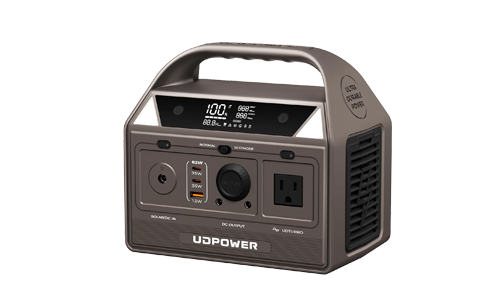
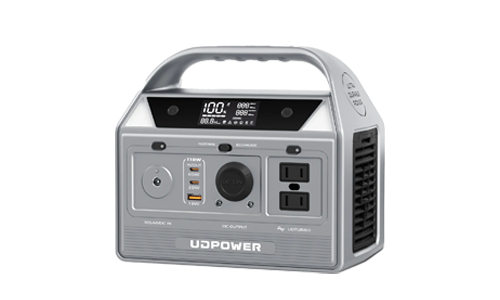
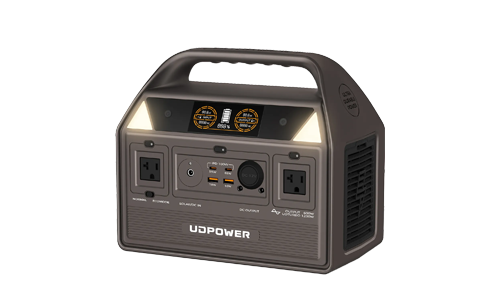
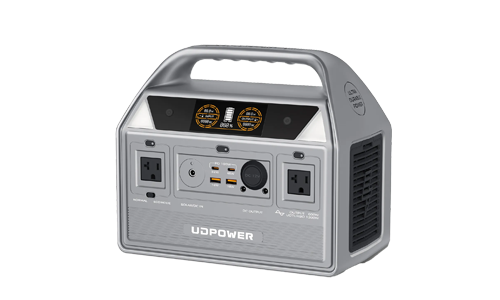
Before using a portable station, follow the UDPOWER device compatibility guide to compare charger wattage with AC output.
Charging With Solar Energy
Solar charging can reduce the marginal utility cost of an off-grid charge to zero when the energy is collected from sunlight. That does not make the overall system free: the solar panel, portable power station, cables, storage, and replacement costs still matter.
The practical charging path is:
Solar production changes with shade, panel angle, cloud cover, temperature, panel cleanliness, cable loss, and the power station’s input limit. Read the complete portable power station solar charging guide before building an off-grid setup.
Recommended UDPOWER Power Stations for E-Bike Charging
E-bike chargers commonly require much less AC output than household appliances, so battery capacity is usually the deciding factor. The estimates below use 90% power-station AC conversion efficiency and 90% e-bike charging efficiency, for an estimated combined delivery factor of 81%.
| UDPOWER Model | Capacity | Rated AC Output | Weight | 500Wh Charge Equivalents | 750Wh Charge Equivalents |
|---|---|---|---|---|---|
| C600 | 596Wh | 600W | 12.3 lb | About 0.97 | About 0.64 |
| S1200 | 1,190Wh | 1,200W | 26 lb | About 1.93 | About 1.29 |
| S2400 | 2,083Wh | 2,400W | 40.8 lb | About 3.37 | About 2.25 |
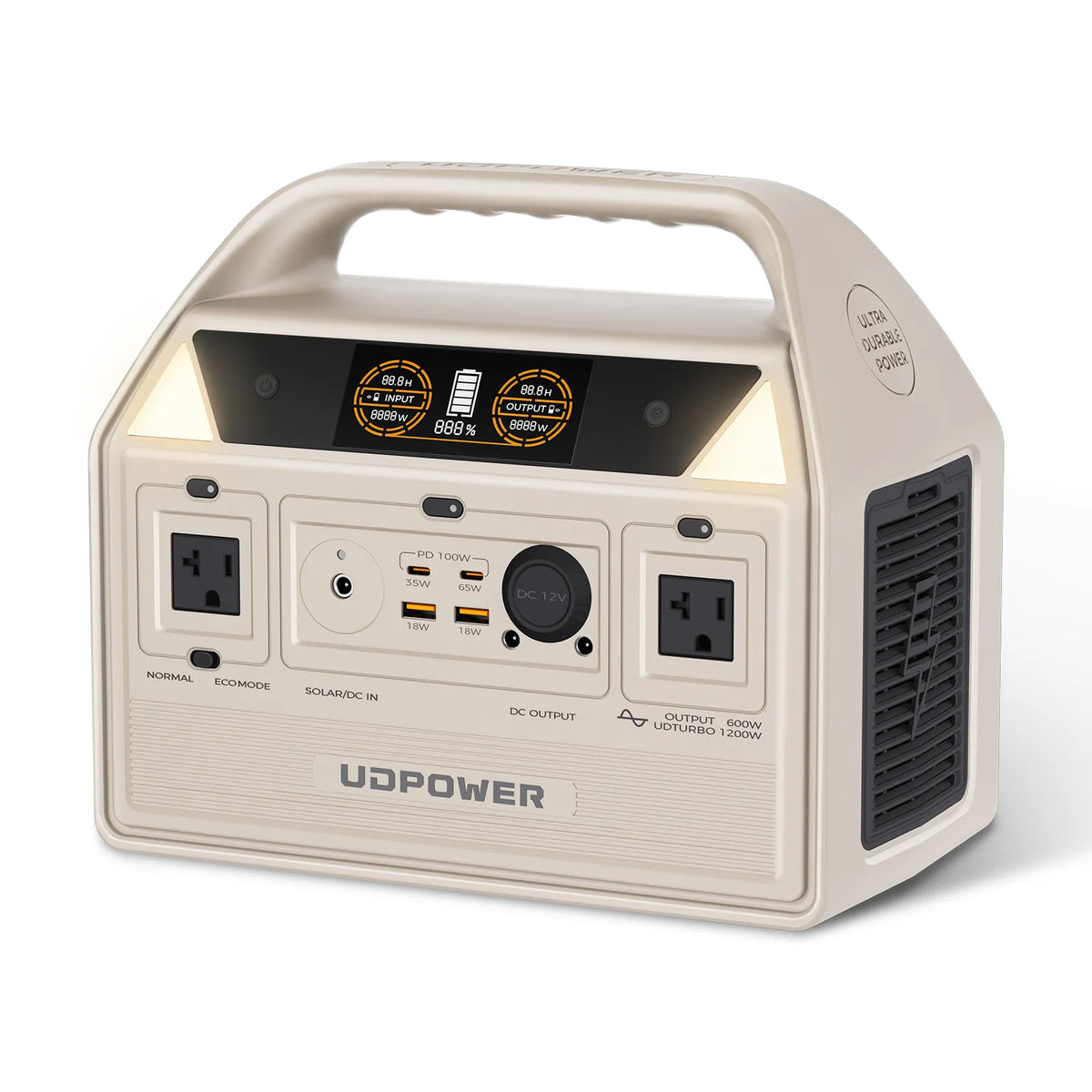
UDPOWER C600: Best for Emergency Top-Ups
596Wh capacity · 600W rated output · 12.3 lb · LiFePO4 battery
The C600 is the most portable option in this comparison. It can handle the AC demand of many standard e-bike chargers, but its 596Wh battery does not provide a comfortable zero-to-100% recharge for a 500Wh bike battery after both conversion stages.
It makes the most sense for lunch-stop top-ups, smaller batteries, emergency range extension, or riders who value lower carrying weight more than multiple full charges.
View UDPOWER C600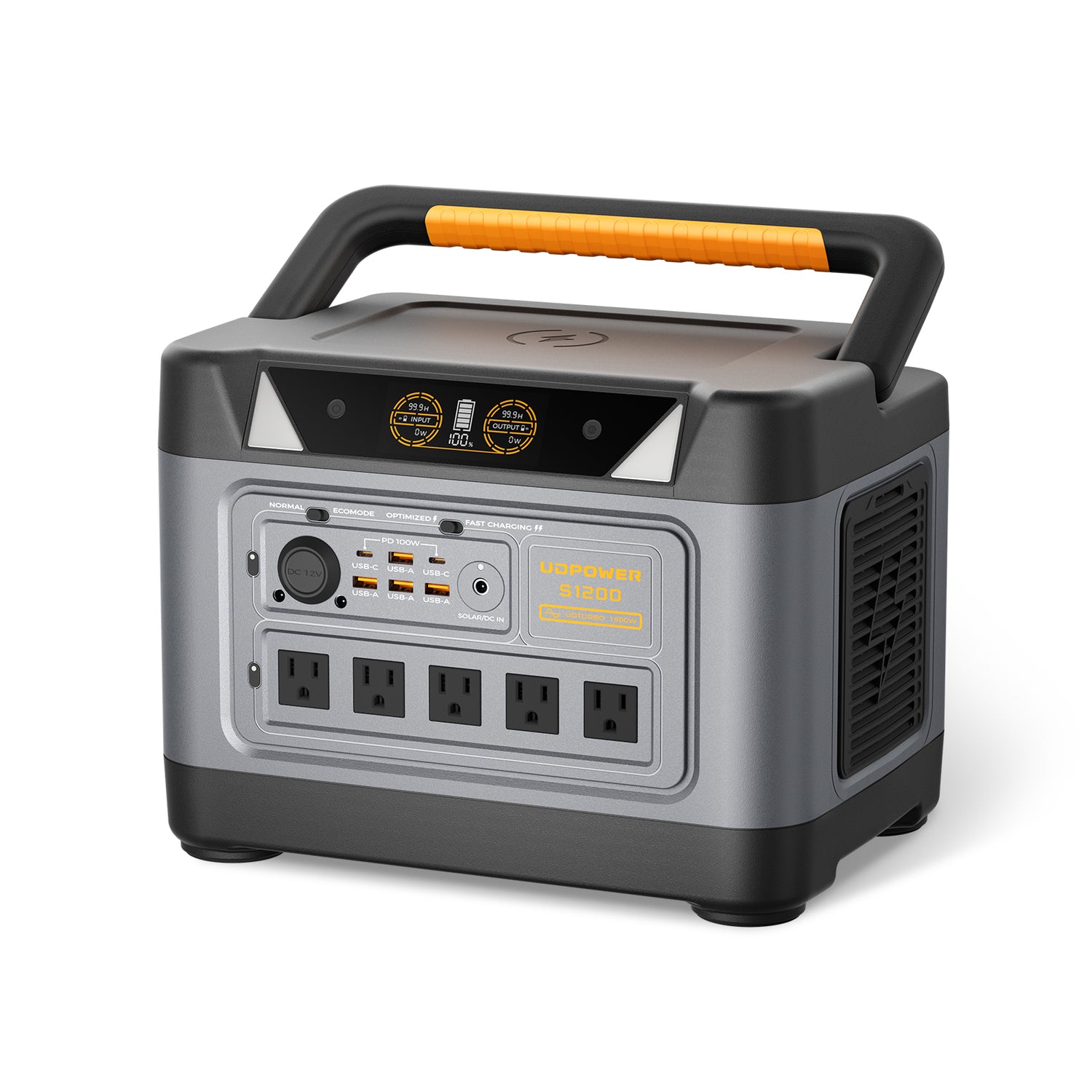
UDPOWER S1200: Best Overall for One E-Bike
1,190Wh capacity · 1,200W rated output · 26 lb · LiFePO4 battery
The S1200 offers the most practical balance for a single e-bike. Its estimated usable delivery is enough for approximately 1.9 charge-equivalents on a 500Wh battery or 1.3 on a 750Wh battery.
That leaves more flexibility for lights, phones, cameras, a laptop, or other low-power camping equipment than a smaller station would provide.
View UDPOWER S1200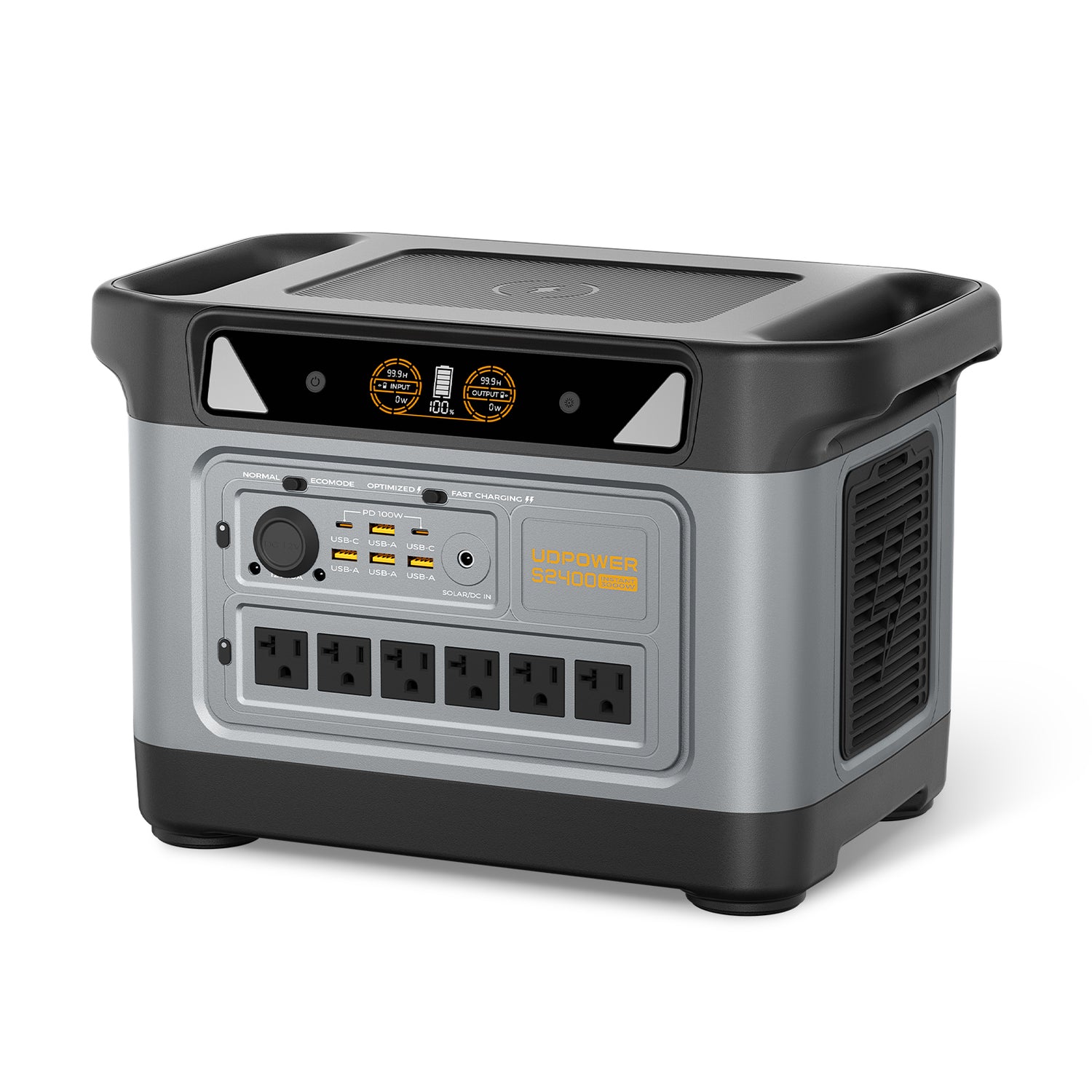
UDPOWER S2400: Best for Two Bikes or Multi-Day Trips
2,083Wh capacity · 2,400W rated output · 40.8 lb · 6 AC outlets · LiFePO4 battery
The S2400 is the stronger option for couples, families, support vehicles, RV trips, cargo bikes, and riders who need to charge more than one battery. It provides approximately 3.4 charge-equivalents for a 500Wh battery or 2.25 for a 750Wh battery under the planning assumptions used here.
Its higher output and six AC outlets also allow multiple chargers to operate when their combined wattage remains within the station’s rated output.
View UDPOWER S2400Charge-equivalent estimates assume a full power station, a healthy e-bike battery, 90% power-station AC conversion efficiency, and 90% charger-to-battery efficiency. Actual results may be lower because of standby consumption, temperature, battery age, and reserve capacity.
What Can Change the Real Cost of Charging an E-Bike?
1. Starting and Ending Battery Percentage
A 30%-to-80% top-up adds half of the battery’s capacity, not a complete battery’s worth of energy. Charging frequency alone does not tell you total electricity use unless each session begins at the same percentage.
2. Local Electricity Price
The same 500Wh charge costs approximately $0.08 in Washington and $0.29 in Hawaii using the May 2026 state averages and the efficiency assumption in this guide.
3. Time-of-Use Pricing
Some utilities charge different rates during peak and off-peak periods. Moving a charge to a lower-price period can reduce cost, but e-bike battery safety remains more important than saving a few cents. Do not leave the battery charging unattended or while sleeping.
4. Charger and Battery Efficiency
Energy becomes heat during charging. A damaged, incompatible, unusually hot, or poor-quality charger should not be used merely because it appears inexpensive.
5. Temperature
Very cold conditions can temporarily reduce usable range, causing the rider to recharge more frequently. Charging outside the manufacturer’s approved temperature range can also damage the battery or create a safety risk.
6. Riding Conditions
High speed, steep climbs, low tire pressure, heavy cargo, headwinds, repeated acceleration, and high assist levels increase Wh per mile. These factors often have a larger effect on monthly electricity use than small differences between compatible chargers.
7. Battery Age
Battery aging is not as simple as “an old battery always costs more to fill.” An older battery may charge less efficiently, but it may also hold fewer usable watt-hours than it did when new. A full display reading can therefore represent less stored energy. Charging cost alone is not a reliable battery-health test.
8. Charger Standby Time
Leaving a charger connected after charging finishes can add unnecessary standby consumption and conflicts with recommended charging practices. Disconnect the charger when the manufacturer’s charging process is complete.
Safe E-Bike Charging Checklist
- Follow the charging instructions in the e-bike owner’s manual.
- Use only the manufacturer-provided or manufacturer-approved charger.
- Remain present while the battery is charging.
- Do not charge while sleeping or while away from home.
- Unplug the charger when charging is complete.
- Charge in a dry, ventilated area away from combustible materials.
- Do not cover the battery, charger, or portable power station.
- Do not charge a swollen, cracked, leaking, wet, or unusually hot battery.
- Stop charging if you notice smoke, hissing, deformation, or an unusual odor.
- Do not use a charger marketed as universal unless the bike manufacturer approves it.
- Keep exits and evacuation routes clear.
- Do not place lithium batteries in household trash or ordinary recycling.
Review the CPSC Micromobility Information Center for current battery and charging safety recommendations.
Frequently Asked Questions
How much does it cost to fully charge an e-bike?
At the May 2026 U.S. residential average electricity price of 18.44¢/kWh, a full charge typically costs about $0.06 for a 300Wh battery, $0.10 for a 500Wh battery, $0.15 for a 750Wh battery, and $0.21 for a 1,000Wh battery. These estimates assume 90% charging efficiency.
How much does it cost to charge a 500Wh e-bike battery?
A complete 500Wh charge costs approximately $0.10 at 18.44¢/kWh after allowing for 90% charging efficiency. The actual amount depends on your local electricity rate and how empty the battery is.
How much does it cost to charge an e-bike every day?
Thirty complete 500Wh charges cost approximately $3.07 per month at the U.S. electricity rate used in this guide. Most riders use partial charges, so their real monthly cost may be lower.
Does an e-bike use a lot of electricity?
No. Even a 1,000Wh battery stores only about one kilowatt-hour. Allowing for charging losses, a full recharge uses approximately 1.11kWh from the outlet under the assumptions used here.
Does a faster e-bike charger cost more?
Not necessarily. A faster approved charger mainly reduces charging time. Battery capacity and the amount of charge added determine most of the total electricity cost.
How can I find my e-bike battery size?
Check the battery label, bike specifications, or owner’s manual for a watt-hour rating. If only nominal volts and amp-hours are listed, multiply volts by amp-hours to estimate watt-hours.
How do I find the electricity rate for my home?
Check your utility bill or online account for a cents-per-kWh or dollars-per-kWh rate. Customers on time-of-use plans should use the rate that applies during the charging period.
Is it cheaper to charge an e-bike at night?
It may be cheaper under a time-of-use plan with lower off-peak rates. However, CPSC recommends remaining present during charging and never charging a micromobility battery while sleeping or away from home.
How much does an e-bike cost per mile in electricity?
At 10–30Wh per mile and an electricity rate of 18.44¢/kWh, the estimated electricity cost is approximately $0.002–$0.006 per mile after charging losses, which remains below one cent per mile.
Can a portable power station charge an e-bike?
Yes. A portable power station can run the e-bike’s original AC charger when the charger wattage remains below the station’s continuous AC output and the station has enough usable watt-hour capacity.
Does charging through a portable power station cost more?
It can use more grid electricity because energy passes through additional charging and conversion stages. The difference for one e-bike charge is usually only a few cents, but direct wall charging is generally more efficient.
Can solar panels charge an e-bike for free?
Solar energy has no per-kWh utility charge once collected, but the equipment is not free. The solar panel, portable power station, compatible cables, maintenance, and replacement costs remain part of the overall charging setup.
Can I use a universal charger to save money?
Do not use a charger merely because the connector fits. Use only the charger supplied with or recommended by the e-bike manufacturer. Voltage, polarity, current control, connector wiring, and battery communication must all be compatible.
Why did my electricity meter show more energy than the battery rating?
The battery rating represents stored energy, while the meter records energy drawn from the outlet. Some electricity is lost as heat in the charger, battery, wiring, and final charge-balancing process.
Choose the Right Off-Grid Charging Setup
For home charging, use the e-bike’s approved charger and the electricity rate from your utility bill. For campsites, trailheads, road trips, and emergency range extension, choose a portable power station by usable watt-hour capacity—not charger wattage alone.
View Portable Power Stations View Solar Generator Kits Get the Power-Station Sizing GuideSources
- U.S. Energy Information Administration: May 2026 Residential Electricity Price
- U.S. Energy Information Administration: Residential Electricity Prices by State
- U.S. Consumer Product Safety Commission: Micromobility Charging Safety
- UDPOWER C600 Official Product Specifications
- UDPOWER S1200 Official Product Specifications
- UDPOWER S2400 Official Product Specifications
Related Articles


