How Many Watts Does a Hairdryer Use?
A typical hairdryer uses about 1,200 to 1,875 watts, with many full-size U.S. models drawing 1,500 to 1,875 watts on high heat. This guide explains how to find your dryer’s real wattage, calculate electricity cost, avoid tripping breakers, and choose the right portable power station for outage, RV, or off-grid use. For most standard hairdryers, the UDPOWER S2400 is the better match because of its 2,400W AC output, while the S1200 is better suited for low-watt travel dryers and essential backup loads.
Updated April 24, 2026 Hair dryer wattage guide
A typical U.S. hairdryer uses about 1,200 to 1,875 watts, with many full-size home models landing around 1,500 to 1,875 watts on high heat. Compact travel dryers can be lower, while salon-style dryers may pull near the upper end.
The number that matters most is printed on your dryer’s label. A hairdryer is a heat appliance, so even a short styling session can draw more power than a TV, laptop, router, fan, or small refrigerator.
Quick Answer: Hair Dryer Watts at a Glance
Most hairdryers use 1,200–1,875W. A 1,875W dryer used for 10 minutes consumes about 0.31 kWh. At the February 2026 U.S. residential average electricity price of 17.65¢/kWh, that is about $0.06 per 10-minute session. Your local rate may be higher or lower.
- Travel / compact dryer: usually around 800–1,200W
- Standard home dryer: commonly around 1,500–1,875W
- High-heat or salon-style dryer: often 1,800W or higher
- Portable power station match: use a station with continuous AC output above the dryer’s rated watts
Practical rule: If your hairdryer says 1,875W, do not treat it like a small device. It needs strong AC output, circuit headroom, and a safe outlet.

Hair Dryer Wattage by Type
Hairdryers vary because heat setting, airflow, motor design, and voltage all affect power draw. The label rating is usually the maximum input. Lower heat settings may use less, but the only way to know the exact draw is to check the label or measure it with a plug-in watt meter.
| Hairdryer type | Typical wattage | Approx. amps at 120V | Best use case | Power note | Source / method |
|---|---|---|---|---|---|
| Compact travel dryer | 800–1,200W | 6.7–10A | Travel, occasional use, shorter hair, low-power locations | Slower drying, but easier to run from smaller circuits or larger power stations. | Check the dryer label; calculate amps × volts using the U.S. Department of Energy method. |
| Standard home dryer | 1,500–1,875W | 12.5–15.6A | Daily home styling, medium to long hair | This is the most common range to plan around for U.S. households. | Virginia Cooperative Extension lists hair dryers at 1,200–1,875W. |
| High-output / salon-style dryer | 1,800W+ | 15A+ | Fast drying, thick hair, frequent styling | Can run close to the limit of a household 15A circuit. Avoid sharing the circuit with another high-watt appliance. | Use the nameplate wattage and the watts = amps × volts calculation. |
| Low-heat or cool-shot mode | Varies by model | Varies by model | Finishing, reducing heat damage, stretching backup battery runtime | The fan still runs. Low heat usually helps, but do not assume it cuts power by exactly half. | Measure with a plug-in watt meter for the most accurate result. |
How to Find Your Hairdryer’s Real Watts
The safest answer is on the dryer itself. Look for a label near the handle, plug, or body. It may show watts directly, such as “1875W,” or it may show amps, such as “12.5A.”
Use this simple formula
Watts = Amps × Volts
Most standard household outlets in the United States are 120V. So if a hairdryer label says 12.5A:
12.5A × 120V = 1,500W
Real-world tip: If the dryer has multiple heat settings, the printed wattage is usually the maximum. A watt meter can show the actual draw on low, medium, and high.
How Much Electricity Does a Hairdryer Use?
Hairdryers use a lot of power while they are on, but most people run them for only a few minutes. That is why the cost per session is usually small even though the wattage is high.
Formula: kWh = watts × minutes ÷ 60 ÷ 1,000
The cost examples below use the February 2026 U.S. residential average electricity price of 17.65¢/kWh from the U.S. Energy Information Administration. Replace that rate with your local utility rate for a more accurate estimate.
| Hairdryer wattage | 5 minutes | 10 minutes | 15 minutes | 20 minutes | Best takeaway |
|---|---|---|---|---|---|
| 800W | 0.067 kWh / ~$0.01 | 0.133 kWh / ~$0.02 | 0.200 kWh / ~$0.04 | 0.267 kWh / ~$0.05 | Good for travel dryers and lighter backup-power use. |
| 1,000W | 0.083 kWh / ~$0.01 | 0.167 kWh / ~$0.03 | 0.250 kWh / ~$0.04 | 0.333 kWh / ~$0.06 | Still high draw, but easier to support than a full-size dryer. |
| 1,200W | 0.100 kWh / ~$0.02 | 0.200 kWh / ~$0.04 | 0.300 kWh / ~$0.05 | 0.400 kWh / ~$0.07 | Upper edge for many 1,200W power stations. |
| 1,500W | 0.125 kWh / ~$0.02 | 0.250 kWh / ~$0.04 | 0.375 kWh / ~$0.07 | 0.500 kWh / ~$0.09 | Common full-size dryer load. |
| 1,875W | 0.156 kWh / ~$0.03 | 0.313 kWh / ~$0.06 | 0.469 kWh / ~$0.08 | 0.625 kWh / ~$0.11 | Fast drying, but heavy load for circuits and backup batteries. |
For normal utility bills, the bigger issue is usually not cost. It is instant power draw. A 1,875W dryer can pull more power at that moment than many refrigerators, TVs, routers, and laptops combined.
Will a Hairdryer Trip a Breaker?
It can. A 1,875W hairdryer at 120V draws roughly 15.6 amps. That is close to the capacity of a common 15A household circuit. If the same circuit is also feeding a space heater, curling iron, microwave, or other high-watt appliance, the breaker may trip.
Safety check: Use the outlet type and instructions recommended by the hairdryer manufacturer. Keep dryers away from standing water. Do not run a high-watt hairdryer through an underrated extension cord or overloaded power strip.
Common reasons a hairdryer trips power
- The dryer is on high heat and already near the circuit limit.
- Another high-watt device is on the same circuit.
- The bathroom GFCI outlet trips because of moisture or a fault condition.
- The outlet, plug, or cord is worn or damaged.
- The power source cannot deliver the dryer’s continuous wattage.
The U.S. Consumer Product Safety Commission advises against overloading extension cords and recommends checking cord ratings before powering appliances that draw significant watts. For hairdryers, the safer habit is simple: use a properly rated outlet and keep the cord setup short, visible, and dry.
Can a Portable Power Station Run a Hairdryer?
Yes, but only if the portable power station’s continuous AC output is higher than the hairdryer’s rated wattage. Hairdryers are not like phone chargers or LED lights. They are heat appliances, and heat appliances drain batteries quickly.
Check these 4 things before plugging in
- Hairdryer rated watts: Find the label first.
- Power station continuous AC output: This must be above the dryer’s watts.
- Battery capacity: More Wh means longer runtime.
- Other loads: Do not run the dryer at the same time as another high-watt AC device unless the station has enough total output.
Easy sizing rule: For a standard 1,500–1,875W hairdryer, choose a 2,000W+ power station class. For a travel dryer under 1,200W, a 1,200W-class station may work if the dryer stays within the station’s continuous output limit.
Recommended UDPOWER Products for Hairdryer Use
For hairdryers, output headroom matters more than almost anything else. A smaller station may have plenty of battery capacity for phones, laptops, lights, or a router, but a full-size hairdryer can exceed its AC output limit.

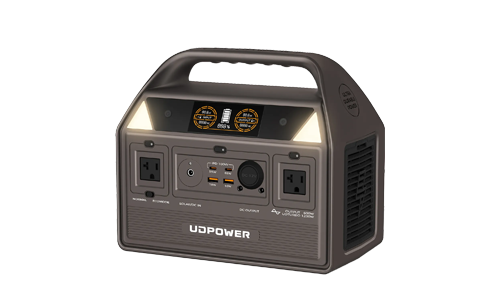
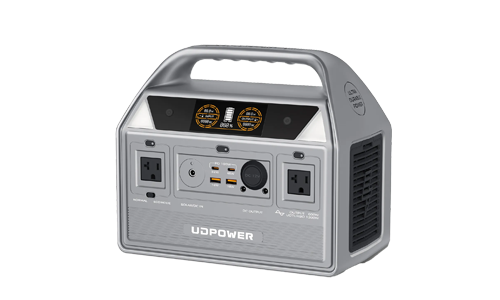
Best Match for Standard Hairdryers: UDPOWER S2400
Why it fits: The UDPOWER S2400 has 2,083Wh capacity, 2,400W AC output, and 3,000W surge support. That gives it enough continuous output headroom for most U.S. hairdryers in the 1,200–1,875W range, as long as the dryer’s label stays within the station’s limits.
- Best for: standard home hairdryers, RV grooming, outage comfort, short high-watt use windows
- Also useful for: fridge backup, small kitchen loads, TV, Wi-Fi, laptop, lights, and other essentials
- Solar-ready option: pair with a solar kit when you want daytime recharging during camping or outages

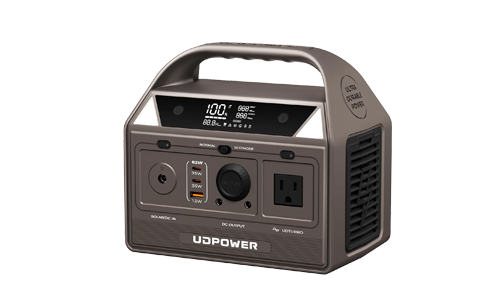
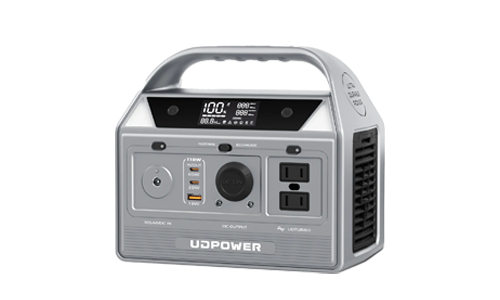
Good for Low-Watt Dryers and Essentials: UDPOWER S1200
Important fit note: The UDPOWER S1200 has 1,190Wh capacity and 1,200W rated AC output. It is a strong match for essentials and many smaller devices, but it is not the right pick for a typical 1,500–1,875W full-size hairdryer on high heat.
- Best for: low-watt travel dryers under 1,200W, phones, laptops, lights, CPAP, router, small fridge, and emergency essentials
- Use caution with: any hairdryer that lists more than 1,200W on the label
- Better choice if hairdryer use is a must: step up to the S2400
Hairdryer Runtime on UDPOWER Power Stations
The table below uses a practical planning estimate of 85% usable AC efficiency. Real runtime can vary depending on dryer setting, ambient temperature, battery condition, and whether other devices are plugged in.
| Hairdryer load | UDPOWER S2400 estimated runtime | S2400 fit | UDPOWER S1200 estimated runtime | S1200 fit | Practical takeaway |
|---|---|---|---|---|---|
| 800W travel dryer | About 133 minutes | Comfortable | About 76 minutes | Within rated output | Good option when battery conservation matters. |
| 1,000W compact dryer | About 106 minutes | Comfortable | About 61 minutes | Within rated output | Still a high draw, but manageable for short sessions. |
| 1,200W dryer | About 89 minutes | Comfortable | About 51 minutes | At the rated limit | For S1200, avoid adding other AC loads at the same time. |
| 1,500W standard dryer | About 71 minutes | Good match | Not recommended | Exceeds rated output | Choose S2400-class output for this load. |
| 1,875W high-output dryer | About 57 minutes | Good match if dryer label is within limits | Not recommended | Exceeds rated output | Use short sessions and keep other AC loads off. |
These runtimes are total accumulated drying time, not a recommendation to run a hairdryer continuously for an hour. In real life, a 5–15 minute session is more typical.
For outage planning, use the UDPOWER Runtime Calculator or read the watts-to-watt-hours runtime guide.
Which Power Station Size Should You Choose?
Use this quick fit table if hairdryer use is part of your camping, RV, van-life, or outage plan.
| Your hairdryer | Recommended power station class | UDPOWER fit | Why |
|---|---|---|---|
| Under 1,000W travel dryer | 1,200W+ AC output | S1200 or S2400 | The load is low enough for the S1200, while the S2400 gives more runtime and headroom. |
| 1,000–1,200W compact dryer | 1,200W+ AC output with no other heavy loads | S1200 or S2400 | S1200 can work at or below its limit; S2400 is more relaxed. |
| 1,500W standard dryer | 2,000W+ AC output | S2400 | S1200 is below this load. S2400 has the continuous output needed. |
| 1,875W high-output dryer | 2,400W+ AC output recommended | S2400 | A high-output dryer needs headroom, especially if the battery is also running other devices. |
How to Use Less Power Without a Bad Blow-Dry
With a hairdryer, the biggest energy saver is not a tiny wattage trick. It is reducing high-heat run time.
- Towel-dry first. Removing extra water before turning on the dryer cuts drying time.
- Start high, finish lower. Use high heat only when needed, then switch to medium, low, or cool shot.
- Clean the lint screen or rear filter. Restricted airflow makes drying slower and can overheat the dryer.
- Use a nozzle or diffuser correctly. Better airflow control can shorten the session.
- Avoid drying in long continuous blocks on backup power. During an outage, run high-watt comfort loads in short windows and save battery for essentials.
Outage priority tip: If battery capacity is limited, run essentials first: Wi-Fi, phone charging, lights, medical devices, and food safety loads. Use the hairdryer only after you know your must-run devices are covered.
Hairdryer vs. Other Household Devices
A hairdryer feels small because it fits in one hand, but it behaves more like a heating appliance than a personal-care gadget.
| Device | Typical power behavior | Why it matters |
|---|---|---|
| Phone charger | Low draw | Easy for almost any power station. |
| Wi-Fi router | Low continuous draw | Often a good outage-priority load. |
| Laptop charger | Moderate draw | Usually much easier than heat appliances. |
| Hairdryer | High draw while running | Needs output headroom; drains battery fast during use. |
| Space heater | High continuous heat draw | Similar caution: high wattage and short runtime on batteries. |
For another high-heat comparison, see: How Much Energy Does a Space Heater Use?
FAQ: Hair Dryer Wattage
How many watts is a normal hairdryer?
Most normal U.S. hairdryers use about 1,200 to 1,875 watts. Many full-size home dryers are around 1,500 to 1,875 watts on high heat.
Is 1875 watts a lot for a hairdryer?
Yes. A 1,875W hairdryer is a high-watt appliance. It can dry hair quickly, but it also pulls enough power to get close to the limit of a common household 15A circuit.
How many amps does a 1875W hairdryer use?
At 120V, a 1,875W hairdryer draws about 15.6 amps. The formula is watts ÷ volts = amps.
How much does it cost to run a hairdryer for 10 minutes?
At 17.65¢/kWh, a 1,500W dryer costs about $0.04 for 10 minutes, and a 1,875W dryer costs about $0.06 for 10 minutes. Use your local electricity rate for a more precise number.
Can the UDPOWER S1200 run a hairdryer?
The S1200 can run a low-watt hairdryer that stays within its 1,200W rated AC output. It is not recommended for a typical 1,500–1,875W full-size hairdryer on high heat.
Can the UDPOWER S2400 run a hairdryer?
Yes, the S2400 is the better UDPOWER match for standard hairdryers because it has 2,400W AC output and 2,083Wh capacity. Always check the dryer label and avoid running other high-watt AC loads at the same time.
Does low heat use fewer watts?
Usually, but it depends on the dryer. Low heat reduces heating-element demand, but the motor still uses power. A plug-in watt meter is the best way to see the actual draw on each setting.
Can I use a hairdryer during a power outage?
You can if your power source is rated for the dryer’s wattage. During an outage, it is smarter to use short drying sessions and protect battery capacity for essentials such as phones, lights, Wi-Fi, medical devices, and refrigeration.
Should I plug a hairdryer into an extension cord?
Avoid using an underrated or damaged extension cord with a high-watt hairdryer. If an extension cord must be used, it must be properly rated for the load, temporary, visible, and dry. Follow the dryer manufacturer’s instructions.
Why does my hairdryer trip the bathroom outlet?
It may be overloading the circuit, sharing power with another high-watt device, or triggering the GFCI because of moisture or a fault condition. If it happens repeatedly, stop using that setup and have the outlet or dryer checked.
Bottom Line
A hairdryer usually uses 1,200–1,875 watts, and a standard full-size dryer should be treated as a high-watt appliance. For normal home use, the cost per session is small. For RV, camping, or power outage use, the output requirement matters much more.
If you want to run a typical 1,500–1,875W hairdryer from a portable power station, choose the UDPOWER S2400. If your dryer is a low-watt travel model under 1,200W, the UDPOWER S1200 may work, but you should still check the dryer label first.
View UDPOWER S2400 Compare Portable Power Stations Get a Runtime EstimateSources Used for Calculations and Safety Checks
| Source | What it supports in this guide |
|---|---|
| U.S. Department of Energy: Estimating Appliance and Home Electronic Energy Use | Watts, amps, volts, and kWh calculation method. |
| Virginia Cooperative Extension: Estimating Appliance and Home Electronic Energy Use | Reference range showing hair dryers at 1,200–1,875W. |
| U.S. Energy Information Administration: Electric Power Monthly Table 5.6.A | U.S. residential average electricity price used in cost examples. |
| U.S. Consumer Product Safety Commission: Extension Cord Safety | Safety guidance on cord ratings, overload risk, and high-watt appliances. |
| UDPOWER S2400 Product Page | S2400 capacity, output, surge, LiFePO4 cycle-life, and product image. |
| UDPOWER S1200 Product Page | S1200 capacity, output, UPS, LiFePO4 cycle-life, and product image. |
| UDPOWER Battery Runtime Basics | Runtime planning logic: watts, watt-hours, and real-world efficiency. |
Related Articles