Electric Stove Energy Usage: Watts, Amps, kWh, and Backup Power Explained
ZacharyWilliamPortable Power Station Knowledge
Last updated: May 28, 2026
Quick Answer
Most electric stove burners use about 1,000 to 3,000 watts while heating. A full-size electric oven often uses about 2,000 to 5,000 watts when the heating element is on, and a complete electric range can draw much more if several burners and the oven are running at the same time.
- Watts tell you power draw: how hard the stove is pulling electricity right now.
- Amps depend on voltage: Amps = Watts ÷ Volts. A 2,400W burner is about 10A at 240V, but 20A at 120V.
- kWh tells you energy used: kWh = Watts × Hours ÷ 1,000.
- Built-in electric ranges are usually not a portable power station load: most are 240V appliances. A standard 120V portable power station is better matched with a 120V countertop burner, portable induction cooktop, rice cooker, slow cooker, microwave, or coffee maker within its rated output.

Electric stove energy use looks confusing because people mix up watts, amps, volts, and kilowatt-hours. The simple version is this: a stove is a heat appliance, and heat appliances draw a lot of power in short bursts. That does not always mean your bill will explode, but it does mean you should size circuits, extension cords, solar generators, and backup batteries carefully.
This guide gives you the numbers most homeowners actually need: burner wattage, oven wattage, 120V vs 240V amps, cooking-session kWh, estimated cost, and whether a UDPOWER portable power station can support your cooking setup during an outage.
1. Watts, Amps, Volts, and kWh Explained
For electric cooking, you only need three formulas:
Watts = Volts × Amps
Amps = Watts ÷ Volts
kWh = Watts × Hours ÷ 1,000
Watts are the power draw at a moment in time. Kilowatt-hours are the amount of energy used over time. That is the number your utility bill is based on.
Example: a 1,500W portable burner used for 20 minutes uses:
1,500W × 0.33 hours ÷ 1,000 = about 0.5 kWh
That same 1,500W burner does not use “1,500 watts per hour.” It draws 1,500 watts while heating. If it runs for one hour at full draw, it uses 1.5 kWh.
2. Electric Stove Wattage Chart
Exact power depends on the model, burner size, setting, pan size, and whether the element is cycling. Use this chart as a practical planning range, then check your appliance label or manual before buying a backup power source.
| Cooking appliance or element | Typical running watts while heating | Common voltage | What it means in real life | Source / note |
|---|---|---|---|---|
| Small electric coil burner | 1,000–1,500W | 120V or 240V depending on appliance | Good for simmering, small pans, boiling small amounts of water, and lower-demand cooking. | EnergySage stove/oven wattage ranges |
| Medium electric burner | 1,500–2,500W | Usually 240V on a built-in range; 120V on some portable burners | Common for frying, boiling, and everyday stovetop cooking. | Burner-size wattage comparison |
| Large electric burner | 2,000–3,700W+ | Usually 240V on a full-size range | Fast heating but high draw. Running a large burner with other heat appliances at the same time can overload smaller circuits or batteries. | Burner-size wattage comparison |
| Portable 120V electric burner | 800–1,800W | 120V | This is the most realistic “electric stove” option for a portable power station. Use one burner at a time and check input watts. | Check the product label before use |
| Portable induction cooktop | 1,000–1,800W for many countertop models | 120V for plug-in countertop units | Often a good outage-cooking choice because it heats the pan efficiently and can be controlled precisely. | U.S. Department of Energy induction overview |
| Full-size electric oven heating element | 2,000–5,000W while heating | Usually 240V | The element cycles on and off after preheating, so the average over a full bake can be lower than the element’s peak draw. | EnergySage oven wattage ranges |
| Full-size electric range, multiple elements available | 6,000–12,000W+ connected load is common | Usually 240V | The whole range is a home circuit load, not a normal portable battery load. The nameplate shows the actual connected load. | Use the appliance nameplate and installation manual |
3. Watts-to-Amps Chart for 120V and 240V Cooking
Amps change with voltage. This is why a 2,400W built-in burner can be reasonable on a 240V range circuit, but the same power would be too much for a normal 120V household outlet.
| Watts | Amps at 120V | Amps at 240V | Typical cooking example | Practical note |
|---|---|---|---|---|
| 800W | 6.7A | 3.3A | Low-power hot plate, warm setting, small cooker | Easy load for most power stations rated above 800W. |
| 1,200W | 10A | 5A | Small burner, compact kettle, some rice cookers | Near the top of what a 1,200W station should handle continuously. |
| 1,500W | 12.5A | 6.25A | Many countertop burners, kettles, coffee makers | Use a power station with enough continuous output headroom. |
| 1,800W | 15A | 7.5A | High setting on many 120V portable induction cooktops | Often the upper practical limit of a 120V plug-in cooking appliance. |
| 2,400W | 20A | 10A | Large electric burner or high-output appliance | At 120V, this belongs on a 20A-capable setup; at 240V, it is a normal range-type load. |
| 3,000W | 25A | 12.5A | Large burner or oven element while heating | Not a standard 120V plug-in load. |
| 9,600W | 80A | 40A | Example full electric range connected load | This is why full-size ranges usually use dedicated 240V circuits. |
Simple rule
For 120V appliances, divide watts by 120. For 240V appliances, divide watts by 240. If the number is close to the circuit, outlet, cord, or power station limit, leave more headroom instead of pushing the limit.
4. How Much Does an Electric Stove Cost to Run?
Your real cost depends on your local electricity rate and how long the heating element is actually on. The table below uses the U.S. Energy Information Administration’s March 2026 average residential electricity revenue of 18.83 cents per kWh as a rough national planning number. Use your own utility rate for a more accurate estimate.
| Cooking scenario | Power used in math | Time | Estimated kWh | Estimated cost at $0.1883/kWh | Source / formula |
|---|---|---|---|---|---|
| Small burner simmer | 700W average | 45 min | 0.53 kWh | $0.10 | DOE kWh formula + EIA rate |
| Portable burner on high | 1,500W | 20 min | 0.50 kWh | $0.09 | DOE kWh formula + EIA rate |
| Large burner heating quickly | 2,500W | 30 min | 1.25 kWh | $0.24 | DOE kWh formula + EIA rate |
| Oven preheat and bake cycle | 3,000W while element is on | 45 min full-draw equivalent | 2.25 kWh | $0.42 | Oven wattage range + EIA rate |
| Several burners and oven running together | 9,600W example load | 20 min | 3.20 kWh | $0.60 | DOE kWh formula + appliance nameplate |
One important detail: a thermostat-controlled burner or oven may not pull full wattage the entire time. It heats hard, cycles down, then heats again. That is why a plug-in watt meter is useful for 120V countertop appliances. For a built-in 240V range, rely on the manufacturer’s nameplate, manual, or a qualified electrician.
5. How to Find Your Stove’s Real Wattage
Start with the nameplate. Look around the oven door frame, rear panel, drawer area, or manual. Full electric ranges often list total connected load in watts or kilowatts.
For a 120V countertop burner, check the plug-in label. Many portable burners and induction cooktops print input watts directly on the underside or back.
Do not use a standard plug-in watt meter on a built-in 240V range. Those meters are usually for 120V plug-in appliances. A built-in range is a different electrical setup.
Use the highest setting for sizing. Even if you usually simmer, the appliance may briefly draw full rated power when it first heats.
6. Can a Portable Power Station Run an Electric Stove?
A portable power station can run some electric cooking appliances, but not a full-size built-in electric range in the normal way.
Here is the practical split:
| Cooking load | Portable power station match? | Why | Better outage plan |
|---|---|---|---|
| Full-size 240V electric range | No for standard 120V portable stations | Voltage, outlet type, and total connected load are not a match. | Use a 120V countertop cooking appliance instead. |
| Full-size electric oven | Usually no | High wattage, 240V power, long heating time, and poor battery practicality. | Use a microwave, air fryer, toaster oven, or pressure cooker if within wattage limits. |
| 120V portable induction cooktop | Often yes with a large enough station | Many countertop units draw 1,000–1,800W and plug into 120V. | Use one burner at a time and run it in short cooking bursts. |
| 120V portable hot plate | Often yes with a large enough station | Typical models may draw 800–1,800W. | Choose a lower-watt model if runtime matters more than speed. |
| Slow cooker | Yes for many stations | Often far lower draw than a burner, especially after heating. | Good for efficient outage meals if you have time. |
| Coffee maker, microwave, air fryer | Depends on input watts | Many use 1,000–1,800W, but only for short periods. | Check input watts and run one high-draw appliance at a time. |
Do not use DIY adapters to force a 240V range into a 120V portable power station
If the plug, voltage, or amperage does not match, stop. A mismatch can damage equipment and create a serious safety risk. For outage cooking, the safer approach is to choose a 120V cooking appliance that is already designed for a normal outlet and falls within your power station’s rated AC output.
7. Best UDPOWER Picks for Emergency Cooking
For electric cooking, choose by continuous AC output first, then battery capacity. Heating appliances are high-draw loads, so the biggest mistake is buying based only on watt-hours and ignoring inverter output.
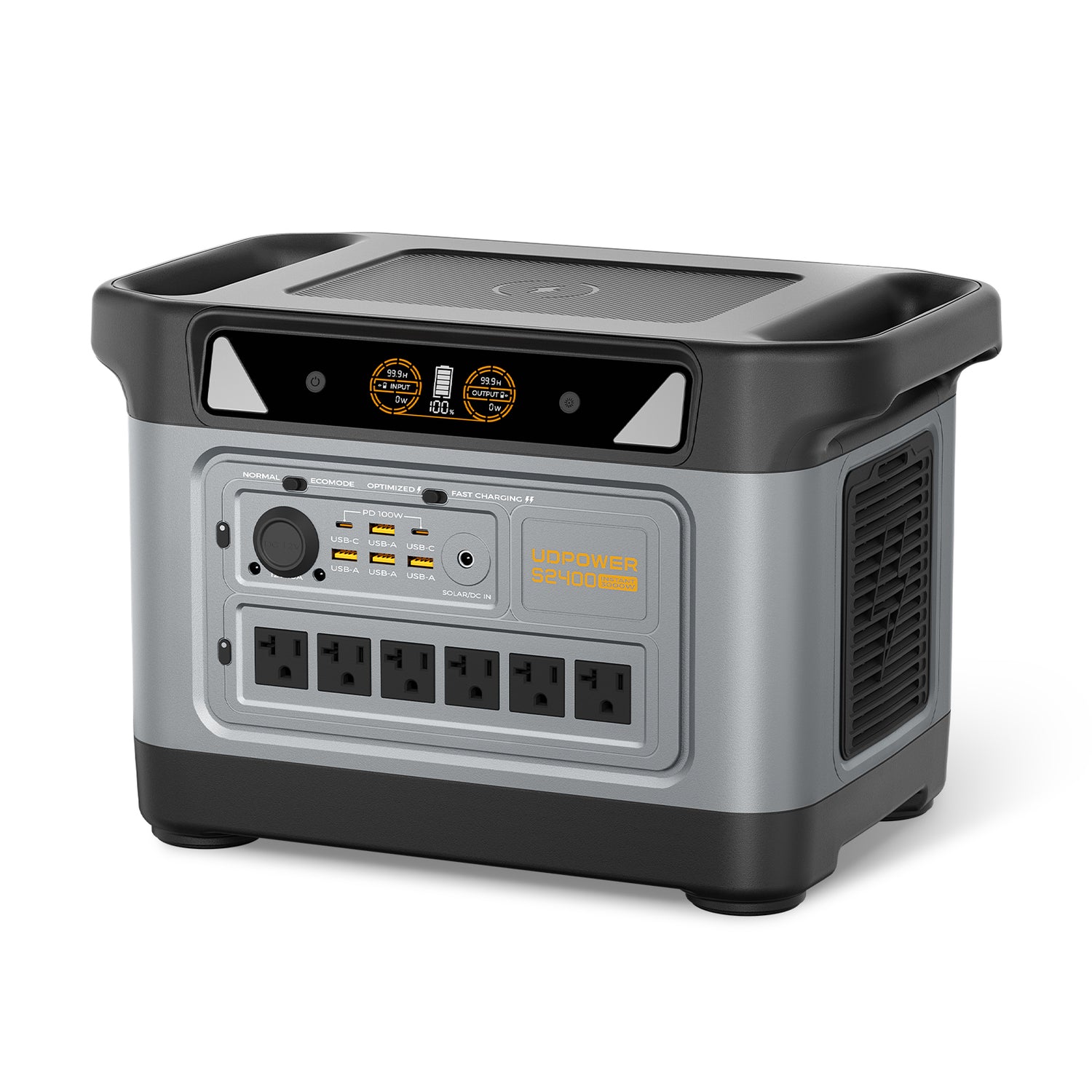
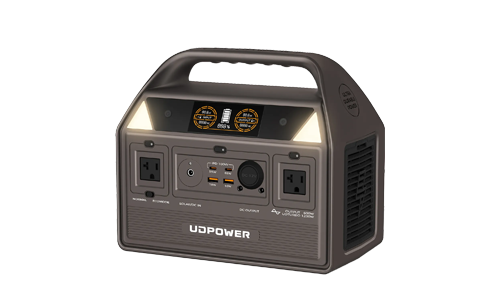
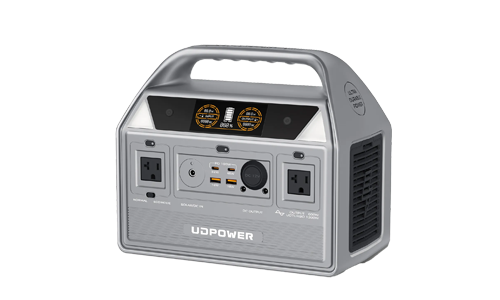
Best match: UDPOWER S2400 Portable Power Station
2,083Wh2,400W AC output3,000W surge120V AC
The UDPOWER S2400 is the better UDPOWER pick if your emergency cooking plan includes a 120V portable induction cooktop, hot plate, coffee maker, microwave, or similar high-draw kitchen appliance. It is not a replacement for a full 240V built-in electric range, but it gives you more output headroom for short, practical cooking sessions.
- Use it for one high-draw cooking appliance at a time.
- For best results, choose a countertop appliance with adjustable power levels.
- Avoid running a burner, microwave, coffee maker, and refrigerator startup load all at the same time.
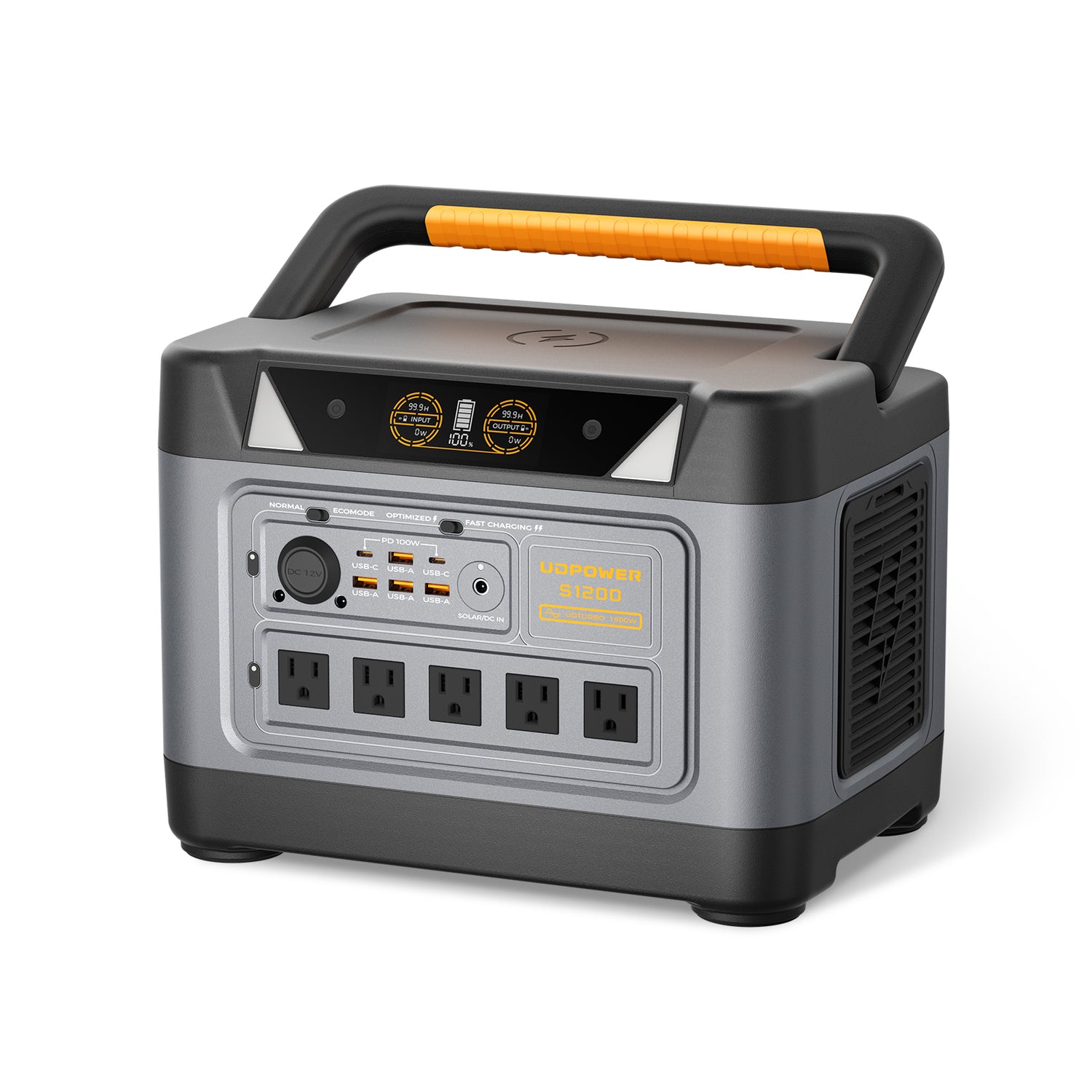
Lower-watt cooking pick: UDPOWER S1200 Portable Power Station
1,190Wh1,200W AC output1,800W surge120V AC
The UDPOWER S1200 is a practical choice for lower-watt cooking tools and home backup essentials. For electric stove-style cooking, keep the regular load at or below the 1,200W continuous rating. It is not the right pick for a full-size electric range or for repeatedly running a 1,500–1,800W burner on high.
- Good fit for many low-watt rice cookers, small warmers, compact cooking tools, and short kitchen tasks within its rating.
- Better for backup essentials when you want to preserve runtime.
- Use the UDPOWER runtime calculator before relying on it for a specific appliance.
Why not recommend a smaller station for an electric stove?
Smaller power stations are excellent for phones, lights, Wi-Fi, CPAP, laptops, cameras, fans, and compact DC devices. Electric cooking is different. A burner is a heating load, and heating loads can drain a battery quickly while also pushing the inverter hard. If cooking is part of your outage plan, size up or use lower-watt cooking methods.
8. Runtime Examples for Countertop Cooking
UDPOWER runtime planning should use realistic usable energy, not just the battery label. The estimates below use 90% conversion efficiency for AC loads:
Estimated runtime = Battery capacity × 0.90 ÷ appliance watts
| Cooking load | Example appliance | S2400 estimated runtime | S1200 estimated runtime | Practical takeaway |
|---|---|---|---|---|
| 600W | Small cooker, low hot plate setting | About 3.1 hours | About 1.8 hours | Much better for battery cooking than high heat. |
| 1,000W | Small burner, cooker, compact appliance | About 1.9 hours | About 1.1 hours | Good target range for emergency cooking. |
| 1,200W | Small electric burner on high | About 1.6 hours | About 0.9 hours | S1200 is at its continuous output limit; run no other large AC loads. |
| 1,500W | Common 120V burner, kettle, coffee maker | About 1.2 hours | Not recommended as a continuous load | Better suited to S2400, and still best used in short bursts. |
| 1,800W | Portable induction on high | About 1.0 hour | Not recommended as a continuous load | Use adjustable power levels to stretch runtime. |
| 2,400W | Maximum S2400 rated AC output | About 47 minutes | No | Possible only within S2400 rating, but not an efficient battery-cooking habit. |
These estimates assume full continuous draw. Many cooktops cycle after reaching temperature, so real cooking time can be longer. On the other hand, cold weather, battery age, poor ventilation, and running other devices at the same time can reduce runtime.
9. How to Reduce Electric Stove Energy Use
You do not have to cook less to use electricity more intelligently. Small habits can cut wasted heat and make a power station last longer during an outage.
| Habit | Why it helps | Best use case |
|---|---|---|
| Use the smallest burner that fits the pan | Less heat spills around the cookware. | Eggs, sauces, small pots, reheating. |
| Keep lids on pots | Traps heat and cuts boil/simmer time. | Rice, pasta water, soup, boiling water. |
| Lower the setting after the pan is hot | High heat is usually needed only at the start. | Searing, boiling, frying, induction cooking. |
| Choose induction when cookware is compatible | Induction heats the pan directly and is generally more efficient than conventional smooth-top electric cooking. | Fast boiling, precise simmering, short outage meals. |
| Batch cook when using the oven | One preheat cycle can handle more food. | Baking, roasting, meal prep. |
| Use smaller appliances for small meals | A microwave, rice cooker, pressure cooker, or air fryer may use less total energy than heating a large oven. | Leftovers, single meals, emergency meals. |
The U.S. Department of Energy notes that induction can be up to 10% more efficient than conventional smooth-top electric ranges, and ENERGY STAR certified electric cooking products are 18% more efficient on average than standard models. If you are replacing appliances anyway, efficiency is worth considering.
10. Safety Checklist Before You Plug Anything In
- Match voltage first. A 240V range is not the same as a 120V countertop burner.
- Check continuous watts, not only surge watts. Cooking heat is often a sustained load.
- Run one high-watt appliance at a time. Do not stack a burner, microwave, kettle, and coffee maker on one station.
- Avoid light-duty extension cords. High-draw cooking appliances need properly rated cords, and shorter is better.
- Keep heat away from the power station. Do not place a hot plate directly beside or on top of a battery unit.
- Keep everything dry and ventilated. Cooking steam, outdoor moisture, and blocked vents are bad combinations.
- Follow the appliance manual. Some portable burners have duty-cycle limits and should not be left unattended.
FAQ
How many watts does an electric stove use?
Most individual electric stove burners use about 1,000 to 3,000 watts while heating. A full electric oven often uses about 2,000 to 5,000 watts while its heating element is on. A complete range can draw much more if multiple burners and the oven run together.
How many amps does an electric stove use?
Use Amps = Watts ÷ Volts. A 2,400W burner draws about 10A at 240V, but about 20A at 120V. Full-size electric ranges are usually 240V appliances and often require a dedicated high-amp circuit. Always follow the appliance manual and local electrical code.
How many kWh does an electric stove use per hour?
At full draw, a 1,500W burner uses 1.5 kWh in one hour. A 3,000W oven element uses 3 kWh in one hour if it runs continuously. In real baking or simmering, the element may cycle on and off, so measured energy can be lower than the full-draw estimate.
Is induction cheaper to run than a coil or smooth-top electric stove?
Often, yes. Induction heats compatible cookware directly, so less energy is wasted heating the cooktop surface and surrounding air. Savings depend on your cookware, cooking style, electricity rate, and appliance efficiency.
Can the UDPOWER S2400 run an electric stove?
The UDPOWER S2400 can run many 120V countertop electric cooking appliances if the input watts are within its 2,400W AC output rating. It should not be treated as a plug-in replacement for a full-size 240V electric range.
Can the UDPOWER S1200 run an electric stove?
The UDPOWER S1200 is best for lower-watt cooking tools at or below its 1,200W continuous output rating. It is not a good match for a full-size electric range or for repeatedly running a 1,500–1,800W burner on high.
Why does my electric range use a 40A or 50A circuit?
A full electric range can power multiple burners and an oven, so the total connected load can be much higher than one burner alone. The exact circuit requirement comes from the appliance nameplate, installation manual, and local electrical code.
Does turning the stove to a lower setting save electricity?
Yes, especially after the pan is hot. A lower setting usually reduces the average heating time and energy use. The biggest waste comes from leaving a burner on high longer than needed or using a burner much larger than the pan.
Can solar panels power an electric stove directly?
Not in the normal plug-and-cook sense. Solar panels need a compatible power station, inverter, charge controller, or home energy system between the panels and the appliance. For emergency cooking, solar is usually used to recharge the battery between cooking sessions.
What is the best electric cooking appliance for an outage?
A 120V portable induction cooktop, low-watt hot plate, rice cooker, slow cooker, microwave, or pressure cooker is usually more practical than a full-size electric range. Pick the appliance that cooks the meal with the least total watt-hours, not just the highest heat.
Build a Smarter Emergency Cooking Setup
Start with the appliance watts, choose a power station with enough continuous AC output, then estimate runtime before the next outage.
Use the Runtime Calculator View Portable Power Stations View UDPOWER S2400