

Can a Portable Power Station Charge an E-Bike?
Last updated: August 6, 2026
Charging an e-bike away from a wall outlet is possible, but choosing a power station based only on its advertised wattage can leave you with an incomplete charge. You need to check the e-bike charger’s power draw, the bicycle battery’s watt-hour capacity, conversion losses, and the amount of reserve power you want to keep.
Quick Answer
Yes, a portable power station can charge most e-bikes when it has a standard pure sine wave AC outlet, enough continuous output for the bike’s original charger, and enough usable watt-hours for the amount of charge you need.
Plug the e-bike manufacturer’s charger into the power station’s AC outlet just as you would plug it into a household outlet. Do not connect a portable power station directly to the battery unless the e-bike manufacturer specifically approves that charging method.
As a practical example, a 500Wh e-bike battery may require approximately 615–650Wh from the power station for a complete charge after inverter and charger losses. A 600Wh-class power station is therefore better viewed as a top-up solution for a 500Wh battery, while a 1,000Wh-class or larger station provides more dependable full-charge capacity.

How Does a Portable Power Station Charge an E-Bike?
A portable power station acts like a rechargeable household outlet. Its internal battery stores DC energy, and its inverter converts that energy into the 120V AC electricity required by a standard U.S. e-bike charger.
The normal charging path is:
The power station does not replace the bike’s charger. It supplies AC electricity to that charger. The original charger still controls the voltage, current, charge taper, battery communication, and cutoff behavior required by the e-bike battery.
Check These Three Numbers Before Charging
1. The Charger’s AC Power Draw
The portable power station’s continuous AC output must be higher than the charger’s actual AC input power. Many standard e-bike chargers draw roughly 100–250W, while high-current or dual-battery chargers may draw considerably more.
Check the charger label or owner’s manual first. When possible, use the listed input wattage or measure actual AC draw with a plug-in watt meter.
2. The E-Bike Battery’s Watt-Hour Capacity
Battery capacity determines how much stored energy is needed. It is usually printed directly on the battery as Wh. When only volts and amp-hours are listed, calculate capacity with this formula:
For example, a battery labeled 48V and 15Ah has a nominal capacity of:
This is nominal battery energy, not the exact amount the portable power station will consume. Charging losses mean the power station must supply more than 720Wh to refill a fully depleted 720Wh battery.
3. The Power Station’s Usable AC Capacity
A power station’s advertised capacity is stored battery energy. Some of that energy is used by the inverter, electronics, cooling system, and cables before it reaches the e-bike charger.
For UDPOWER planning calculations, this article uses approximately 90% AC conversion efficiency. We also use an estimated 90% efficiency for the e-bike charger and battery charging process. Combined, approximately 81% of the power station’s rated capacity may become stored energy in the e-bike battery.
Actual results vary with temperature, charger design, battery condition, cable losses, standby consumption, and how long the AC inverter remains switched on after charging ends.
How Many Watts Do You Need to Charge an E-Bike?
For most riders, charger wattage is not difficult for a portable power station to handle. Capacity is usually the more important limitation. Even so, you should leave output headroom instead of running the station continuously at its maximum rating.
| Measured Charger Draw | Minimum With 25% Headroom | Practical Station Class | Typical Situation |
|---|---|---|---|
| 100W | 125W | 200W or higher | Compact or slower standard charger |
| 150W | 188W | 300W or higher | Common commuter-bike charger |
| 200W | 250W | 300–400W or higher | Faster charger or larger battery |
| 300W | 375W | 500–600W or higher | High-current charger |
| 500W | 625W | 700W or higher | Dual-battery or specialized fast-charging setup |
Do Not Confuse Charger Output With AC Input
A charger may list an output such as 54.6V at 2A. Multiplying those numbers gives approximately 109W on the battery side:
The charger will draw somewhat more than 109W from the portable power station because the charger itself is not perfectly efficient.
An input label such as “100–240V, 2A max” can also overstate normal operating power because it may show a maximum input current across a wide voltage range. When exact sizing matters, use the manufacturer’s wattage specification or measure the charger with a watt meter.
What Size Portable Power Station Do You Need?
The correct size depends on whether you need a small emergency top-up, one complete recharge, multiple recharges, or power for other camping equipment at the same time.
| Power-Station Capacity | Best Use | What to Expect | Main Limitation |
|---|---|---|---|
| 200–300Wh | Emergency range extension | A partial recharge for many full-size e-bike batteries | Usually cannot fully refill a 400–750Wh battery |
| 500–700Wh | Day trips and smaller batteries | One smaller battery recharge or a substantial top-up | A 500Wh battery may not receive a complete zero-to-100% charge |
| 1,000–1,300Wh | Camping and dependable full charges | About one to two full charges depending on battery size | Heavier than compact travel stations |
| 2,000Wh or more | Multiple bikes, long weekends, RV use | Multiple complete charges with room for other devices | Higher weight and larger storage footprint |
A Simple Sizing Formula
Using an estimated combined efficiency of 81%, a 500Wh battery requires:
For travel planning, add another 10–15% reserve so the station is not completely depleted. A comfortable target for one complete 500Wh recharge is therefore closer to 700–750Wh.
How Many Times Can a Portable Power Station Charge an E-Bike?
The estimates below use 90% AC conversion efficiency for the power station and 90% charging efficiency for the e-bike charger and battery. The resulting combined factor is 81%.
| E-Bike Battery | UDPOWER C600 596Wh |
UDPOWER S1200 1,190Wh |
UDPOWER S2400 2,083Wh |
|---|---|---|---|
| 400Wh | About 1.2 charges | About 2.4 charges | About 4.2 charges |
| 500Wh | About 1.0 charge | About 1.9 charges | About 3.4 charges |
| 625Wh | About 0.8 charge | About 1.5 charges | About 2.7 charges |
| 750Wh | About 0.6 charge | About 1.3 charges | About 2.2 charges |
| 1,000Wh | About 0.5 charge | About 1.0 charge | About 1.7 charges |
These are charge-equivalent estimates, not guaranteed zero-to-100% results. Keep a reserve for lighting, phones, refrigeration, unexpected detours, cold weather, and normal variation in battery capacity. Product specifications: C600, S1200, and S2400.
You Usually Do Not Need a Full Charge
Many real trips involve topping up the battery rather than charging from completely empty. Calculating only the energy needed between the current and target charge levels produces a more accurate trip plan.
Suppose you have a 720Wh e-bike battery and want to charge it from 25% to 80%. The increase is 55 percentage points:
Allowing for the estimated combined efficiency:
This means a 596Wh station could reasonably handle that specific 25%-to-80% top-up, even though it would not be a comfortable choice for completely recharging the same 720Wh battery from empty.
How to Charge an E-Bike From a Portable Power Station
Step 1: Inspect the Battery and Charger
Do not charge a battery that is swollen, cracked, leaking, unusually hot, water-damaged, or producing an unfamiliar odor. Inspect the plug, charging port, and cable for bent pins or exposed wiring.
Step 2: Check the Charger Wattage
Confirm that the charger’s AC draw is below the power station’s rated continuous output. Include anything else connected to the station in the combined load.
Step 3: Place Both Batteries in a Dry, Ventilated Area
Keep the power station and e-bike battery away from rain, wet ground, direct midday sun, enclosed vehicle interiors, blankets, sleeping bags, and other materials that restrict airflow.
Step 4: Turn On the Power Station
Switch on the main power and then activate the AC output. Confirm that the station has enough remaining charge for the planned top-up.
Step 5: Connect the Original E-Bike Charger
Follow the connection order specified by the e-bike manufacturer. Some brands instruct users to connect the charger to the battery before connecting AC power, while others specify the reverse.
Step 6: Watch the Initial Power Draw
Check the power-station display during the first several minutes. Confirm that the output remains stable and that no overload, temperature, or short-circuit warning appears.
Step 7: Remain Nearby
Do not leave an e-bike battery charging while sleeping or while away from the campsite, garage, RV, or vehicle.
Step 8: Disconnect When Charging Is Complete
Unplug the charger according to the bike manufacturer’s instructions, switch off the power station’s AC output, and let the equipment cool before packing it away.
Recommended UDPOWER Portable Power Stations for E-Bikes
The best model depends primarily on battery capacity and how many bikes you need to charge. The recommendations below use current specifications from the official UDPOWER product pages.

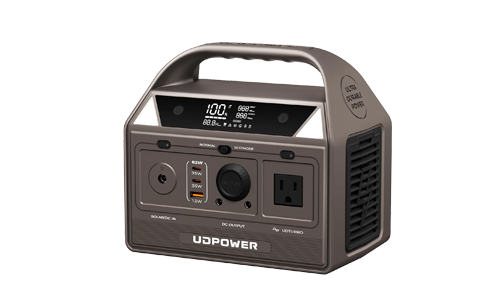
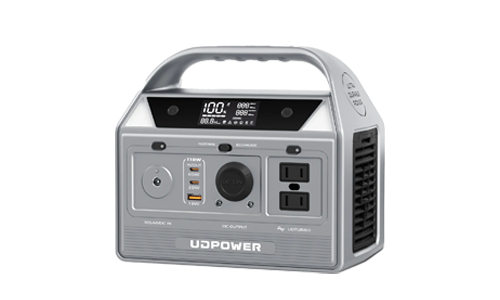
UDPOWER C600: Best for Top-Ups and Smaller E-Bike Batteries
The C600 is a practical trunk or campsite option for riders who need an emergency top-up, regularly recharge a battery near 400Wh, or want to restore part of a larger battery before the next ride.
It can theoretically deliver about 483Wh to an e-bike battery after the two estimated conversion stages. That is close to one 500Wh charge-equivalent, but it leaves little reserve. For a 500Wh or larger battery, treat the C600 as a substantial top-up solution rather than a guaranteed full-charge solution.
View UDPOWER C600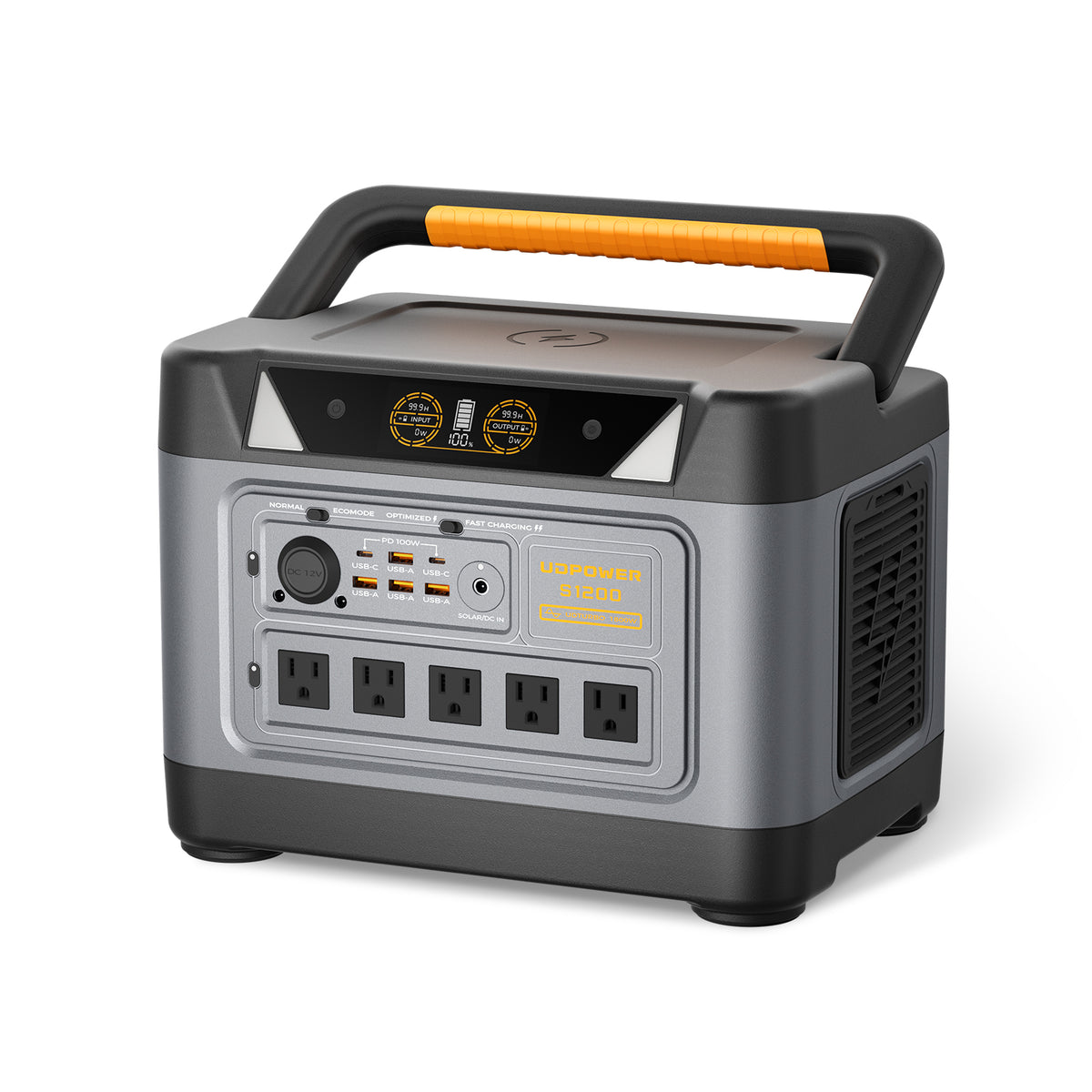
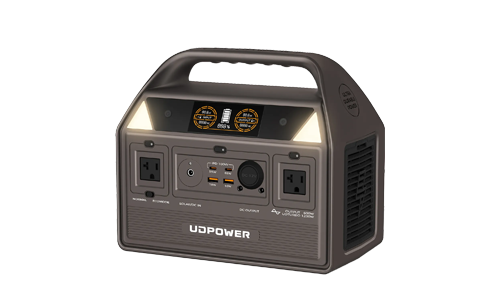
UDPOWER S1200: Best Overall Choice for One E-Bike
The S1200 offers a useful balance between capacity and portability. It can provide approximately 1.9 charge-equivalents for a 500Wh battery, 1.5 for a 625Wh battery, or 1.3 for a 750Wh battery under the efficiency assumptions used in this guide.
This is the most practical option for a single-bike camping setup because it can usually provide one dependable full recharge while retaining some capacity for phones, lights, a laptop, or other low-wattage gear.
View UDPOWER S1200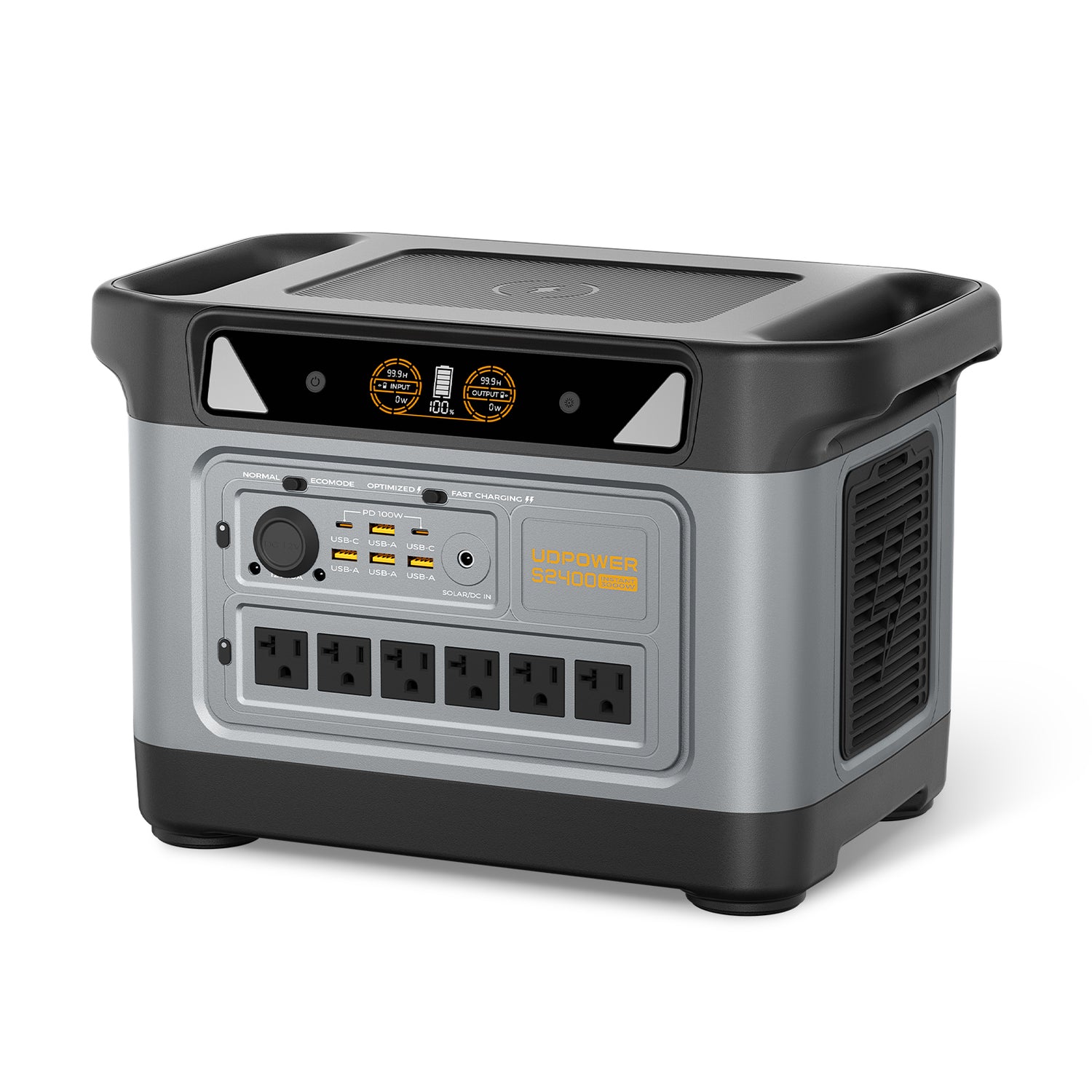
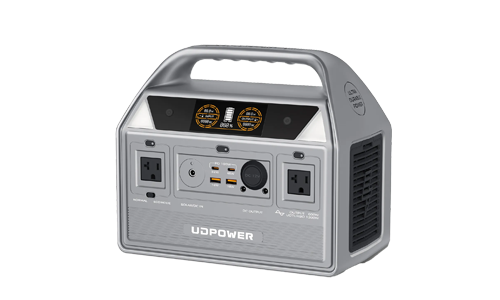
UDPOWER S2400: Best for Two E-Bikes or Multi-Day Trips
The S2400 is better suited to couples, families, e-bike tour support vehicles, RV trips, and riders carrying larger 750–1,000Wh batteries. It provides approximately 3.4 charge-equivalents for a 500Wh battery or 2.2 for a 750Wh battery under the assumptions used in this article.
Its higher output also makes it easier to run two chargers at the same time while keeping substantial headroom for other equipment. Capacity, not charger wattage, is likely to be the deciding advantage for most e-bike users.
View UDPOWER S2400Product appearance, included accessories, available configurations, and specifications may change by production version. Confirm the current product-page details before ordering.
Can You Charge an E-Bike With Solar Panels?
Yes. The practical setup is to recharge a solar-compatible portable power station with solar panels and then plug the e-bike’s original charger into the station’s AC outlet.
This approach keeps the bike’s manufacturer-approved charger in the system and allows the power station to stabilize the variable power arriving from the solar panel.
How Much Solar Energy Is Needed?
A 500Wh e-bike battery may require roughly 617Wh from the power station under the combined-efficiency assumption. Allowing for variable sunlight and solar charging losses, planning to collect approximately 650–700Wh from the panels is more realistic than expecting exactly 500Wh of panel production.
If the station averages 150W of actual solar input during good conditions, collecting 675Wh would take approximately:
This does not necessarily mean 4.5 clock hours. Clouds, shade, panel temperature, sun angle, cable loss, and morning or evening conditions can reduce actual input.
Can the Bike Charge While the Power Station Is Receiving Solar?
A model that supports pass-through operation may power the e-bike charger while receiving solar input. However, the battery level will still fall whenever the charger draws more power than the panels are producing.
For example, a charger drawing 200W while the panels provide only 120W creates an approximate 80W deficit before other conversion losses. Solar slows the rate of depletion but does not make the setup energy-neutral.
Explore current kits on the UDPOWER solar generator collection .
Can One Portable Power Station Charge Two E-Bikes?
Yes, provided the station has enough AC outlets, enough combined continuous output, and enough battery capacity.
Check both requirements separately:
- Output requirement: Add the actual wattage of both chargers and any other connected devices.
- Capacity requirement: Add the energy required by both e-bike batteries after conversion losses.
Suppose two 500Wh e-bikes are charged from empty. Their batteries need 1,000Wh of stored energy in total.
A 1,190Wh station would be slightly undersized for two guaranteed full charges from empty. A 2,083Wh station provides much more comfortable capacity and leaves reserve power.
If each charger draws 180W, their combined load is approximately 360W. That output is easy for many medium-sized stations, but the total watt-hour requirement remains substantial. This is why battery capacity usually matters more than AC wattage for e-bike charging.
E-Bike Charging Safety Checklist
- Use only the charger supplied with or approved for the e-bike.
- Do not use an unverified charger marketed as “universal.”
- Remain present while the battery is charging.
- Do not charge while sleeping or while away from the property.
- Charge in a dry, ventilated location away from combustible items.
- Do not cover the charger, battery, or power station.
- Do not charge a damaged, swollen, leaking, or water-exposed battery.
- Allow a hot battery to cool after riding before charging it.
- Follow the e-bike manufacturer’s approved charging-temperature range.
- Keep the portable power station protected from rain and wet ground.
- Stop charging if you notice unusual heat, odor, smoke, hissing, or deformation.
- Keep exits and evacuation routes clear while charging indoors.
The U.S. Consumer Product Safety Commission advises users to charge micromobility devices only with the charger provided or recommended by the manufacturer, remain present during charging, and avoid charging while sleeping. See the CPSC Micromobility Information Center .
UL 2849 evaluates the e-bike electrical system as a combination that includes the battery and charger. Learn more from UL Solutions’ UL 2849 overview .
Charging-temperature limits vary by manufacturer. As one established reference, Bosch advises charging its e-bike batteries between 32°F and 104°F and ideally at room temperature. Follow your own bike’s manual when its instructions differ. See Bosch eBike battery guidance .
Frequently Asked Questions
Can any portable power station charge an e-bike?
No. The station needs a compatible AC outlet, enough continuous output for the original charger, and enough usable watt-hour capacity. Very small power banks with only USB outputs generally cannot charge a full-size e-bike battery.
What size power station is best for a 500Wh e-bike battery?
A station around 700–1,000Wh is a comfortable choice for one dependable full recharge after conversion losses and reserve capacity. A 500–600Wh station is better for partial recharges or emergency top-ups.
Will a 300W power station charge an e-bike?
It may run a typical 100–200W e-bike charger, but a 300Wh battery capacity is unlikely to fully recharge a mainstream 400–750Wh e-bike battery. Output wattage determines whether the charger runs; watt-hour capacity determines how much charge can be delivered.
Can a 500W portable power station charge an e-bike?
A station with 500W of continuous AC output can run many standard e-bike chargers. Check the station’s battery capacity separately, because a 500W output rating does not mean the station stores 500Wh.
Can I charge my e-bike through USB-C?
Only when the e-bike manufacturer explicitly supports USB-C charging. Most full-size e-bike batteries require their dedicated charger and cannot be charged from an ordinary laptop or phone USB-C port.
Can I connect the power station directly to the e-bike battery?
Do not bypass the original charger unless the e-bike manufacturer provides an approved direct-DC charging system. Matching the connector alone does not confirm correct voltage, polarity, current control, or battery communication.
Does a portable power station charge an e-bike more slowly?
Normally, no. A stable pure sine wave AC outlet should allow the original charger to operate much like it does on a household outlet. Charging speed is mainly controlled by the e-bike charger and battery management system.
How long does it take to charge an e-bike from a power station?
Charging time is generally similar to wall charging. A 500Wh battery paired with a charger delivering approximately 100W may take roughly five or more hours, while a higher-output approved charger can finish sooner. Charging usually slows near full capacity.
Can I charge the e-bike battery while it is still on the bike?
Follow the bike manufacturer’s instructions. Some batteries are designed to charge either on or off the bike, while others have specific requirements for safe charging.
Can I leave the e-bike charging overnight?
No. CPSC guidance recommends remaining present during micromobility charging and not charging while sleeping or while away from home.
Can I charge an e-bike in a car or enclosed trailer?
Avoid charging in a closed vehicle exposed to sunlight or high temperatures. Use a dry, ventilated area within the temperature limits specified by both the e-bike and power-station manufacturers.
Can a solar panel charge the e-bike directly?
Most riders should connect the panel to a compatible portable power station and then use the e-bike’s original AC charger. A raw solar panel produces variable voltage and current and should not be connected directly to an e-bike battery unless the manufacturer provides a purpose-built charging system.
Can I ride the e-bike while charging it from a power station?
Standard e-bike chargers are intended for stationary charging. Riding with a power station and charger connected can create cable, impact, heat, weather, and handling hazards. Stop in a safe location and charge while the bicycle is parked.
Is a portable power station better than carrying a second e-bike battery?
A second compatible bike battery is lighter and more efficient when your only goal is additional riding range. A portable power station is more versatile because it can recharge different bikes and power phones, lights, laptops, refrigeration, and camping equipment.
Choose the Right Portable Power Station for Your E-Bike
Start with the battery’s watt-hour rating, decide how much charge you need to add, account for conversion losses, and keep a travel reserve. For most single-bike camping setups, a power station near 1,000Wh or larger offers the most useful balance between portability and dependable charging capacity.
View Portable Power Stations View Solar Generator Kits Get a Power-Station Sizing GuideSources and Further Reading
- U.S. Consumer Product Safety Commission: Micromobility Safety
- CPSC Warning About Universal Micromobility Chargers
- UL Solutions: Testing E-Bike Electrical Systems to UL 2849
- Bosch eBike Systems: Battery Charging and Temperature Guidance
- UDPOWER C600 Official Specifications
- UDPOWER S1200 Official Specifications
- UDPOWER S2400 Official Specifications
Related Articles


