2000 Watt Generator Guide: What Can a 2000W Generator Run?
ZacharyWilliamGenerator Buying Guide
A 2000-watt generator sounds straightforward, but it trips up a lot of buyers for one reason: the headline number is often not the same as the generator’s real continuous output. In the inverter-generator category, “2000 watts” is frequently the surge number, while the true running output is closer to 1600 watts.
That single detail changes everything. It affects whether your fridge starts, whether your microwave works without nuisance overloads, and whether your “small emergency backup plan” actually works in real life.
What a 2000W Generator Can Usually Run
A typical 2000-class inverter generator can usually handle:
- A microwave by itself
- A coffee maker by itself
- A toaster or toaster oven by itself
- Lights, a TV, chargers, a router, and a fan together
- Many drills and lighter-duty tools
- Some refrigerators or freezers, depending on startup surge
- Space heaters
- Hair dryers plus other major loads
- Larger sump pumps or well pumps
- Electric water heaters
- Central air systems
- “Run everything at once” outage plans
The biggest mistake people make is assuming a 2000W generator gives them 2000 watts of steady output all day. In many cases, it does not.
What “2000 Watts” Really Means
The most important distinction is the difference between running watts and starting watts.
Running Watts
This is the amount of power the generator can deliver continuously during normal operation. It is the number that matters most for real-world planning.
Starting Watts
This is the short burst of extra power available when a motor first starts up. It is not the same as a continuous power budget.
That is why a generator labeled “2000 watts” may still behave like a 1600-watt generator once you start adding real loads. If you size only by the headline number, you are setting yourself up for overloads, startup failures, and frustration.
Why overloads happen even when the math looks fine
- The surge number was treated like a continuous number
- A motor-driven load had a higher startup surge than expected
- Two hot appliances were used at the same time
- No headroom was left for real-world fluctuations
The Real Rule of Thumb
If you are working with a typical 2000-class inverter generator, plan around a practical steady-use range instead of the marketing number.
1) Treat 1300–1500W as your comfort zone
That gives you a safer everyday operating range on many 2000-class models without crowding the generator’s true continuous limit.
2) Let one major appliance be the main event
A microwave, coffee maker, toaster oven, or hair dryer should usually be the big load, not one load among several other heavy ones.
3) Respect motor startup surge
Fridges, pumps, and compressors are where small generator plans most often fail. The running watts may look easy, but the startup moment is what matters.
4) Leave headroom on purpose
The smartest small-generator users do not plan right to the limit. They leave room for startup spikes, efficiency losses, and real-life surprises.
Typical Appliance Wattage Chart
This chart is meant as a practical planning guide, not a universal guarantee. Real appliance draw changes by brand, age, mode, temperature, and startup behavior. Always trust the appliance nameplate first.
| Appliance / Tool | Running Watts | Starting Watts | 2000W Generator Verdict |
|---|---|---|---|
| Refrigerator / Freezer | 700W | 2200W | Maybe; running is fine, startup may fail |
| Deep Freezer | 500W | 1500W | Often yes |
| Microwave (1000W cooking) | 1000W | 0W | Usually yes |
| Coffee Maker | 1000W | 0W | Usually yes |
| Toaster Oven | 1200W | 0W | Usually yes, by itself |
| Toaster | 850W | 0W | Usually yes |
| Box Fan | 200W | 0W | Easy load |
| Space Heater | 1800W | 0W | Usually too much for many 2000-class units |
| Hair Dryer | 1250W | 0W | Usually okay alone |
| Furnace Blower (1/3 HP) | 700W | 1400W | Often possible, but watch startup |
| Sump Pump (1/3 HP) | 800W | 1300W | Possible, but don’t crowd it |
| Well Pump (1/2 HP) | 1000W | 2100W | Often too much |
| Circular Saw (7-1/4 in.) | 1400W | 2300W | Borderline to poor fit |
| Electric Drill (1/2 in.) | 600W | 900W | Usually yes |
| Air Compressor (1/4 HP) | 975W | 1600W | Maybe, with no competing loads |
The lesson here is simple: many loads look manageable in their running state, but startup demand is what decides whether the generator succeeds or trips.
What a 2000W Generator Is Actually Good At
A 2000W generator works best when you use it like a smart, compact backup tool instead of a miniature whole-home system.
Good Uses
- Coffee maker in the morning
- Microwave meals during a short outage
- TV, router, chargers, lights, and a fan
- Camping and RV convenience loads
- Light-duty jobsite tools
- Some refrigerator backup scenarios
Poor Uses
- Heating-heavy plans
- Large pump loads
- Electric cooking for long stretches
- Whole-home ambitions
- Large air-conditioning loads
- Running multiple major appliances together
Real-Life Load Examples
These examples show how a 2000-class generator behaves in the kind of situations buyers actually care about.
Coffee + lights + fan
A coffee maker plus a few lights and a box fan is usually an easy, realistic load combination for this size class.
Microwave + TV
This is often manageable, especially if there are no other major loads competing in the background.
Fridge + a few essentials
This is the classic “maybe.” Running watts can look perfectly fine on paper, but the compressor startup surge may still trip the generator.
Space heater + anything else
This is usually a poor plan. A space heater can consume most of the real continuous budget by itself.
Circular saw on a DIY project
The running draw may seem manageable, but startup surge can push the generator too hard, especially if anything else is already connected.
How to Calculate Your Exact Generator Size
If you want to size a generator correctly, stop guessing and use a simple three-step method.
1) List what you want to run at the same time
Do not count appliances you will not actually use together. This step needs to reflect real behavior, not wishful thinking.
2) Add the running watts
This gives you the steady-load requirement the generator must support during normal operation.
3) Add the single largest additional startup surge
The worst startup moment matters more than your average load. That is why refrigerators, pumps, and compressors change the answer so quickly.
Simple formula
Minimum generator size ≈ total running watts + largest additional starting watts
That formula is not flashy, but it is much closer to the way small generators succeed or fail in real life.
Generator Safety Basics You Cannot Skip
Portable generators are useful, but they can also be dangerous if used casually. The biggest risk is carbon monoxide. A generator should never be treated like an indoor-safe device.
Always Do This
- Run the generator outdoors only
- Keep it well away from doors, windows, and vents
- Use heavy-duty outdoor-rated cords when needed
- Plug in loads after the generator stabilizes
- Install working CO alarms indoors
Never Do This
- Do not run it in a garage, even with the door open
- Do not run it in a carport or enclosed porch area
- Do not backfeed a house through a wall outlet
- Do not ignore fuel storage and exhaust direction
- Do not assume “brief use” makes unsafe placement okay
When a Portable Power Station Is the Better Alternative
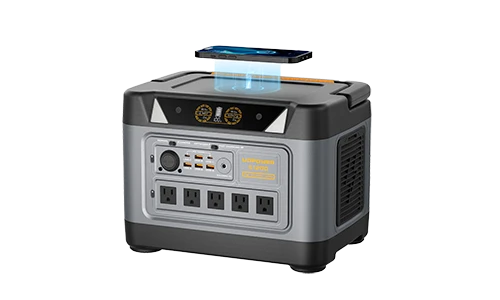
A gas generator still makes sense when you need longer runtime with easy refueling or you expect to be outside anyway. But for many quieter, cleaner, plug-and-play use cases, a portable power station is easier to live with.
That is especially true for apartments, indoor backup use, overnight essentials, RV electronics, and situations where noise and fumes are a bigger problem than raw runtime.
UDPOWER S1200

With 1190Wh capacity, 1200W output, and 1800W surge support, the S1200 is a practical choice for electronics, lights, routers, fans, and basic everyday emergency loads. It is also far easier to use indoors than a gas generator.
UDPOWER S2400

With 2083Wh capacity and 2400W output, the S2400 gives you a much more forgiving backup setup if you want higher output, more outlets, and less constant load juggling.
Simple way to choose
- Choose a 2000W gas generator when fuel-based runtime matters most
- Choose a portable power station when you care more about quiet operation, no fumes, indoor use, and simple backup for electronics and essentials
FAQ
Can a 2000W generator run a refrigerator?
Sometimes yes, sometimes no. The running wattage may be fine, but compressor startup surge is often the deciding factor.
Can a 2000W generator run a microwave?
Usually yes. A microwave is one of the more realistic major loads for this size class, especially if it is the main appliance running at that moment.
Can a 2000W generator run a space heater?
Usually not comfortably. Many space heaters draw so much continuous power that they leave little or no room for anything else.
Is a 2000W generator enough for home backup?
It is enough for selective emergency essentials, but not for whole-home backup. Think of it as a compact survival and convenience tool, not a house-wide solution.
What is the biggest mistake buyers make?
The biggest mistake is using the surge number as if it were the continuous number. That is what causes many overload complaints and unrealistic expectations.
Final Take
A 2000W generator can be a very useful size, but only when you size it honestly. In real life, many 2000-class inverter generators behave more like compact machines with limited continuous output and a short burst reserve.
That is enough for small essentials, one major kitchen appliance at a time, lighter tools, and some outage basics. It is not enough for stacking heat-heavy loads, large pumps, or whole-home ambitions.
The smartest approach is simple: keep your steady watts lower than you think, respect startup surge, and stop treating the headline number like unlimited capacity.