
How to Live In The Woods [Complete Guide]
Living in the woods requires much more than basic camping equipment. This practical guide explains how to choose a legal and safe location, build reliable shelter, water, sanitation, food, power, communication, and emergency systems, and test your setup before attempting a long-term off-grid lifestyle. It also compares suitable UDPOWER portable power stations for weekend trips, extended stays, and powered forest basecamps.
Last updated:
Living in the woods can mean a two-week dispersed camping trip, a seasonal cabin, or a full-time home on private forested land. Those are very different projects. The safest way to begin is not to disappear into the forest with a tent and hope your survival skills are good enough. It is to build a legal, repeatable system for shelter, water, sanitation, food, heat, power, communication, transportation, and emergency exit.

Can You Really Live in the Woods?
Yes, but usually not by permanently occupying random public land. Short-term camping may be allowed in designated or dispersed areas, while long-term living normally requires private land, the owner's permission, and compliance with local zoning, building, sanitation and fire rules.
A practical beginner should first complete several short trips, then a 7-day test, a 30-day trial and one trip in difficult weather. Only consider full-time forest living after your water, waste, heating, power, communication and evacuation systems have already worked in real conditions.
1. What Living in the Woods Actually Means
The phrase “live in the woods” is often used as though there is only one version. In practice, it can describe four very different lifestyles. Identifying your real goal prevents you from buying the wrong land, shelter or power system.
| Living style | Typical duration | Likely shelter | Main challenge | Best starting point |
|---|---|---|---|---|
| Short forest stay | One night to two weeks | Tent, vehicle or small trailer | Weather, water and local camping limits | Developed campground or legal dispersed campsite |
| Seasonal forest base | Several weeks or months | Wall tent, RV, permitted cabin or leased property | Waste disposal, resupply, weather changes and land permission | Private land with written permission and nearby road access |
| Part-time off-grid cabin | Weekends or part of the year | Cabin, tiny home or RV | Building approval, water, septic, freeze protection and maintenance | Legally usable private parcel within reasonable distance of town |
| Full-time forest residence | Year-round | Code-compliant home or permitted off-grid dwelling | Everyday reliability through winter, illness, wildfire and road failure | A tested property with legal residence, water and wastewater solutions |
A full-time forest home is less like a long camping trip and more like operating a small utility company for one household. You become responsible for every service that a normal home receives automatically: drinking water, sewage, heating, power, road access, fire protection, trash removal and communications.
2. Is It Legal to Live in the Woods?
Whether you can stay in a forest depends on who owns the land, the local camping order, zoning rules and the type of structure you use. Rules can change between neighboring counties and individual ranger districts, so never rely on a general internet answer for a specific parcel or campsite.
| Land type | What is commonly possible | What usually is not allowed | What to verify | Official source |
|---|---|---|---|---|
| BLM land | Short-term dispersed camping in areas where it is permitted | Using a recreational campsite as a permanent residence | Local stay limit, fire rules, road restrictions and required relocation distance | BLM camping guidance |
| National Forest land | Dispersed camping outside developed areas where local orders allow it | Building a permanent structure or remaining indefinitely | District-specific stay limits, Motor Vehicle Use Maps, fire restrictions and closed areas | U.S. Forest Service dispersed camping guidance |
| National Park land | Camping in designated areas or with a valid backcountry permit | Permanent residence, unapproved camps or unauthorized structures | Reservation, permit, food storage and backcountry rules | Check the official page for the specific national park |
| State forest or state land | Varies widely by state and property | Assuming federal dispersed-camping rules apply | State agency rules, permits, maximum stay and seasonal closures | Check the responsible state land agency |
| Private land | Camping or residence with ownership or written permission | Ignoring county zoning, septic, driveway, dwelling and fire codes | Legal access, zoning, permitted use, wastewater, water rights and structure approval | County planning, building and environmental health departments |
BLM guidance says dispersed camping is generally limited to 14 days within a 28-day period, but local offices may set different limits and relocation rules. Forest Service areas also commonly use limited stays, often around 14 days, but individual forests may be shorter or apply limits over different time periods.
Questions to ask before using private forest land
- Does the parcel have recorded legal access, not just a visible dirt road?
- Is residential use allowed under the current zoning classification?
- Can an RV or temporary shelter be occupied while building?
- Is a septic system required, and has the soil been evaluated?
- Can a well be drilled, or are there restrictions on water use?
- Are there minimum dwelling sizes or foundation requirements?
- Are wildfire defensible-space rules enforced?
- Who maintains the road after snow, flooding or fallen trees?
- Can emergency vehicles physically reach the site?
- Are there deed restrictions, an HOA or conservation easements?
3. Use a Trial Ladder Before Moving Full-Time
The fastest way to discover whether a forest-living plan works is to test it in stages. Each stage should expose a new weakness while you still have a safe way home.
| Stage | Test duration | What to test | You are ready to continue when |
|---|---|---|---|
| Stage 1: Weekend systems test | Two nights | Shelter setup, sleep, cooking, lighting, water and packing | You finish with unused water, reserve power and no critical missing gear |
| Stage 2: Seven-day test | One week | Food rotation, hygiene, trash, battery use, weather and resupply | You can maintain cleanliness and routine without emergency shopping |
| Stage 3: Bad-weather test | Three to seven days | Rain, cold, heat or low-sun conditions appropriate to the area | Shelter stays dry, water remains safe and power never reaches the emergency reserve |
| Stage 4: Thirty-day trial | One month | Laundry, repairs, repetitive chores, loneliness, mail, internet and medical access | Your routine remains physically, financially and mentally sustainable |
| Stage 5: Seasonal test | One full season | Changing temperatures, road conditions, pests, storms and solar variation | You have documented consumption and backup plans for the worst week |
Keep a simple field log
Record daily water use, power use, battery percentage at sunset, solar energy recovered, fuel use, food consumed, temperature, rainfall, maintenance and trips into town. Memory is unreliable. A 30-day log tells you what your real lifestyle costs in gallons, watt-hours, time and money.
- Water ledger: gallons collected, treated, stored and used.
- Energy ledger: watt-hours consumed and restored each day.
- Resupply ledger: food, fuel, medicine and waste trips.
If one of these repeatedly reaches zero before the next planned resupply, the system is undersized.
4. How to Choose a Safe Location
A beautiful site can still be a poor place to live. Flat ground beside a stream may flood. A deep forest may block nearly all useful solar energy. A remote road may become impassable after one storm. Evaluate a location as a working system, not as a photograph.
| Factor | Good sign | Red flag | How to test it |
|---|---|---|---|
| Legal access | Recorded easement or maintained public road | Access depends on crossing another owner's land without documentation | Review deed records and county maps |
| Year-round road | Drainage, stable surface and a realistic snow or storm plan | Deep mud, low-water crossings or steep untreated grades | Visit after heavy rain and during the difficult season |
| Flood exposure | Elevated site away from drainage channels | Flat bench beside a creek, dry wash or narrow canyon | Check official flood maps and visible high-water debris |
| Tree hazards | Healthy trees with open clearance around shelter | Dead limbs, leaning trunks, root damage or recent fire scars | Inspect overhead and uphill before placing a shelter |
| Water | Legal, dependable source plus stored reserve | One seasonal stream with no backup | Confirm late-season flow and test treatment logistics |
| Solar access | Open clearing with several continuous hours of direct sun | Dappled shade all day | Perform an hourly sun-window test |
| Emergency access | Two exit routes or one highly reliable road | Single road through a flood, fire or landslide corridor | Drive both exits and identify turnarounds |
| Distance to care | Clinic, pharmacy and supplies within a manageable trip | Several hours from help with no communication backup | Time the actual drive, including the slow road section |
| Wildfire exposure | Defensible space and more than one evacuation direction | Dense fuel around shelter and only one narrow exit | Review local evacuation zones and fire history |
Do a 24-hour site observation before committing
Arrive before noon and stay through the following morning. Note where sunlight reaches the ground, where cold air settles, how wind moves, whether insects become severe at dusk, how much road noise carries and whether cellular service changes by location. One afternoon visit misses most of these conditions.
Distance from water is not the same as access to water
Living directly beside a stream may increase flood, insect, erosion and wildlife exposure. A safer site may be farther away on elevated ground, with water carried to camp. Follow the local land manager's required setback rather than assuming one universal distance.
5. Shelter, Heat and Fire Planning
A shelter must manage four things: precipitation, ground moisture, wind and condensation. Warm bedding cannot compensate for a leaking roof or a wet sleeping platform.
Choose shelter by duration
| Shelter | Best use | Strength | Main limitation |
|---|---|---|---|
| Backpacking tent | Short, mobile stays | Fast setup and low weight | Limited living space and weaker long-term weather protection |
| Heavy car-camping tent | Weekend or short seasonal use | More space and comfort | Fabric degrades under constant UV, moisture and snow load |
| Wall tent | Legal seasonal base | Usable interior and optional stove compatibility | Requires careful fire, ventilation, platform and snow planning |
| RV or trailer | Longer stays with road access | Built-in water, storage and sanitation systems | Road limits, freezing, moisture and waste-tank management |
| Permitted cabin | Part-time or full-time private property | Durability and year-round protection | Higher cost, permitting and maintenance |
Build a dry sleeping system
- Choose elevated ground that does not collect runoff.
- Use a footprint that does not extend beyond the shelter walls.
- Separate bedding from the cold ground with an insulated pad or raised platform.
- Ventilate the shelter to release moisture from breathing and wet clothing.
- Store dry sleep clothing in a waterproof bag and use it only for sleeping.
- Inspect seams, guylines and drainage before rain begins.
Use the right tool for heat
Battery-powered space heating consumes enormous amounts of energy. A 1,500W heater can use 1,500Wh in only one hour, which is more than the full usable energy of many portable power stations. Use insulation, weather-appropriate sleep systems, sheltered cooking and a properly installed approved heating system instead of planning to heat an entire shelter with a battery.
Create a fire-season version of your plan
- Check restrictions before every trip, not only at the beginning of the season.
- Keep vegetation, firewood and flammable storage away from the shelter.
- Park facing the exit when evacuation risk is elevated.
- Keep keys, identification, medication and emergency supplies together.
- Know where smoke may block your normal road.
- Leave early when officials issue an evacuation order.
6. Build a Dependable Water System
Water is usually the first hard limit on how long a person can remain in one place. A nearby stream is not automatically a safe or dependable water supply. Flow may stop, freeze, become muddy after a storm or be contaminated upstream.
Plan water in three layers
- Primary source: the water you expect to use most days.
- Treatment system: a method appropriate for the likely contaminants.
- Stored reserve: clean water available when collection or treatment fails.
| Use | Lean-use planning range | Comfortable planning range | Ways to reduce demand safely |
|---|---|---|---|
| Drinking | Varies with weather and activity | More in heat, altitude or physical work | Carry water continuously and monitor urine color and symptoms |
| Cooking and hot drinks | 0.25–0.75 gallon | 0.5–1 gallon | Use one-pot meals and measure water before heating |
| Dishwashing | 0.25–0.5 gallon | 0.5–1 gallon | Scrape dishes first and use a small wash basin |
| Personal hygiene | 0.5–1 gallon | 1–3 gallons | Use targeted washing rather than full showers every day |
| Emergency reserve | At least several days | More where roads or sources can fail | Store in multiple containers so one leak does not drain everything |
Water needs vary too much for one universal number. Hot weather, hard labor, pregnancy, illness, pets and high altitude all increase demand. During your trial period, measure actual use instead of estimating from memory.
Treat natural water before drinking or cooking
The CDC recommends bringing clear water to a rolling boil for one minute, or three minutes above 6,500 feet. Treatment options differ in their ability to address bacteria, parasites, viruses and chemical contamination. A filter does not make water safe when the source contains fuel, mining runoff, harmful algae or other chemicals.
| Method | Useful for | Important limitation | Reader resource |
|---|---|---|---|
| Boiling | Killing common disease-causing organisms | Requires fuel and does not remove chemical contamination | CDC water-treatment guidance |
| Backcountry filter | Removing particles and organisms covered by the filter's rating | Some filters do not remove viruses; freezing can damage wet filter media | Check the manufacturer's tested pore size and instructions |
| Chemical disinfectant | Lightweight emergency or secondary treatment | Contact time and effectiveness change with temperature and water clarity | Follow the product label exactly |
| UV treatment | Clear water when batteries and equipment are functioning | Cloudy water reduces performance and electronics can fail | Prefilter cloudy water and carry a backup method |
Prevent one-container failure
Do not store all drinking water in one large container. Divide it between several clean containers. A broken cap, puncture, contamination event or frozen container should not eliminate your entire reserve.
Cold-weather water management
- Keep filters from freezing after they have been used.
- Leave expansion room in containers when freezing is possible.
- Store the next morning's water where it will remain usable overnight.
- Do not assume snow provides water without a large fuel and time cost.
- Maintain a reserve that does not depend on pumping from a frozen source.
7. Food, Cooking and Wildlife Protection
A practical forest food plan begins with purchased staples and dependable resupply. Foraging, fishing and hunting may be useful skills where legal, but they are seasonal, regulated and uncertain. They should not be the only plan keeping you fed.
Use a three-level food system
- Ready food: meals that require little or no cooking for bad weather or illness.
- Daily staples: foods you routinely cook and rotate.
- Emergency reserve: sealed food that remains untouched unless resupply fails.
| Category | Examples | Why it matters | Storage concern |
|---|---|---|---|
| No-cook reserve | Nut butter, crackers, tuna pouches, bars and shelf-stable meals | Provides food during storms, illness or stove failure | Odor and wildlife attraction |
| Dry staples | Rice, oats, pasta, lentils and powdered ingredients | Low cost and long storage life | Moisture, rodents and cooking-fuel demand |
| Canned food | Beans, vegetables, fish, soup and fruit | Reliable and easy to inventory | Weight, trash volume and freezing |
| Fresh food | Produce, eggs and refrigerated items | Improves nutrition and meal quality | Spoilage, temperature control and resupply frequency |
| Emergency calories | Foods selected for compact energy and long shelf life | Protects against delayed travel or damaged supplies | Must be rotated before expiration |
Separate sleeping, cooking and food storage
Food, trash, cookware and scented toiletries can attract animals. Requirements differ by location: some areas require lockers, approved bear-resistant containers or specific hanging methods. Follow the rule for the exact park, forest or district rather than copying another camper's setup.
The National Park Service advises placing an approved bear-resistant container on flat ground at least 100 feet from the campsite in areas where that method is permitted. Do not place it near water or a cliff where an animal could roll it away.
Review National Park Service food-storage guidance and then check the location-specific rules for your destination.
Measure refrigerator energy instead of guessing
A compressor refrigerator cycles on and off, so its daily energy use cannot be estimated accurately from running watts alone. Test it for 24 hours in weather similar to your trip. Record the watt-hours consumed, how often the lid or door was opened and the starting temperature of the food.
For a deeper planning method, see How to Power a Camping Fridge .
8. Sanitation, Hygiene and Waste
Waste problems close campsites, contaminate water and attract wildlife. A long-term plan must explain exactly where human waste, gray water, trash, food scraps and damaged gear will go.
Human waste
Use a toilet or approved pack-out system whenever required. Where catholes are allowed, Leave No Trace recommends holes 6–8 inches deep and at least 200 feet from water, camp and trails. Some environments require all solid waste and toilet paper to be packed out.
Read Leave No Trace waste guidance and follow stricter local requirements when they apply.
Gray water and dishwashing
- Carry wash water away from lakes and streams.
- Remove food particles before disposing of dishwater.
- Use only a small amount of soap.
- Do not dump oily food waste or scraps on the ground.
- Follow local rules for RV and trailer holding tanks.
Trash management
Pack out food scraps, damaged batteries, foil, wipes, hygiene products, fishing line, cigarette filters and small packaging. Burning trash is not a safe substitute for carrying it out.
Hygiene that remains realistic after the first week
- Create a handwashing station before preparing food.
- Keep clean and dirty water containers clearly separated.
- Dry feet daily and rotate socks to prevent skin problems.
- Store a clean set of sleep clothing in a sealed bag.
- Schedule laundry and bathing instead of waiting until supplies run out.
- Protect minor cuts early; small wounds become harder to manage remotely.
9. Off-Grid Power in a Forest
Forest power planning has one major complication: trees create shade. A solar panel that performs well in an open desert campsite may produce far less under a dense canopy. Size the battery for nighttime and low-sun periods, then treat solar as the recharge system—not as guaranteed daily energy.
Start with a one-day energy budget
Add all devices, then include a reserve for conversion losses, cold weather, unexpected use and cloudy days.
| Device | Planning power | Daily use | Estimated daily energy | Reduction strategy |
|---|---|---|---|---|
| Two phones | About 15Wh per full charge each | One charge each | 30Wh | Use airplane mode when signal is unavailable |
| LED lighting | 10W | 4 hours | 40Wh | Use task lighting instead of lighting the whole shelter |
| Laptop | 65W | 2 hours | 130Wh | Charge through USB-C where possible |
| Ventilation fan | 25W | 8 hours | 200Wh | Use a lower setting and improve passive ventilation |
| 12V refrigerator | Measured daily cycling use | 24 hours | Example: 400–700Wh | Pre-cool food, add shade and limit opening |
| Communication equipment | Varies | Scheduled windows | Example: 100–300Wh | Use fixed check-in periods rather than continuous operation |
The example above can range from roughly 500Wh per day without a refrigerator to more than 1,000Wh per day with refrigeration and continuous communications. Measure your own equipment because labels and real use often differ.
Use 90% conversion efficiency for planning UDPOWER runtime
This is a planning estimate, not a guarantee. Temperature, device cycling, startup surge, battery condition, cable loss and AC-versus-DC use change the result.
| Daily load profile | Daily energy | C600 596Wh |
S1200 1,190Wh |
S2400 2,083Wh |
|---|---|---|---|---|
| Essential electronics | 250Wh/day | About 2.1 days | About 4.3 days | About 7.5 days |
| Comfort campsite | 600Wh/day | About 0.9 day | About 1.8 days | About 3.1 days |
| Fridge, fan and communications | 1,000Wh/day | About 0.5 day | About 1.1 days | About 1.9 days |
These estimates address capacity only. The power station's AC output must also be high enough for every appliance you intend to run, including startup surge.
To build a detailed device list, use How Many Wh Do I Need for Camping? .
Perform a forest sun-window test
Do not choose a solar array from a weather app alone. Place the actual panel at the proposed site and record input power every hour from morning to evening.
- Fully unfold the panel and point it toward direct sun.
- Keep the entire panel free from branch shadows.
- Record input watts at least once per hour.
- Record the battery percentage or watt-hours restored by sunset.
- Repeat the test for at least three days, including one cloudy day if possible.
- Use the lowest successful day—not the best day—as your planning baseline.
| Panel location | Likely behavior | Planning response |
|---|---|---|
| Open clearing with continuous direct sun | Best chance of useful daily recovery | Measure actual watt-hours and size the battery for overnight use |
| Edge of clearing | Strong output for only part of the day | Reposition the panel or use a longer compatible cable where safe |
| Dappled branch shade | Output can change sharply as small shadows cross the panel | Move the panel rather than assuming more rated wattage solves the problem |
| Dense canopy | Solar may be too weak for daily replacement | Reduce loads, move to a clearing or plan vehicle/wall recharging |
| Short winter sun window | Lower recovery and greater heating/lighting demand | Increase reserve capacity and shorten the resupply interval |
10. Which UDPOWER Power Station Fits Forest Living?
Choose by daily watt-hours, maximum appliance wattage and the number of low-sun days you want to cover. A larger battery does not create more sunlight, so combine the station with realistic load reduction and a tested recharge plan.

UDPOWER C600: Short Trials and Weekend Forest Stays
- Battery capacity: 596Wh
- Rated AC output: 600W
- Maximum solar input: up to 240W
- Weight: approximately 12.3 lb
- Battery chemistry: LiFePO4
The C600 is suitable for a light campsite using phones, LED lighting, camera batteries, a laptop and limited fan use. It can support a small refrigerator only when the refrigerator's startup demand and measured daily consumption fit within the station's output and capacity.
It is better suited to a weekend test or mobile setup than to a high-consumption, full-time forest base.
View UDPOWER C600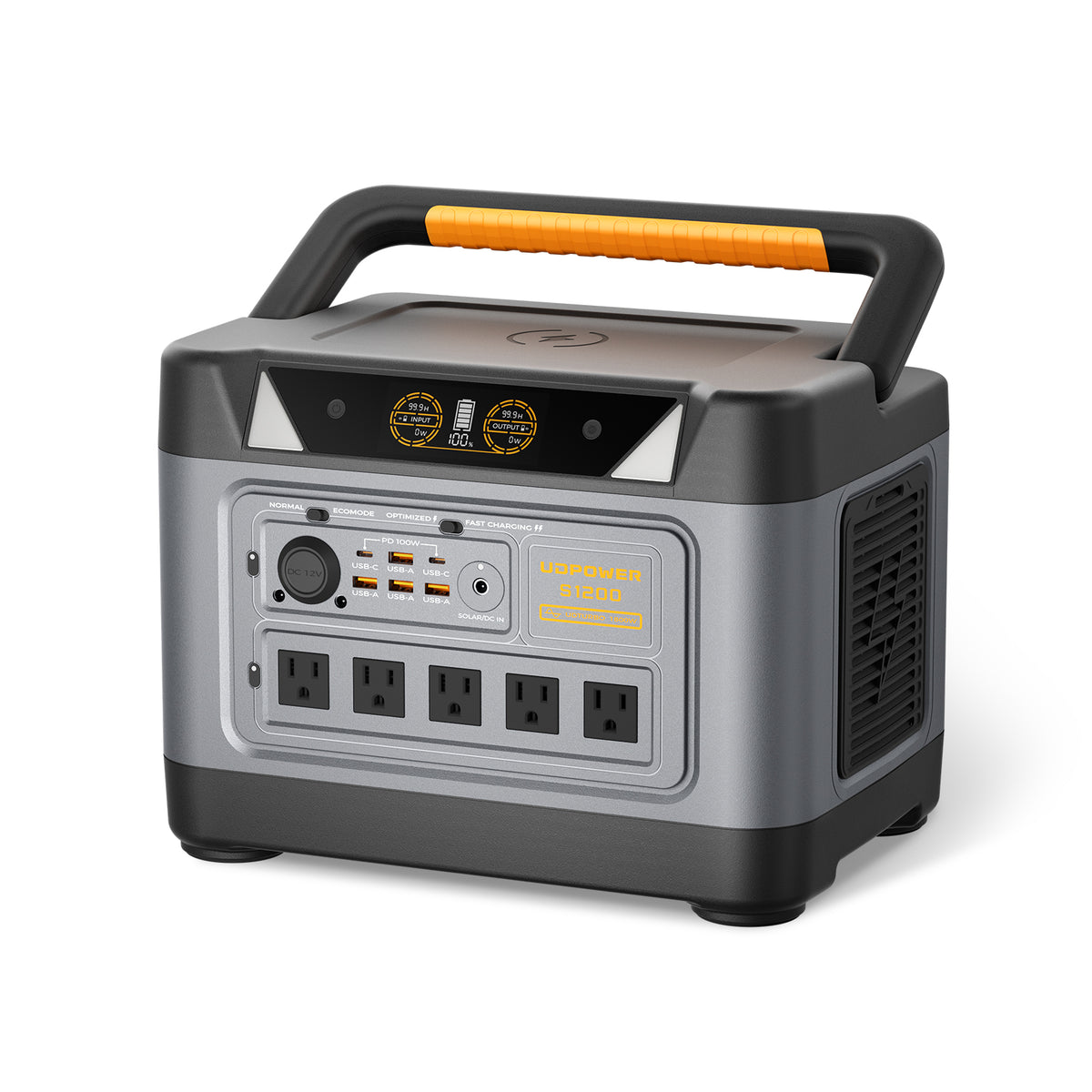
UDPOWER S1200: Longer Stays and Moderate Daily Loads
- Battery capacity: 1,190Wh
- Rated AC output: 1,200W
- Surge support: up to 1,800W through UDTURBO
- Maximum solar input: up to 400W
- Weight: approximately 26 lb
- Battery chemistry: LiFePO4
The S1200 is a stronger match for a comfort campsite, CPAP use, laptop work, lighting, fans and carefully measured refrigeration. Its larger solar input also makes it easier to recover meaningful energy during a limited forest sun window.
It remains important to test very low continuous loads and overnight behavior before depending on any power station for medical or communication equipment.
View UDPOWER S1200
UDPOWER S2400: Powered Basecamp and High-Output Appliances
- Battery capacity: 2,083Wh
- Rated AC output: 2,400W
- Surge support: up to 3,000W through UDTURBO
- Maximum solar input: up to 400W
- Weight: approximately 40.8 lb
- Battery chemistry: LiFePO4
The S2400 is the best fit of these three for a vehicle-supported forest basecamp using a refrigerator, communications, fans, laptops, multiple chargers or occasional high-output appliances.
Its larger capacity gives more weather reserve, but a 1,000Wh daily load can still use most of the battery in about two days without recharging. Long stays therefore require a dependable solar window, vehicle charging, periodic wall charging or lower daily consumption.
View UDPOWER S2400Quick model selection
| Model | Best fit | Not ideal for | Planning priority |
|---|---|---|---|
| C600 | Weekend trips, short trials and essential electronics | Multi-day refrigeration plus several comfort loads without daily charging | Keep the load list small and recharge regularly |
| S1200 | Longer stays, CPAP, fan, laptop, lights and moderate refrigeration | Continuous electric heating or several high-watt appliances together | Measure daily Wh and complete a full overnight test |
| S2400 | Powered basecamp, larger refrigerator, tools and multiple users | Backpacking or carrying far from a vehicle | Protect the unit from weather and secure dependable recharging |
11. Communication and Emergency Exit
A phone showing one bar during your property visit is not an emergency communication plan. Service changes with weather, foliage, terrain, carrier and your exact position.
Build communications in layers
- Primary: cellular service at a tested location.
- Secondary: satellite messenger or another independent remote communication method.
- Local information: battery-powered or hand-crank weather radio.
- Human backup: a trusted person who knows your location and check-in schedule.
NOAA Weather Radio broadcasts official warnings, watches, forecasts and hazard information around the clock. Coverage depends on terrain and transmitter location, so test reception before relying on it.
See NOAA Weather Radio information.
Create a check-in protocol
- Give a trusted contact the property or campsite coordinates.
- Share vehicle description, route and planned return date.
- Set a specific check-in time rather than saying “I will message sometime.”
- Define what the contact should do after one missed check-in.
- Define when emergency services should be contacted.
- Update the plan whenever you change location.
Use exit triggers, not last-minute judgment
| Trigger | Why it matters | Action |
|---|---|---|
| Drinking-water reserve reaches the minimum emergency level | A damaged source or road delay can become critical quickly | Leave or resupply before consuming the emergency reserve |
| Battery drops below the communications reserve | Lighting and comfort loads may prevent an emergency call later | Stop optional loads and begin the recharge or exit plan |
| Road condition is worsening | Waiting may remove the only safe route | Leave before flooding, snow or fallen trees block travel |
| Wildfire evacuation warning or rapidly increasing smoke | Visibility and road access can deteriorate faster than expected | Follow official instructions and leave early |
| Uncontrolled illness, injury or infection | Remote conditions make treatment and transportation slower | Seek professional medical care |
| Shelter can no longer remain dry or structurally secure | Wet bedding and wind exposure can create a serious cold risk | Move to safe shelter rather than attempting to endure it |
| Communication backup fails | No one can confirm your status during a second failure | Repair, replace or relocate before continuing alone |
12. Daily, Weekly and Monthly Routines
Long-term comfort comes from routine, not constant improvisation. Small checks performed early prevent large failures later.
| Frequency | Tasks | What to record |
|---|---|---|
| Every morning | Check weather, water reserve, battery percentage, shelter moisture and road condition | Starting water, battery state and expected hazards |
| Every afternoon | Reposition solar panels, refill treated water and complete outdoor chores before dark | Solar input and water collected |
| Every evening | Secure food, trash, tools and scented items; prepare emergency lighting | Ending battery percentage and next-day priorities |
| Weekly | Inspect shelter, clean containers, inventory food, test backup communication and review the exit route | Damaged gear, supply shortages and maintenance needs |
| Monthly | Review actual consumption, rotate emergency supplies and update contacts or local rules | Average daily water and power use |
| Before each season | Rebuild the plan for heat, cold, storms, insects, wildfire and shorter daylight | New worst-case assumptions and required upgrades |
Example daily order
- Check weather and official alerts.
- Confirm clean-water and emergency-power reserves.
- Inspect the shelter and overhead tree hazards.
- Move the solar panel into the first direct-sun position.
- Complete water collection and physical work before peak heat.
- Prepare food and clean the cooking area immediately afterward.
- Finish repairs, firewood handling and waste tasks before dusk.
- Secure all food, trash and scented items.
- Complete the scheduled check-in.
- Prepare clothes, lighting and exit items for the night.
13. Common Mistakes When Trying to Live in the Woods
Starting with a permanent move
A long lease, land purchase or job resignation should not be the first test of whether you can tolerate cold mornings, repetitive chores, isolation and long resupply drives.
Assuming public land is free housing
Dispersed camping is normally a short-term recreational use. Stay limits, movement rules and local closures prevent most public land from being used as a permanent residence.
Choosing land before checking legal access
Cheap property may be inaccessible, unbuildable or unsuitable for septic. A visible road is not proof that you have the legal right to use it.
Depending on one water source
Springs change, pumps fail and streams become contaminated. Keep stored treated water and a second treatment method.
Planning solar from the panel's advertised wattage
Rated wattage is not daily energy. Shade, sun angle, clouds, heat and limited daylight determine how many watt-hours actually reach the battery.
Using electricity for all heating and cooking
High-watt heat appliances can consume a day's battery energy in a short period. Reserve battery power for lighting, refrigeration, communication, medical devices and electronics that are difficult to replace.
Ignoring condensation
Wet bedding and clothing may come from moisture produced inside the shelter, even when the roof does not leak. Ventilation and drying routines are essential.
Storing food inside the sleeping area
Odors from food, trash and toiletries attract wildlife. Follow the area's approved storage method.
Waiting until supplies are almost gone
Reorder and resupply based on a minimum level. Remote roads, weather and delivery failures make last-minute planning unreliable.
Having only one vehicle route
Fire, flooding, snow, fallen trees and landslides can block a single road. Identify alternatives before an emergency.
Buying more gear instead of reducing demand
Reducing daily water, power and fuel use is often cheaper and more reliable than trying to build a larger system around inefficient habits.
Refusing to leave
Forest living is not a test of how long you can endure a failing situation. A clear exit decision is a survival skill.
14. Final Readiness Checklist
Do not begin a long stay until you can answer every item below with a specific action, location or quantity.
- I have verified that I may legally camp or reside at this location.
- I know the exact maximum stay and relocation rules.
- I have legal road access and know who maintains it.
- My shelter has already remained dry in comparable weather.
- I have a primary and backup drinking-water method.
- I carry several days of treated emergency water.
- I know where every type of waste will be legally disposed of.
- My food-storage method complies with local wildlife rules.
- I have measured my real daily power use in watt-hours.
- My battery can cover nighttime use and at least one low-sun period.
- I have tested solar output at the actual site.
- My essential appliances remain within the station's output limit.
- I have tested critical equipment through a complete night.
- I have a communication method that does not rely only on cellular service.
- A trusted person has my location, route and check-in schedule.
- I have medication, first aid and a realistic route to professional care.
- I know the wildfire, flood, storm and wildlife risks for the season.
- I have written exit triggers and will follow them.
- My vehicle is fueled, maintained and positioned for departure.
- I have completed at least one shorter trial using the same systems.
15. Frequently Asked Questions About Living in the Woods
Can I legally live in a National Forest?
You can camp in many National Forest areas where dispersed camping is allowed, but stays are limited and local rules vary. You generally cannot establish a permanent residence, build a structure or remain indefinitely. Contact the responsible ranger district before setting up camp.
Can I live permanently on BLM land?
Ordinary dispersed camping on BLM land is intended for short-term recreation, not permanent residence. BLM says the general limit is 14 days in a 28-day period, although local limits and movement requirements vary.
Can I live in the woods if I buy land?
Ownership alone does not guarantee that you may occupy the property full-time. County zoning, legal access, wastewater, water, fire and dwelling rules still apply. Verify the intended use with local officials before purchasing.
How much money do I need to live in the woods?
The cost depends on land, shelter, road work, water, wastewater, heating, insurance, transportation, power and distance from town. A tent-based trial may be inexpensive, while a legal year-round cabin can require substantial property and infrastructure costs. Build a budget from the actual site rather than using one national average.
Can I live in the woods without money?
Long-term forest living still requires food, medical care, transportation, repairs, clothing, communications, waste disposal and replacement equipment. Depending entirely on natural food or found materials is unreliable and may violate land, hunting or resource rules.
How do people get drinking water in the woods?
They may carry water, use a permitted well, collect from an approved source or treat natural water. Natural water should be assessed and treated before use. Always maintain stored clean water in case the primary source fails.
How much power do I need to live in the woods?
A light setup with phones, lighting and occasional laptop use may consume 200–500Wh per day. A refrigerator, fan, communications and work equipment can raise demand above 1,000Wh per day. Measure every device and multiply its watts by daily operating hours.
What size portable power station is best for living in the woods?
A 500–600Wh station is suitable for short, light trips. Around 1,000–1,500Wh is more practical for longer stays with fans, laptops, CPAP or limited refrigeration. A 2,000Wh-class station provides more reserve for a powered basecamp, but it still requires regular recharging.
Will solar panels work under trees?
They may produce some energy, but branch shade can reduce output sharply. Place the panel in an open clearing and measure actual daily watt-hours. Do not assume that a panel will deliver its rated wattage throughout the day.
Can a portable power station stay outside?
The station should be protected from rain, standing water, direct heat and blocked ventilation. Put the solar panel in sunlight while keeping the power station dry and shaded, and follow the product manual.
Is winter a good time to begin living in the woods?
Winter adds frozen water, shorter solar windows, difficult roads, higher food and heating needs, wet clothing and hypothermia risk. Beginners should first test their systems in a milder season and treat winter living as an advanced project.
What is the most important survival skill for living in the woods?
Planning and judgment are more valuable than any single bushcraft technique. Knowing when to reduce consumption, repair a system, request help or leave prevents small problems from becoming emergencies.
Build Your Forest Power Plan Before You Leave
List every device, calculate its daily watt-hours and test your solar window at the real location. Choose enough battery capacity for nighttime, essential equipment and at least one low-sun period.
View Portable Power Stations View Complete Solar Generator Kits Get the Power Sizing GuideRelated Articles





