Hunting Power Backup Guide: How to Keep Essential Gear Charged Off-Grid
ZacharyWilliamModern hunting trips use more power than most people expect. Trail cameras, phones, GPS units, radios, heated clothing, camera batteries, camp lights, satellite internet, and a small fridge can all become part of the setup. The goal is not to carry the biggest battery possible. The goal is to carry the right backup power system for your hunting style, weather, distance from the truck, and number of days out.
Quick Answer: What Size Power Backup Do Hunters Need?
For most hunters, a small power bank is enough for a daypack, but a portable power station is the better choice once you need to recharge multiple devices, run camp lights, keep communication gear alive, or power comfort items at a blind, cabin, truck camp, or base camp.
- Day hunt: 100–300Wh is usually enough for phones, GPS, lights, and camera batteries.
- Overnight blind or truck camp: 500–700Wh gives a more comfortable buffer for lights, radios, phones, cameras, and a small fan or short cooler use.
- Weekend camp: 1,000Wh+ is the practical range when you add a powered cooler, heated gear, CPAP, laptop, Starlink Mini, or repeated camera/drone charging.
- Multi-day hunting camp: 2,000Wh+ with solar charging is the safer setup when several people share power or you need longer runtime without driving back to town.
Simple sizing formula: Device watts × hours used = watt-hours needed. For UDPOWER runtime estimates, use about 90% usable efficiency: power station capacity × 0.9 ÷ device watts = estimated runtime hours.

Why Backup Power Matters on a Hunting Trip
A dead phone at home is annoying. A dead phone, GPS, radio, or light in the field can become a real problem. Hunting power backup is about comfort, but it is also about communication, navigation, and keeping a clean camp routine.
The most common mistake is planning only for phone charging. A realistic hunting camp may include:
- Phone, GPS, or satellite messenger charging
- Headlamps, lanterns, and red-light camp lighting
- Trail camera batteries or external battery packs
- Two-way radios and handheld communication gear
- Action cameras, DSLR batteries, drone batteries, or camera traps
- Heated socks, heated gloves, heated vests, or a low-watt blanket
- Small fan, CPAP, powered cooler, mini fridge, or Starlink Mini at base camp
Once you write down each device and how long you actually use it, the right power system becomes much easier to choose.
Hunting Gear Power Budget Table
Use the table below as a planning starting point. Your exact numbers should come from the label on the device, the charger, or the manufacturer manual. The U.S. Department of Energy also recommends estimating energy use by finding wattage and multiplying by hours used.
| Gear | Typical power or energy need | Example field use | Daily energy estimate | Planning note | Source / verification |
|---|---|---|---|---|---|
| Smartphone | 10–20Wh per full charge | Navigation, photos, maps, emergency contact | 10–40Wh | Cold weather can drain small batteries faster. Keep it warm and avoid unnecessary screen time. | DOE watt-hour method |
| GPS / satellite messenger | 5–15Wh per recharge | Route tracking and emergency communication | 5–30Wh | Carry the correct USB cable. Do not assume every cable supports charging. | DOE watt-hour method |
| Headlamp / camp lantern | 3–15W while charging or running | Cleaning gear, walking to blind, camp tasks | 10–60Wh | Low brightness modes stretch runtime dramatically. | DOE watt-hour method |
| Two-way radio | 10–25Wh per battery pack | Group communication | 10–50Wh | Charge at camp, not at the last minute before leaving. | DOE watt-hour method |
| Trail camera battery pack | Varies widely by model, trigger rate, cell signal, and temperature | Pre-season scouting or long sits near a blind | Check the camera manual | Cellular cameras and cold conditions increase battery demand. | Trail-camera power example |
| Camera / action camera / drone batteries | 10–90Wh per battery | Filming, scouting, content capture | 20–300Wh | Drone batteries quickly change the power plan. Count every pack. | DOE watt-hour method |
| Heated vest / heated socks / heated gloves | 10–60W depending on setting | Cold sits, glassing, late-season hunts | 40–300Wh | Use low or medium settings when possible. Heat is one of the fastest ways to drain a battery. | DOE watt-hour method |
| Powered cooler / compact fridge | 35–80W when compressor is running | Food, drinks, harvested meat staging, medicine storage | 300–900Wh depending on cycling | Pre-chill before the trip. Keep it shaded. Do not open it constantly. | Appliance cycling guidance |
| Starlink Mini / satellite internet | Often planned around 20–40W | Remote messaging, weather, mapping, work check-ins | 160–960Wh for 8–24 hours | Use only when needed if battery capacity is limited. | Starlink support reference |
How to Choose the Right Battery Size for Hunting
The best hunting backup power setup depends on where the battery will sit. A pocket power bank works for a backpack. A portable power station makes more sense for a truck, blind, cabin, base camp, or group camp.
| Hunting style | Typical devices | Suggested capacity | Best fit | Why this range works |
|---|---|---|---|---|
| Day hunt from truck | Phone, GPS, headlamp, camera battery | 100–300Wh | Power bank or compact station | Lightweight and enough for emergency charging without overpacking. |
| Ground blind or overnight sit | Lights, phone, radio, heated gear, camera battery | 300–700Wh | Compact portable power station | Gives AC, DC, USB, and enough buffer for cold-weather electronics. |
| Weekend truck camp | Phones, lights, radios, cooler, laptop, camera gear | 1,000Wh+ | Mid-size power station | Better balance of runtime, output, portability, and multi-device charging. |
| Multi-day cabin or base camp | Cooler/fridge, Starlink Mini, lights, CPAP, several users | 2,000Wh+ | Large power station + solar | Capacity matters more because the camp may be stationary for several days. |
| Emergency storm backup before or after hunt | Fridge, router, lights, phones, medical device | 1,000–2,000Wh+ | Home-and-field backup station | A station that works at camp can also protect home essentials during outages. |
Do not choose by watts alone. Watts tell you whether the station can run a device at one moment. Watt-hours tell you how long it can run. A 600W station can run many small hunting devices, but a 2,000Wh-class station will keep a camp powered much longer.
Real-World Runtime Examples
These estimates use a practical 90% usable efficiency assumption. Actual runtime changes with temperature, device settings, inverter use, battery age, and whether your device cycles on and off.
| Power station | Usable estimate | 20W lights / charging hub | 40W heated gear | 60W powered cooler average | 30W Starlink Mini planning load | Spec source |
|---|---|---|---|---|---|---|
| UDPOWER C400, 256Wh | About 230Wh usable | About 11.5 hours | About 5.8 hours | About 3.8 hours | About 7.7 hours | UDPOWER C400 |
| UDPOWER C600, 596Wh | About 536Wh usable | About 26.8 hours | About 13.4 hours | About 8.9 hours | About 17.9 hours | UDPOWER C600 |
| UDPOWER S1200, 1,190Wh | About 1,071Wh usable | About 53.5 hours | About 26.8 hours | About 17.9 hours | About 35.7 hours | UDPOWER S1200 |
| UDPOWER S2400, 2,083Wh | About 1,875Wh usable | About 93.7 hours | About 46.9 hours | About 31.2 hours | About 62.5 hours | UDPOWER S2400 |
Example: Weekend Deer Camp Power Plan
Assume two hunters share one station for two nights:
- Two phones: 60Wh total
- Two headlamps and one lantern: 80Wh total
- Two radios: 40Wh total
- Camera batteries: 80Wh total
- Powered cooler averaging 50W for 10 hours of compressor runtime: 500Wh
Total: about 760Wh. Add a 25% buffer for cold weather and unexpected charging, and the trip needs roughly 950Wh. This is where a 1,000Wh-class station such as the UDPOWER S1200 becomes much more comfortable than a small power bank.
Recommended UDPOWER Backup Options for Hunting Trips
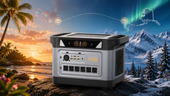
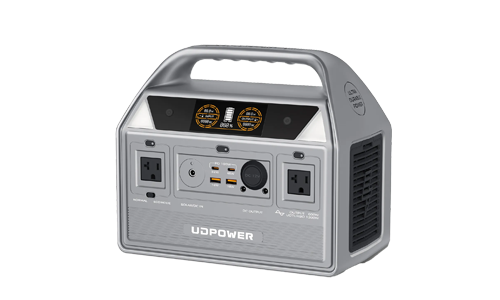
UDPOWER portable power stations use LiFePO4 battery chemistry, support practical AC/DC/USB charging, and are designed for quiet off-grid power. For hunting, quiet operation matters because you do not want generator noise around camp, a blind, or a cabin.
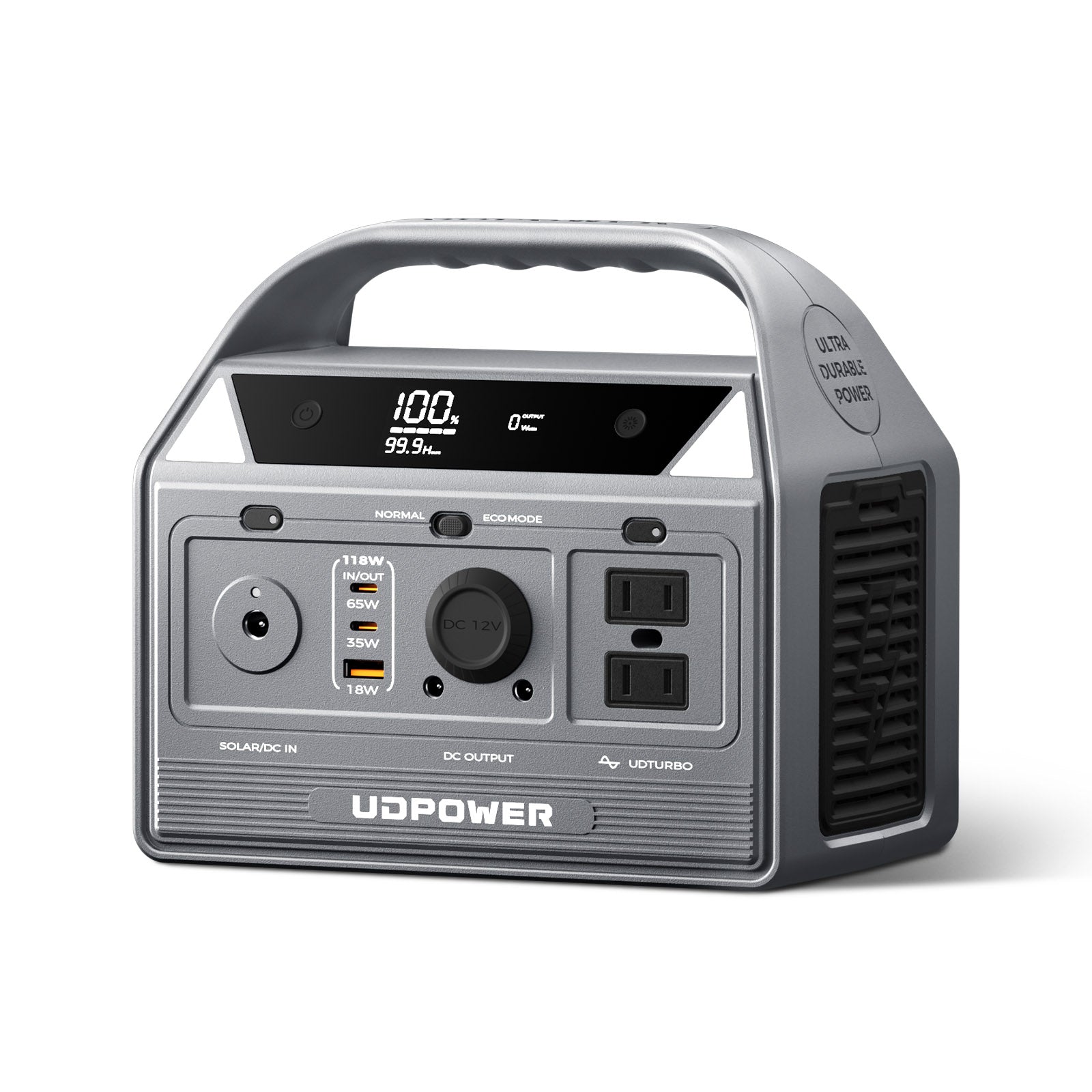
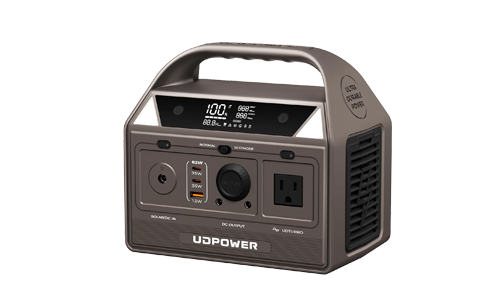
UDPOWER C400 — Best for Day Hunts and Light Overnight Use
The C400 is a compact choice when you want backup power without turning the packout into a heavy electronics load. It is best for phones, GPS, lights, cameras, radios, and short low-watt use around a truck or blind.
- Capacity: 256Wh
- Output: 400W AC, 800W surge
- Battery: LiFePO4, 4,000+ cycles
- Weight: 6.88 lb
- Useful hunting angle: compact, solar-ready, and suitable for small electronics

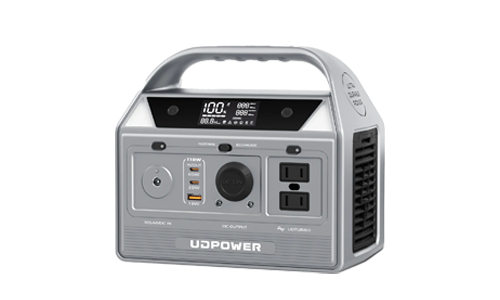
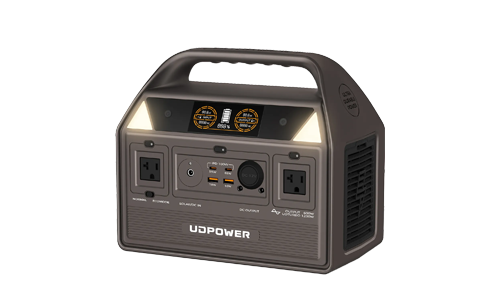
UDPOWER C600 — Best for Blind, Truck Camp, and Weekend Basics
The C600 gives hunters a useful middle ground: more capacity than a pocket battery, but still easy enough to move between the truck, tent, blind, and cabin.
- Capacity: 596Wh
- Output: 600W rated, 1,200W peak
- Battery: LiFePO4, 4,000+ cycles
- Ports: AC outlets, USB-C, USB-A, and 12V car outlet
- Useful hunting angle: good for lights, phones, cameras, radios, and short cooler use
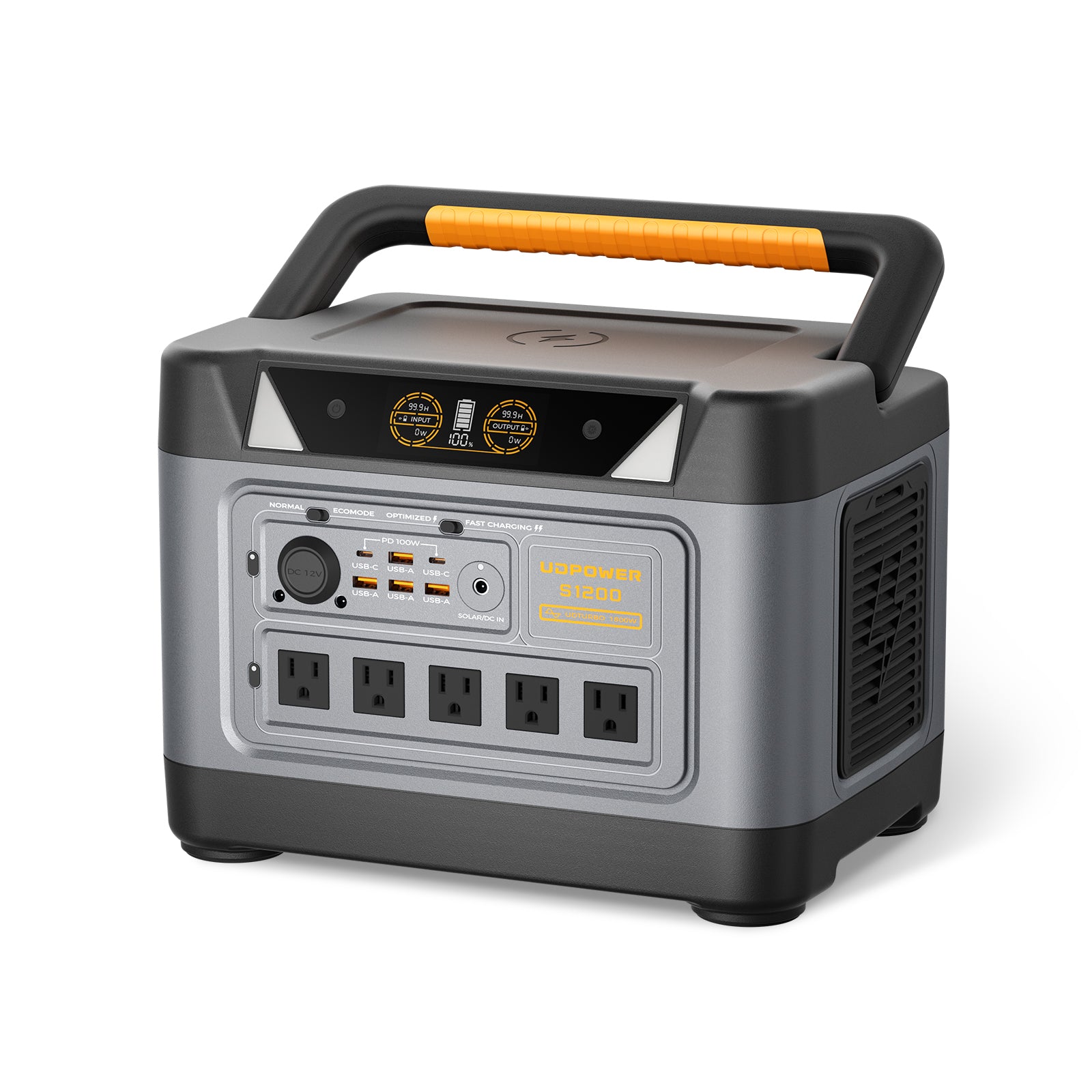
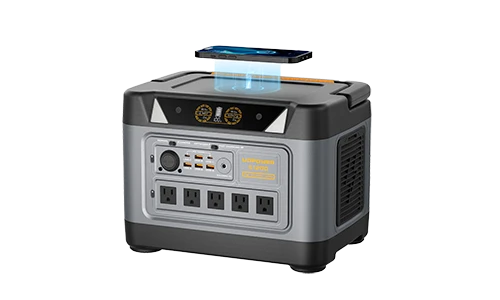
UDPOWER S1200 — Best All-Around Choice for Weekend Hunting Camp
The S1200 is the practical sweet spot when you want real backup capacity without moving into a large camp-power setup. It fits hunters who need to recharge many devices, run camp lighting, power camera gear, and support moderate comfort loads.
- Capacity: 1,190Wh
- Output: 1,200W rated pure sine wave, UDTURBO up to 1,800W
- Ports: 5 AC outlets + 10 DC outputs
- Noise: less than 25dB
- UPS: less than 10 ms UPSPRIME backup switching
- Useful hunting angle: strong weekend-camp capacity with quiet operation
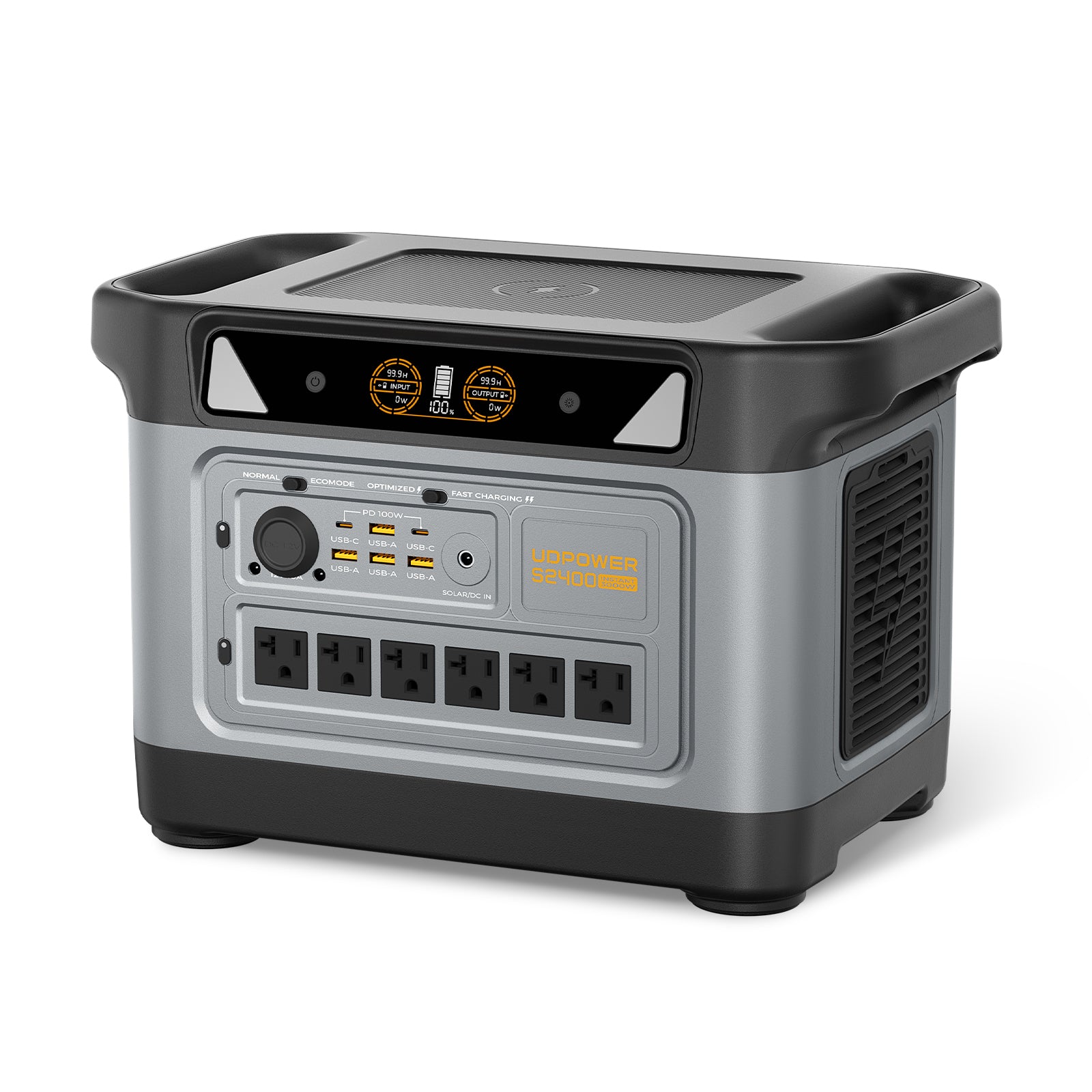
UDPOWER S2400 — Best for Multi-Day Base Camp and Shared Power
The S2400 is the better fit when runtime matters more than minimum weight. It is built for larger hunting camps, several people sharing one power source, powered coolers, Starlink Mini use, or emergency backup before and after the trip.
- Capacity: 2,083Wh
- Output: 2,400W pure sine wave AC, UDTURBO surge up to 3,000W
- Ports: 6 AC outlets + 10 DC outputs
- Battery: LiFePO4, 80%+ capacity after 3,000 cycles
- Solar kit option: S2400 + 420W solar panel kit available
- Useful hunting angle: best for longer stays, higher output, and solar recovery
| Model | Capacity | Rated output | Best hunting use | Product source |
|---|---|---|---|---|
| UDPOWER C400 | 256Wh | 400W | Day hunting, cameras, lights, phones, GPS | Official C400 page |
| UDPOWER C600 | 596Wh | 600W | Blind power, truck camp, overnight backup | Official C600 page |
| UDPOWER S1200 | 1,190Wh | 1,200W | Weekend hunting camp, shared charging, cooler support | Official S1200 page |
| UDPOWER S2400 | 2,083Wh | 2,400W | Multi-day base camp, solar kit, higher-output backup | Official S2400 page |
Solar, Car Charging, and Cold-Weather Planning
Hunting trips are not always sunny, clean, or warm. Backup power planning should include how you will recharge, where the battery will sit, and what happens when temperatures drop.
1. Charge fully before leaving home
Start the trip with a full station. Wall charging before departure is the fastest and most predictable method. Do not wait until the morning of the hunt to discover a cable is missing.
2. Use vehicle charging between spots
If you are driving between trailheads, blinds, public land access points, or camp, vehicle charging can top up a station during the day. This is especially useful when solar conditions are weak.
3. Add solar for base camp recovery
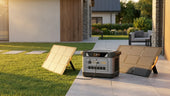
Solar is most useful when the station stays near a truck, cabin, wall tent, or base camp during daylight. UDPOWER’s portable power station collection highlights solar-ready charging for camping, RV, emergency backup, and off-grid use. The S2400 page also lists a 420W solar panel kit option for stronger recovery during longer stays.
| Recharge method | Best use | Strength | Limitation | Source |
|---|---|---|---|---|
| Wall charging | Before leaving home or cabin | Fast and predictable | Requires grid or generator access | UDPOWER S1200 fast charging |
| Car charging | Travel days, scouting routes, moving camp | Useful while driving | Slower than wall charging and vehicle-dependent | UDPOWER charging overview |
| Portable solar panel | Base camp, truck camp, cabin, long daylight sits | Quiet, fuel-free recovery | Depends on sun, panel angle, shade, and weather | UDPOWER 120W solar panel |
| Solar generator kit | Multi-day camp and emergency backup | Station and panel planned together | Panel shipment and station shipment may arrive separately for bundles | UDPOWER solar generators |
4. Keep batteries protected from cold and wet conditions
Portable power stations should be kept dry and protected from rain, snow, mud, and standing water. Cold weather can also reduce the performance of small electronics, so keep phones, camera batteries, GPS units, and radio batteries warm when possible. Do not charge a device outside its safe temperature range.
Field tip
For late-season hunts, store small batteries in an inner pocket and keep the power station inside a dry vehicle, cabin, tent vestibule, or protected box with airflow. Never cover vents while the station is under load.
Hunting Power Backup Packing Checklist
Power failure in the field is often caused by small missing parts, not by the battery itself. Use this checklist before you leave.
- Main backup: power bank or portable power station matched to trip length
- Charging cables: USB-C, Lightning, micro-USB, DC cable, camera charger, radio charger
- AC adapter: only if the device cannot charge by USB or DC
- 12V car charging cable: useful for driving days
- Solar panel and solar cable: for base camp or multi-day use
- Dry storage: waterproof bag, tote, or protected camp box
- Label tags: mark cable ownership in group camps
- Small backup light: keep one light separate from the main electronics bag
- Power log: write down what was charged and when, especially for group use
Common Mistakes to Avoid
- Only counting phone charges. Lights, camera batteries, radios, and heated gear often use more total energy than the phone.
- Ignoring cold weather. Plan extra capacity for late-season hunts and keep small batteries warm.
- Using AC when DC or USB would work. Direct DC/USB charging usually wastes less energy than running an AC brick through an inverter.
- Leaving the station exposed. Power stations are electrical devices. Keep them dry and protected.
- Buying only by peak watts. Peak output helps with startup loads, but capacity decides how long your camp stays powered.
- Forgetting the buffer. Add at least 20–30% extra capacity for cold weather, longer sits, unexpected overnight stays, and shared charging.
Related Reading from UDPOWER
These guides help you build a more complete off-grid power plan without guessing:
FAQ: Hunting Power Backup
What is the best power backup for hunting?
For a day hunt, a high-quality power bank may be enough. For a blind, truck camp, cabin, or multi-day base camp, a portable power station is better because it gives you more capacity, AC outlets, USB ports, DC output, and solar or car recharge options.
How many watt-hours do I need for a weekend hunting trip?
For basic electronics, 300–700Wh may be enough. If you add a powered cooler, heated gear, camera gear, CPAP, laptop, or satellite internet, plan around 1,000Wh or more. For several people sharing power, a 2,000Wh-class station is more comfortable.
Can I use a portable power station in a hunting blind?
Yes, as long as it is kept dry, ventilated, and within the operating limits in the manual. Battery power stations are quiet and do not produce exhaust, which makes them more suitable than gas generators for many blind and cabin situations.
Can a power station run heated hunting gear?
Yes, if the heated gear stays within the station’s output limit. Heated items can use a lot of energy over time, so use lower heat settings when possible and calculate watts × hours before the trip.
Is solar worth it for hunting camp?
Solar is worth it when you stay in one place during daylight, such as a truck camp, cabin, wall tent, or base camp. It is less useful for constant hiking through shaded timber because panel angle, shade, clouds, and short winter days reduce output.
Should I use AC outlets or USB/DC ports?
Use USB or DC when your device supports it. Running an AC wall adapter through the inverter can waste extra energy. Save AC outlets for devices that truly need household-style power.
Can I leave a portable power station outside overnight?
It is better to keep it inside a dry, protected space such as a vehicle, tent, cabin, or covered camp box. Do not leave it exposed to rain, snow, mud, or standing water.
Which UDPOWER model is best for hunting?
Choose C400 for day hunts and light charging, C600 for blind or truck-camp basics, S1200 for weekend hunting camps, and S2400 for multi-day base camps, shared power, solar recovery, and larger loads.
Build Your Hunting Power Setup Before the Trip
Make your gear list, estimate watt-hours, add a cold-weather buffer, then choose the smallest power station that still covers your real devices. For most hunters, that means C600 for lighter camp power, S1200 for a comfortable weekend setup, and S2400 when several people or longer runtime matter.
- Need a quick model comparison? Start with the portable power station collection.
- Need solar recovery? Compare solar generator kits.
- Need a weekend camp workhorse? Start with S1200 or S2400.