How Cold Is Too Cold for a Solar Generator?
ZacharyWilliamWinter use guide • Battery-safe charging • Solar input gotchas
If you only remember one thing: cold weather is usually a charging problem, not a “can I run my stuff” problem. Most solar generators (portable power stations) use lithium batteries. They can power devices in the cold, but charging a cold lithium battery is where you can shorten lifespan—or trigger a protective shutdown.

Quick temperature chart: what’s “too cold,” really?
Temperature limits depend on your exact model, but the pattern is consistent: discharging works colder than charging. Use this chart as a decision tool, then cross-check your manual/product page.

| Ambient temp range | What’s usually OK | What to avoid | Why it matters (with sources) |
|---|---|---|---|
| 50°F to 104°F | Normal charging (AC/car/solar), normal output, normal storage | Blocking vents, leaving it sealed in a hot vehicle | Most lithium packs are happiest in “moderate” temps; UDPOWER lists charging up to 104°F (40°C) on its published specs (see S1200 and S2400 operating temperature sections). |
| 32°F to 50°F | Charging is typically allowed (often slower). Discharging usually fine. | Assuming your runtime will match summer numbers | Cold increases internal resistance, so you may see lower usable energy and lower peak output. Many brands keep “standard” charging at or above freezing; see Battery University. |
| 23°F to 32°F (borderline) | Discharging often still works. Some units may allow limited charging, but safest practice is to warm first. | Fast-charging a battery that has been sitting outside all night | UDPOWER lists charging down to 23°F (-5°C) on S-series models like S1200 and S2400. But general lithium guidance still warns against charging below 32°F (0°C) due to lithium plating risk (Battery University). Practical takeaway: if you can, warm the unit above freezing before serious charging. |
| 0°F to 23°F | Emergency discharging may work (with reduced performance) if your model supports it. | Trying to charge from solar/AC without warming the battery first | Many lithium systems will block charging here. Even Victron’s lithium guidance is explicit that charging below 0°C should be avoided (Victron community archive). |
| Below -4°F | Plan on “no,” unless your model explicitly supports lower temps. | Relying on the unit as your only heat-critical backup without insulation/warming | UDPOWER commonly lists -4°F (-20°C) as the lower discharging limit for multiple stations (example: S1200, S2400). |
What actually changes in the cold (and why “solar generator” gets confusing)

1) The battery is the limiter (not the solar panel)
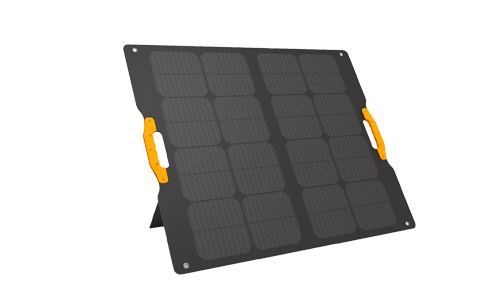
A “solar generator” is really two things: a power station (battery + inverter + BMS) and solar panels. In winter, panels are usually fine—UDPOWER’s portable panels are rated down to -40°F (see the 120W panel specs here and the 210W panel specs here). The battery chemistry is what dictates charging limits.
2) Charging below freezing can permanently hurt lithium batteries
The short explanation: cold makes it harder for lithium ions to move into the anode during charge. If you force charging while the cells are below freezing, metallic lithium can plate onto the anode—damage that doesn’t “heal.” Battery University calls out 0°C (32°F) as the “don’t charge below this” line for consumer lithium packs (source). UDPOWER’s own LiFePO4 guide echoes the same principle: don’t charge below 0°C unless the pack explicitly supports low-temp charging (source).
3) Even when discharging is allowed, expect reduced performance
In the cold, you can see lower usable capacity and sometimes lower peak output. This is normal. The important planning move is to build buffer: charge earlier, keep the station warmer, and avoid running your inverter near its max.
UDPOWER temperature specs at a glance (examples)
Below are published operating temperature ranges from UDPOWER product pages and their FAQ page. Always follow your specific model’s listing.

| Model / reference | Discharging (use) | Charging (AC / car / solar) | Storage | Notes |
|---|---|---|---|---|
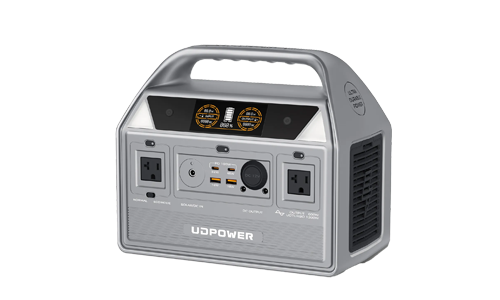
| UDPOWER S1200 (example solar generator setup: S1200 + panels) | -4°F to 113°F (-20°C to 45°C) | 23°F to 104°F (-5°C to 40°C) | 32°F to 104°F (0°C to 40°C) | Solar input listed as 12V–75V, 12A, 400W max on the S1200 page (useful when planning winter solar strings). |
| UDPOWER S2400 | -4°F to 113°F (-20°C to 45°C) | 23°F to 104°F (-5°C to 40°C) | 32°F to 104°F (0°C to 40°C) | Solar charging input listed as 12V–50V, 10A max on the S2400 page. (That “50V” matters more in cold weather—see the solar voltage section.) |
| UDPOWER FAQ “Operating temperature range” (FAQ page) | -4°F to 113°F (-20°C to 45°C) | 32°F to 104°F (0°C to 40°C) | 32°F to 104°F (0°C to 40°C) | This reflects a common baseline across many power stations: charge at/above freezing, discharge well below freezing. |
How to use this table: If you’re shopping (or comparing), prioritize the numbers that match your winter reality: charging low-temp limit, discharge low-temp limit, and solar input voltage max. UDPOWER publishes these directly on product pages like S1200 and S2400.
Winter charging steps that actually work (without babying the unit)
If you’re using a solar generator for outages, camping, RV shoulder season, or just a cold garage workshop, the goal is simple: keep the battery warm enough to accept charge.

Step-by-step
- Let the unit acclimate. If it’s been in a cold trunk/garage, bring it inside for a while before charging. UDPOWER explicitly recommends acclimating in extreme conditions (source).
- Start with a small load (optional, but helpful). Running a modest load can gently warm the pack internally—then charging becomes more stable. Avoid pushing near max inverter output when the unit is ice-cold.
- Charge slowly first, if you have the option. Cold + “fast charge” is the combo most likely to trigger limits.
- Keep airflow around vents. Don’t wrap the unit in a blanket while it’s actively charging/discharging. If you insulate, leave vent paths open.
- Watch the input wattage. In cold weather, it’s normal to see the station accept less power until it warms up.
Why the “warm first” advice is so common: Charging below 32°F is the widely accepted “avoid” zone in lithium safety guidance (see Battery University), and even manufacturers/integrators repeat it in their documentation. If your model lists sub-freezing charging (like UDPOWER S-series at 23°F), it likely relies on BMS logic and real battery temperature—not just the air temperature. Still, warming above freezing before heavy charging is the safest habit.
Cold weather solar: voltage can rise (don’t ignore this)
Here’s the winter solar “gotcha” almost nobody thinks about the first time: solar panel voltage increases as temperatures drop. NREL notes that on a cold winter day, a module’s voltage can be meaningfully higher than its nameplate—an example given is about a 7% increase (NREL PV DC Systems: Basics and Safety).
To make this concrete, here are UDPOWER panel specs (from product pages) and why winter voltage margin matters:
| UDPOWER panel | Rated power | Open-circuit voltage (Voc) | Max/operating voltage | Current (Isc / running) | Operating temp | Weather rating |
|---|---|---|---|---|---|---|
| 120W Portable Solar Panel | 120W | 17.8V | 21.7V | 6.65A / 6.17A | -40°F to 185°F | IP65 |
| 210W Portable Foldable Solar Panel | 210W | 48.0V | 40.0V | 5.40A / 5.00A | -40°F to 185°F | IP65 |
How this ties back to “too cold”: cold weather can actually help panels (higher voltage can improve power transfer), but if you exceed your station’s max PV input voltage, the station may refuse to charge—or you risk stressing the input stage. UDPOWER publishes station input limits on product pages (example: S1200 lists 12V–75V; S2400 lists 12V–50V), and their pairing guide calls out “keep Voc ≤ 50V” logic for certain setups (source).
Storage + transport in winter (garage, trunk, cabin)
Storage is where people accidentally abuse their solar generator. Not because the unit “can’t handle winter,” but because it sits cold-soaked for days, then gets hit with a big charge request.
| Scenario | What to do | What to avoid | Why |
|---|---|---|---|
| Leaving it in a cold car overnight | Bring it inside before charging. Let it acclimate. | Plugging into AC/solar immediately while the pack is still cold | Cold-soaked lithium charging is the risky moment (see Battery University). |
| Unheated garage / shed | Store closer to 32°F+ when possible; charge indoors if it’s below freezing. | Using “fast charge” as the first thing in the morning on a frozen unit | Even if discharging works, charging limits can kick in below freezing. |
| Cabin / off-grid weekend trips | Keep the station in the warmest indoor spot; run panels outside. | Leaving it on the porch with the panels | Panels tolerate cold; batteries often don’t—UDPOWER panel temp ratings go to -40°F (120W, 210W). |
| Moving from freezing outdoors to a warm house | Let it sit powered off briefly to reduce condensation risk. | Immediately charging if you see condensation | Moisture + electronics is never a great combo; acclimation helps (UDPOWER mentions acclimating in extremes: source). |
Troubleshooting: “It won’t charge” when it’s cold
Symptom: solar input shows 0W (but the sun is out)
- Check battery temperature first. If the station is cold-soaked, it may block charging until it warms.
- Confirm panel Voc vs station input limit. Cold can raise voltage; NREL notes voltage can be higher in cold conditions (source).
- Recheck connectors/adapters. UDPOWER’s solar-buying checklist emphasizes matching connectors and verifying Voc/Vmp alignment (source).
Symptom: it charges, but painfully slowly
- This can be normal in cold weather: the BMS may limit charge current until conditions improve.
- Also check solar angle and snow cover—winter sun is lower, and partial shade is brutal for panel output (UDPOWER’s setup guide has practical angle tips: source).
Symptom: it shuts off during light loads
Many stations have ECO/auto-shutoff logic. If your use case is “tiny load in a cold room,” you may need to disable ECO mode (model-dependent) or bundle loads into a single session. On S-series pages, UDPOWER describes power management features like ECO/auto shutoff (example: S2400).
FAQ
Is it okay to leave my solar generator outside in the snow?
Snow itself isn’t the point—temperature is. Panels may be rated to very low temperatures (UDPOWER panels list -40°F to 185°F: 120W, 210W), but the power station’s battery may not accept charge when cold. If you must leave it outside, plan on warming it before charging.
Why can I run devices below freezing but I can’t charge below freezing?
Discharging is usually allowed colder than charging. Charging below 0°C can cause lithium plating and permanent damage (see Battery University).
Does cold weather make solar panels “better”?
Often, yes—cooler panels can operate more efficiently and at higher voltage. The tradeoff is winter sun angle and shorter daylight. Just remember: higher voltage in cold can also push you closer to your station’s input limits (NREL).
What’s the safest winter habit if I use my station for outages?
Store it inside (or above freezing), keep it topped up, and run panels outside if you’re solar-charging. UDPOWER lists common storage ranges like 32°F to 104°F on their published operating temperature sections (see S1200, S2400, and the FAQ).
If my model claims charging below 32°F, should I trust it?
Trust the published spec—but interpret it realistically. “Ambient temperature” isn’t always “battery cell temperature,” and most lithium guidance still treats 32°F as the safer threshold (see Battery University). If you can warm the unit above freezing before charging, you’ll avoid the worst-case conditions.