Electricity Saving Box: Does It Really Lower Your Electric Bill?
ZacharyWilliamHome energy guide
Updated on
Quick answer: an electricity saving box is not a real shortcut to lower bills
An electricity saving box, power saver plug, watt saver, or “energy optimizer” is usually a small plug-in device advertised as a way to cut your electric bill by 20%, 30%, 40%, or even more. For a normal U.S. home, that claim is not realistic. Most homes are billed mainly by kilowatt-hours, meaning the electricity actually used by your appliances. A box plugged into one outlet cannot make a refrigerator, air conditioner, dryer, water heater, or oven use dramatically less energy.
The practical answer is simple: do not buy a plug-in electricity saving box expecting a lower utility bill. Spend the money on proven steps instead: measure appliance use, reduce HVAC load, switch to LEDs, seal air leaks, improve thermostat habits, manage standby power, and prepare backup power for outages separately.
Important distinction: a portable power station is not an electricity saving box. It stores power for outages, camping, RV use, CPAP backup, routers, lights, refrigerators, and other essentials. It can support a more resilient energy plan, especially when paired with solar charging, but it should not be marketed as a magic bill-reduction plug.

What Is an Electricity Saving Box?
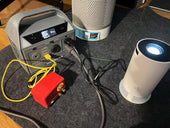
An electricity saving box is usually a plug-in device sold online under names such as power saver box, electricity saver plug, energy saver device, watt saver, voltage optimizer, power factor saver, or smart energy box. Many ads show the device being plugged into a wall outlet and claim it will “stabilize voltage,” “clean dirty electricity,” “balance current,” “reduce wasted power,” or “protect appliances.”
Some devices may contain a capacitor, a small light, basic wiring, or very little useful hardware. Some are marketed with technical-sounding language that makes them appear more advanced than they are. That matters because the average buyer is not trying to solve an industrial power-quality problem. The buyer simply wants a lower monthly electric bill.
| Common name in ads | Typical promise | What a household should know | Helpful source |
|---|---|---|---|
| Electricity saving box | Lower electric bill by a large percentage | A home bill is mostly based on real energy used by appliances. A plug-in box does not make high-load appliances stop consuming energy. | NIST explanation |
| Power factor saver | Fix power factor and cut bill | Power factor correction can matter for some commercial or industrial accounts, but it normally does not cut a typical residential kWh bill. | NIST power factor article |
| Energy saving plug | Reduce wasted electricity automatically | Real savings come from using fewer kWh, using efficient appliances, and reducing heating/cooling demand. | U.S. DOE Energy Saver Guide |
| Voltage optimizer box | Protect equipment and lower consumption | Whole-home voltage work should be evaluated by a licensed electrician. A small plug-in device is not the same as a professionally designed electrical solution. | FTC clean-energy scam guidance |
Does an Electricity Saving Box Work?
For normal household bill reduction, no. A plug-in electricity saving box should not be expected to reduce your U.S. residential electric bill in any meaningful way. It cannot override appliance wattage, cannot change your utility rate, cannot make an air conditioner cool the same space with dramatically less energy, and cannot make a refrigerator compressor run for free.
The most common technical claim is tied to power factor correction. Power factor is a real electrical concept, and power factor correction can be useful in the right setting. The problem is the setting. Many U.S. residential customers are not billed the same way as factories, workshops, or commercial facilities with demand charges and power factor penalties. If your bill is based mainly on kWh, correcting power factor at one outlet is not the same as reducing the real energy your appliances consume.
That is why “save 40% by plugging this in” is a red flag. If a small, inexpensive plug-in box could reliably reduce household bills by that much, it would be recommended by utilities, building science programs, energy auditors, and major retailers as a standard home efficiency product. Instead, trusted energy-saving guidance focuses on insulation, HVAC operation, lighting, appliances, weatherization, water heating, and behavior changes.
Why the Big Savings Claims Fall Apart
The easiest way to understand this is to separate “electrical language” from “bill language.” An ad may talk about current, voltage, reactive power, surges, or “dirty electricity.” Your utility bill, however, usually charges you for the amount of real energy used over time.
| Advertising claim | Why it sounds believable | What actually matters for a home bill | Better action |
|---|---|---|---|
| “It stabilizes voltage.” | Voltage problems can damage equipment in some cases. | A small plug-in device does not reduce the real watt-hours used by major appliances. | For real voltage problems, call your utility or a licensed electrician. |
| “It reduces current draw.” | Lower current sounds like lower cost. | Bill impact depends on real power and energy, not a single current reading alone. | Measure watts and kWh with a plug-in energy meter for individual plug-in loads. |
| “It improves power factor.” | Power factor correction is real in industrial and some commercial systems. | Typical homes are not charged a separate power factor penalty like many commercial accounts. | Check your actual bill. Look for kWh, demand, and any power factor line items. |
| “It protects every appliance in the house.” | Surge protection is a real category. | A generic power saver box is not the same as a listed surge protector or whole-home surge protection device. | Use properly rated surge protection and follow electrical code guidance. |
| “It saves up to 90%.” | High bills make big promises tempting. | Whole-home energy savings of that size require major load reduction, building upgrades, or generation changes. | Start with HVAC, water heating, insulation, appliance use, and lighting. |
One more practical test: look at the appliances that dominate many household bills. Central air conditioning, electric heat, water heaters, clothes dryers, ovens, pool pumps, dehumidifiers, and refrigerators use energy because they move heat, create heat, or run motors. A small box in a wall outlet cannot change the physics of those jobs.
What Actually Controls Your Electric Bill?
Your electric bill is not mysterious. It is usually driven by four things: how much electricity you use, when you use it, your utility rate, and fixed fees. Some homes also have demand charges or time-of-use pricing, but the core idea is still simple: reduce real consumption or shift use to lower-cost times where your rate plan rewards it.
| Bill driver | What it means | What you can control | Example action |
|---|---|---|---|
| kWh usage | Total electricity consumed over time | Appliance run time, appliance efficiency, thermostat settings, lighting, standby loads | Replace frequently used bulbs with LEDs, reduce AC runtime, wash with cold water, unplug unused loads |
| Rate per kWh | The price your utility charges for each unit of electricity | Rate plan selection where available | Compare standard, time-of-use, and off-peak plans if your utility offers choices |
| Peak timing | Some plans charge more during high-demand hours | When you run laundry, dishwasher, EV charging, or other flexible loads | Run flexible loads outside peak hours if your rate plan rewards it |
| Fixed fees | Monthly customer charges, delivery charges, taxes, and riders | Usually limited | Read the bill so you know which parts can and cannot be reduced by behavior |
| Outage risk | Power interruptions do not always raise the bill, but they can create food loss, work disruption, and medical-device risk | Backup planning for selected essentials | Use a properly sized backup battery for critical devices rather than relying on a power saver box |
Red Flags Before You Buy an Electricity Saving Box
Many electricity saving box ads are designed to feel urgent. They often show fake laboratory graphics, celebrity-style endorsements, “utility insider” claims, and countdown discounts. Use this checklist before buying.
- It promises a fixed savings percentage for every home. Real savings depend on your appliances, climate, insulation, rate plan, and habits.
- It says utilities do not want you to know about it. That is a classic persuasion tactic, not evidence.
- It uses a fake news story or fake expert endorsement. Confirm claims through the original source, not a screenshot in an ad.
- It has no credible third-party test showing lower household kWh use. Look for real test methods, not before-and-after bills with no controls.
- It claims to protect your whole home without proper electrical ratings. Whole-home electrical protection is not something to guess at.
- It is sold only through aggressive social ads, limited-time pages, or unfamiliar checkout pages. Be careful with payment details and return policies.
Safety note: If a plug-in device gets warm, smells unusual, has loose prongs, flickers, buzzes, or comes from an unknown seller with no recognized safety information, stop using it. A device that plugs into your home wiring should not be treated as a harmless toy.
How to Test Any “Power Saver” Claim at Home
You do not need to be an engineer to avoid bad purchases. A practical test is to measure real watt-hours, not just trust an ad.
| Step | What to do | What to record | Why it matters |
|---|---|---|---|
| 1 | Pick one plug-in appliance, such as a dehumidifier, mini fridge, fan, TV, or computer setup. | Appliance name, wattage label, room conditions | You need one controlled load before judging a whole-home claim. |
| 2 | Use a plug-in energy meter between the appliance and the wall outlet. | kWh used over 24–72 hours | kWh is the bill-relevant number for normal residential use. |
| 3 | Repeat with the same appliance and similar conditions while the “saving box” is plugged in nearby. | kWh used over the same duration | Short readings can be misleading, especially with cycling loads like refrigerators. |
| 4 | Compare results and account for temperature, door openings, thermostat settings, and use pattern. | Difference in kWh, not just amps | A lower amp reading is not proof of lower real energy use. |
| 5 | Check your utility bill over several months after real efficiency changes. | Total kWh, rate plan, weather, household occupancy | Monthly bills vary with weather and behavior, so one bill is not enough proof. |
If you want a quick rule: a real electricity-saving method should either reduce the watts used, reduce the hours used, improve appliance efficiency, reduce heating/cooling demand, or shift consumption to a cheaper rate period. If it does none of those, be skeptical.
Proven Ways to Reduce Electricity Use
Instead of buying an electricity saving box, put your budget toward actions that match how homes actually use energy. Some are free. Some cost a little. Some require a professional. The best results usually come from stacking several small improvements rather than expecting one magic device.
| Action | Best for | Why it works | Cost level | Source |
|---|---|---|---|---|
| Replace high-use bulbs with LED lighting | Rooms where lights are on every day | LEDs use much less electricity than traditional incandescent bulbs and last longer. | Low | ENERGY STAR tips |
| Use thermostat setbacks | Heating and cooling seasons | HVAC is often one of the largest home energy loads, so reducing runtime matters. | Free to medium | DOE cooling tips |
| Seal air leaks and improve insulation | Drafty homes, hot upstairs rooms, cold rooms, older houses | Less heat gain or heat loss means your HVAC system runs less often. | Low to high | DOE Energy Saver Guide |
| Turn off ceiling fans in empty rooms | Homes that run fans all day | Fans cool people, not empty rooms, so running them when nobody is there wastes electricity. | Free | DOE fan guidance |
| Use cold-water laundry when suitable | Frequent laundry households | Heating water can be a major part of laundry energy use. | Free | DOE home energy guide |
| Measure standby loads | Home offices, entertainment centers, chargers, older electronics | Small always-on loads add up when they run 24/7. | Low | ENERGY STAR low/no-cost tips |
| Maintain HVAC filters and airflow | Homes with central heating or cooling | Restricted airflow can reduce comfort and make equipment work harder. | Low | DOE HVAC tips |
A simple 7-day plan that beats a power saver box
Day 1: Pull your last three utility bills and write down total kWh, not just total dollars.
Day 2: List your likely high-load appliances: AC, electric heat, water heater, dryer, range, pool pump, dehumidifier, refrigerator, freezer, and EV charger.
Day 3: Replace or schedule replacement for the most-used non-LED bulbs.
Day 4: Set a thermostat schedule that reduces heating or cooling when you sleep or leave, while staying safe and comfortable.
Day 5: Use a plug-in energy meter on one suspected energy hog for at least 24 hours.
Day 6: Check for obvious air leaks, blocked vents, dirty filters, and electronics that stay on all day.
Day 7: Create a “must run during outage” list separately from your “lower the bill” list. These are different goals.
Where Backup Power Fits In
A lot of people searching for an electricity saving box are really worried about two separate problems: high bills and power outages. The first problem is solved by energy efficiency. The second problem is solved by backup planning.
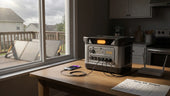
This is where a portable power station can make sense. It will not lower your utility bill just by sitting in the house. But it can keep selected essentials running when grid power is unavailable, and it can be charged from wall power, car charging, or compatible solar panels depending on the model and setup.
| Goal | Electricity saving box | Portable power station | Best practical choice |
|---|---|---|---|
| Lower monthly bill | Not a reliable solution | Only helps if paired with real energy strategy, such as solar charging or rate-based load shifting where practical | Efficiency upgrades first |
| Run a CPAP during an outage | No | Yes, if sized correctly for wattage and hours needed | CPAP battery backup options |
| Keep Wi-Fi and phones powered | No | Yes, usually with a smaller or mid-size unit | Battery powered outlet collection |
| Run a refrigerator temporarily | No | Yes, with enough capacity and surge support | Choose by running watts, startup surge, and runtime target |
| Power selected camping or RV loads | No | Yes | Portable power station collection |
UDPOWER Product Bridge: Choose Backup Power by Real Load
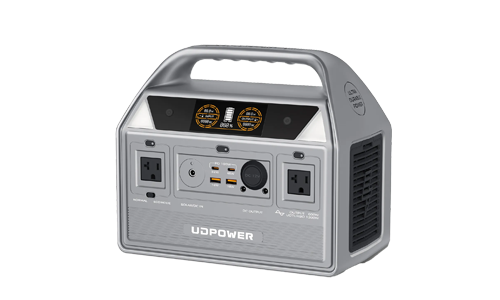
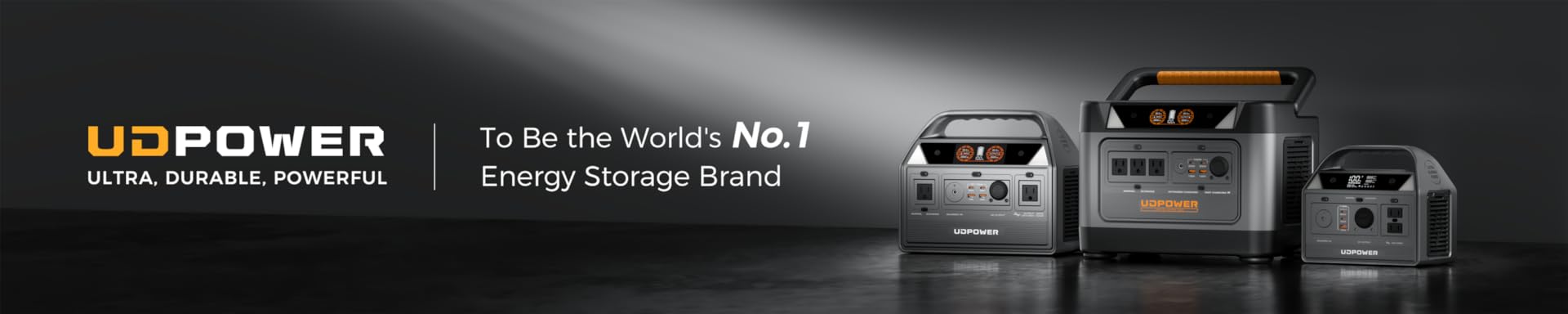
Do not choose backup power based on a vague “save electricity” promise. Choose it based on capacity, output, ports, charging methods, and the devices you actually need to run. The product information below uses UDPOWER’s official product pages and images.

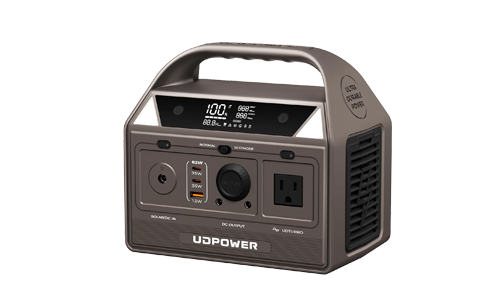
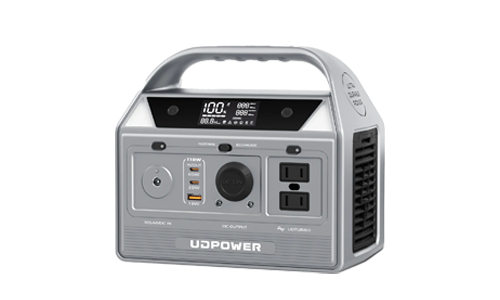
UDPOWER C400 — compact backup for phones, routers, laptops, small DC/AC loads
256Wh400W output800W surge6.88 lbs
- Best fit: short outages, day trips, router backup, phones, laptops, lights, small fans, and low-power devices.
- Official page notes 256Wh LFP capacity, 400W AC output, 800W surge, 1.5-hour fast charging, and solar-ready charging support.
- Not a replacement for whole-home backup or large heating/cooling appliances.
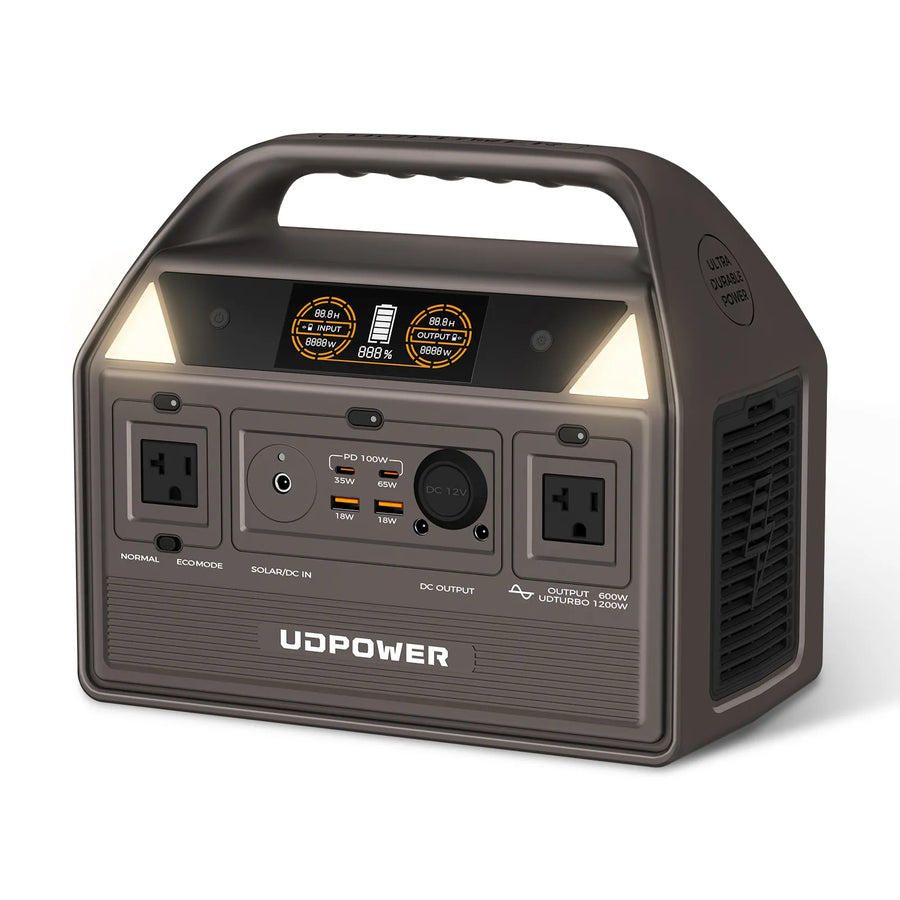
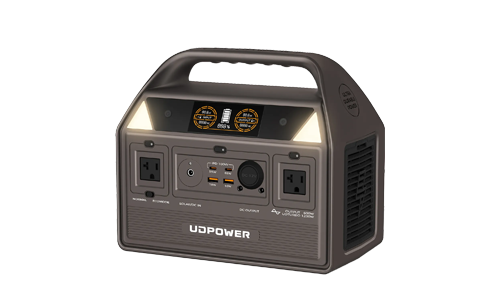
UDPOWER C600 — medium backup for mini fridges, laptops, lights, cameras, small appliances
596Wh600W output1200W max12.3 lbs
- Best fit: medium off-grid use, mini fridge support, drone/camera charging, emergency lights, small fans, and daily backup.
- Official specs list 596Wh capacity, 600W pure sine wave AC output, 1200W max, 2 AC outlets, USB-C, USB-A, DC, and 240W max solar charging input.
- A practical step up when C400 capacity is too small but you still want a compact unit.
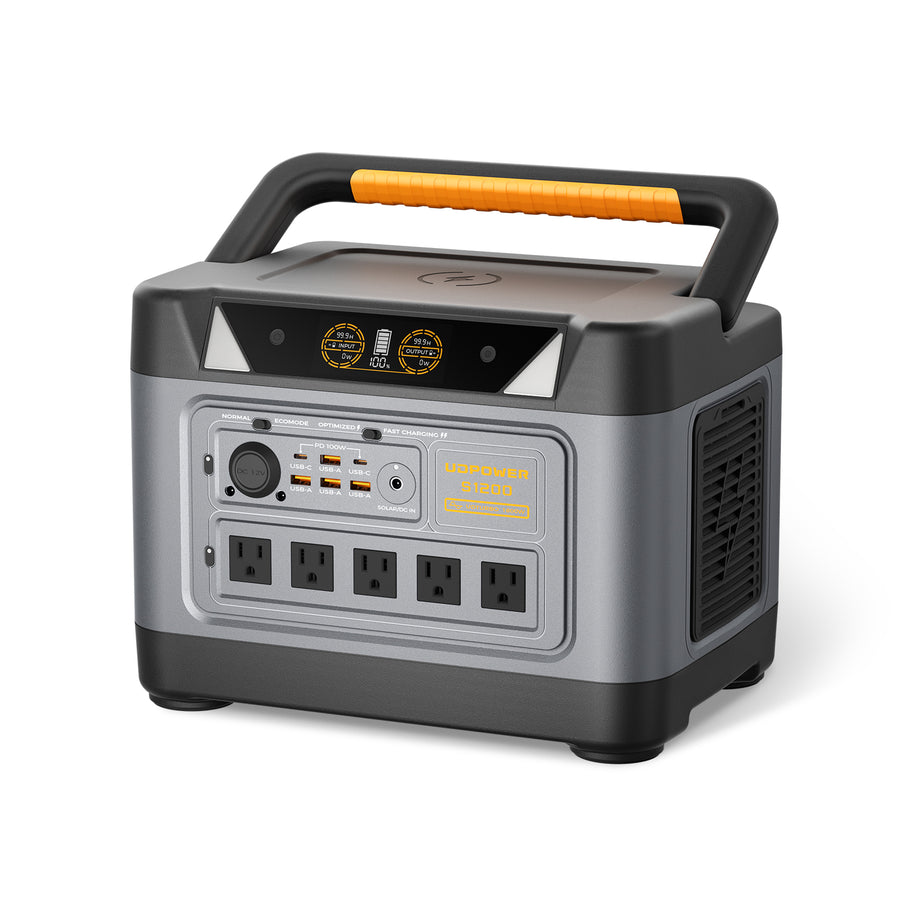
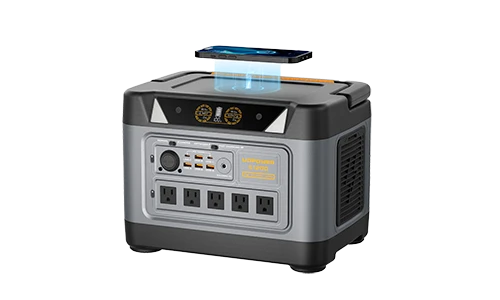
UDPOWER S1200 — stronger home-essential backup with UPS-style switching
1,190Wh class1200W output1800W max≤10ms UPS mode
- Best fit: home essentials, RV use, commercial/camping backup, CPAP, router, lights, TV, laptop, and many refrigerator scenarios when total wattage is within limits.
- Official specs list pure sine wave 120V/60Hz AC output, 1200W rated output, 1800W max, 5 AC outlets, USB-C PD, wireless charging, and 400W max solar charging input.
- Good choice when you want more runtime than compact units and want UPS-style switchover for selected devices.
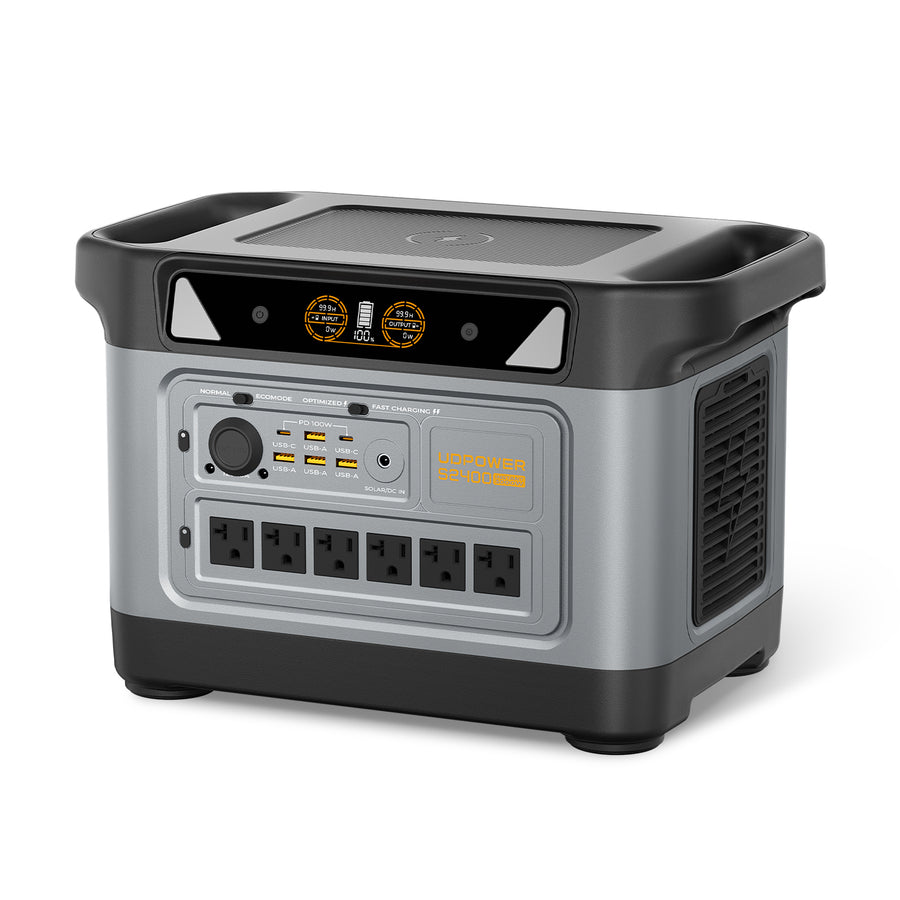
UDPOWER S2400 — higher-output backup for heavier essential loads
2,083Wh2400W output3000W surge6 AC outlets
- Best fit: longer runtime, higher-wattage essentials, refrigerators, coffee makers, microwaves within spec, CPAP, routers, TVs, laptops, and selected emergency loads.
- Official specs list 2083Wh capacity, 2400W pure sine wave AC output, 3000W startup surge support, 6 AC outlets, UPSPRIME switchover ≤10ms, and solar input up to 400W through DC7909 within the stated voltage/current range.
- Not a whole-home 240V system and not designed to power central AC, hardwired electric water heaters, or an entire electrical panel.
UDPOWER comparison table
| Model | Capacity | AC output | Solar input | Best match | Official source |
|---|---|---|---|---|---|
| UDPOWER C400 | 256Wh | 400W rated, 800W surge | 150W max | Short outages, travel, router, phones, laptops, small loads | C400 product page |
| UDPOWER C600 | 596Wh | 600W rated, 1200W max | 240W max | Mini fridge, laptops, lights, camera gear, medium backup | C600 product page |
| UDPOWER S1200 | 1,190Wh class | 1200W rated, 1800W max | 400W max | Home essentials, CPAP, refrigerator support, RV/camping, outage backup | S1200 product page |
| UDPOWER S2400 | 2,083Wh | 2400W rated, 3000W startup surge | 400W max | Longer runtime and higher-wattage essentials | S2400 product page |
Quick sizing examples for outage planning
These examples are planning estimates. Actual runtime depends on appliance wattage, compressor cycling, inverter loss, battery condition, temperature, and whether other loads are connected. Always check the running watts and startup surge of your actual device.
| Device or load | Typical planning wattage | Smallest practical UDPOWER range | Why |
|---|---|---|---|
| Phone charging, LED lamp, small fan | 5W–50W | C400 or C600 | Low wattage loads need convenience and enough outlets more than high surge output. |
| Wi-Fi router and modem | 10W–30W | C400, C600, or S1200 for longer runtime | Routers are low power but often need many hours of runtime during outages. |
| CPAP machine | 15W–80W depending on humidifier and pressure | C600 for shorter needs, S1200/S2400 for longer nights or two machines | Humidifier heating can greatly increase draw; check your exact setup. |
| Mini fridge | 40W–100W average, higher startup surge | C600 or S1200 | Compressor startup and cycling pattern matter more than the label alone. |
| Full-size refrigerator | 60W–200W average, higher startup surge | S1200 or S2400 | Choose enough surge support and capacity for the outage window you care about. |
| Microwave or coffee maker | 700W–1500W+ | S2400 when within the unit’s rated output | These are short-duration but high-wattage loads. Confirm running watts before use. |
So, Should You Buy an Electricity Saving Box?
No, not for the purpose most ads promise. If your goal is to lower a household electricity bill, an electricity saving box is a poor use of money. It does not address the loads that actually drive your bill, and it can distract you from improvements that work.
Use this decision rule:
- If you want lower bills: improve efficiency, reduce runtime, measure kWh, and check your utility rate plan.
- If you want outage protection: size a portable power station for the exact devices you must run.
- If you want solar support: choose compatible solar panels and confirm voltage, current, connector, and max input limits.
- If you have electrical safety concerns: use properly rated surge protection and consult a licensed electrician.
FAQ: Electricity Saving Box
Do electricity saving boxes really work?
For typical residential bill reduction, no. A plug-in electricity saving box does not make household appliances use dramatically fewer kilowatt-hours. Real savings come from reducing energy use, improving efficiency, changing thermostat habits, and managing high-load appliances.
Can a power factor saver lower my home electric bill?
Usually not. Power factor correction is a real electrical concept, but typical residential bills are mainly based on kWh. A power factor correction device may change some electrical measurements without reducing the real energy consumed by your appliances.
Why do some ads show lower amps after plugging in the device?
Lower amps alone do not prove lower energy cost. For a household bill, the more useful measurement is watts over time, recorded as kWh. A device can affect current readings without meaningfully reducing real appliance energy use.
Are electricity saving boxes dangerous?
Some may be harmless but useless; others may be poorly built. Any device that plugs into a wall outlet should be treated seriously. Avoid unknown devices with loose prongs, overheating, buzzing, burning smells, no clear safety information, or unrealistic savings claims.
What should I buy instead of an electricity saving box?
For lower bills, buy tools or upgrades that reduce real energy use: LED bulbs, smart plugs for measuring standby loads, weatherstripping, better filters, insulation improvements, or a programmable thermostat where compatible. For outage protection, choose a portable power station sized for the devices you need to run.
Can a portable power station reduce my electric bill?
A portable power station does not reduce your bill just by being plugged in. It stores energy. It may support a broader energy strategy if charged from solar or used with a rate plan that rewards off-peak charging, but its main value is backup power and portable power.
Which UDPOWER model is best for home backup?
For small loads like phones, routers, and laptops, C400 or C600 may be enough. For home essentials such as CPAP, refrigerator support, lights, router, TV, and longer runtime, S1200 or S2400 is usually a better fit. Always size by your appliance wattage and desired runtime.
Can the UDPOWER S2400 power a whole home?
No. The S2400 is a portable power station for selected essential devices. It provides U.S. standard 120V AC output and is not designed to power an entire home panel, central air conditioning, 240V appliances, or large hardwired systems.
What is the fastest way to find what is wasting electricity at home?
Start with your utility bill to track total kWh, then measure plug-in devices with an energy meter. For larger loads, look at HVAC settings, water heating, laundry, cooking, pool pumps, dehumidifiers, refrigerators, freezers, and EV charging habits.
What is the final verdict on electricity saving boxes?
Skip them. They are not a dependable way to lower a household electric bill. Use proven efficiency steps for bill savings and a properly sized backup battery for outage preparedness.
Build a smarter home power plan
Do not rely on a plug-in “electricity saving box” to do what real energy planning should do. Lower bills with efficiency. Protect essentials with the right backup power size.