

CPAP vs BiPAP: Key Differences, Uses and Power Needs
Quick Answer: What Is the Difference Between CPAP and BiPAP?
CPAP delivers one continuous level of air pressure, while BiPAP delivers a higher pressure when you inhale and a lower pressure when you exhale.
For routine obstructive sleep apnea, CPAP or auto-adjusting PAP is usually the starting treatment. BiPAP, also called BPAP or bilevel PAP, is more commonly prescribed when someone cannot tolerate CPAP pressure, needs higher pressure, or requires additional breathing support.
BiPAP is not automatically better than CPAP. The correct treatment depends on your sleep study, diagnosis, pressure requirements, breathing pattern, comfort, and response to treatment.

CPAP vs BiPAP: Side-by-Side Comparison
Both machines are forms of positive airway pressure therapy. They use a motor, tubing, and a mask to deliver pressurized air. The main difference is how the pressure changes during each part of your breath.

Swipe left to view the full table on mobile.
| Feature | CPAP | BiPAP / BPAP | Source |
|---|---|---|---|
| Full name | Continuous positive airway pressure | Bilevel positive airway pressure | NHLBI sleep apnea treatment guide |
| Pressure pattern | One continuous treatment pressure during inhalation and exhalation | Higher inhalation pressure and lower exhalation pressure | Cleveland Clinic BiPAP guide |
| Common pressure terms | CPAP pressure, measured in cm H2O | IPAP for inhalation and EPAP for exhalation | IPAP and EPAP explanation |
| Most common use | Routine treatment of obstructive sleep apnea | CPAP intolerance, higher pressure needs, hypoventilation, or conditions requiring additional breathing support | American Thoracic Society |
| Exhaling comfort | Some users feel they are breathing against the prescribed pressure | Lower EPAP may make exhaling feel easier | AASM clinical practice guideline |
| Ventilatory assistance | Primarily keeps the upper airway from collapsing | The difference between IPAP and EPAP can provide pressure support | Cleveland Clinic BiPAP overview |
| Prescription required | Yes | Yes | American Thoracic Society |
| Battery backup needs | Runtime depends on actual watts, pressure, humidifier, heated tube, mask leak, power connection, and other devices being used. | UDPOWER CPAP power guide | |
What Is CPAP and How Does It Work?
CPAP stands for continuous positive airway pressure. The machine draws in room air, filters it, pressurizes it, and sends it through a hose and mask. The steady pressure helps prevent the tongue, soft palate, and other upper-airway tissues from narrowing or collapsing while you sleep.
CPAP is commonly prescribed for obstructive sleep apnea. With OSA, the airway repeatedly becomes partly or fully blocked during sleep. A properly adjusted CPAP can reduce these interruptions, improve sleep continuity, reduce snoring, and decrease daytime sleepiness.
CPAP is commonly used when:
- You have uncomplicated obstructive sleep apnea.
- Your prescribed pressure controls airway obstruction effectively.
- You can tolerate the treatment after mask fit and humidity are adjusted.
- Your treatment data shows controlled breathing events and acceptable mask leak.
- You do not require additional ventilatory support.
What Is BiPAP and How Does It Work?
BiPAP is a well-known trade name for bilevel positive airway pressure. The generic terms are BPAP or bilevel PAP.
A bilevel machine provides two pressure levels:
- IPAP: Inspiratory positive airway pressure, delivered while you breathe in.
- EPAP: Expiratory positive airway pressure, delivered while you breathe out.
The difference between IPAP and EPAP is called pressure support. This pressure difference can reduce the work of breathing and improve ventilation for selected patients.
BiPAP may be considered when:
- Effective CPAP pressure feels difficult to exhale against.
- Obstructive events remain uncontrolled after an appropriate CPAP trial.
- Higher treatment pressures are required.
- A patient has hypoventilation and needs help moving air in and out.
- A clinician is treating certain COPD-related, neuromuscular, or obesity-hypoventilation conditions.
- A complex breathing pattern requires a specialist-selected PAP mode.
CPAP or BiPAP: Which One Is Likely to Be Prescribed?
You normally do not choose between CPAP and BiPAP by comparing features online. Your provider uses your diagnosis, sleep-study results, treatment pressure, oxygen and carbon dioxide measurements, symptoms, and response to therapy.
Swipe left to view the full table on mobile.
| Situation | Common Direction | Why | What to Discuss |
|---|---|---|---|
| Routine obstructive sleep apnea | CPAP or APAP | Usually effective, simpler, and widely recommended for routine OSA | Pressure, mask style, ramp, humidification, and follow-up data |
| Difficulty exhaling at higher pressure | Optimize CPAP comfort first; consider BiPAP if problems continue | Ramp and pressure-relief features may solve the issue | Pressure relief, mask changes, or a bilevel titration |
| Persistent mask leak or dry mouth | Fix mask and humidity problems first | BiPAP does not automatically correct a poor seal or mouth leak | Mask size, mask type, humidification, and nasal congestion |
| Hypoventilation or carbon dioxide retention | BiPAP or another ventilation mode may be considered | Pressure support can assist ventilation | Blood-gas results, backup rate, oxygen use, and monitoring |
| Central or complex sleep apnea | Specialist-selected therapy | CPAP, bilevel, timed bilevel, and ASV have different roles | The cause of central apnea and other heart or lung conditions |
CPAP vs APAP vs BiPAP
APAP is often confused with BiPAP because both machines can change pressure. The difference is how they change it.
APAP automatically adjusts CPAP pressure within a prescribed range as airway needs change throughout the night. BiPAP maintains separate inhalation and exhalation pressure levels.
Swipe left to view the full table on mobile.
| Machine | How Pressure Works | Common Use | Main Advantage | Limitation |
|---|---|---|---|---|
| CPAP | One continuous prescribed pressure | Obstructive sleep apnea | Simple, proven, and widely used | Higher pressure may feel uncomfortable during exhalation |
| APAP | Automatically changes pressure within a prescribed range | OSA with changing pressure needs | Can use lower pressure when less pressure is needed | Not appropriate for every complex breathing condition |
| BiPAP | Higher IPAP and lower EPAP | Selected OSA patients and conditions needing pressure support | Easier exhalation and added breathing assistance | More complex and usually more expensive |
Comfort, Side Effects, and Troubleshooting
Is BiPAP easier to breathe with?
It can be, especially when a person requires a relatively high inspiratory pressure. The lower exhalation pressure may reduce the feeling of pushing air out against the machine.
However, easier exhalation does not guarantee better long-term use. A well-fitted CPAP with the correct pressure, mask, humidity, and coaching may be more comfortable than a poorly configured BiPAP.
Common issues shared by both machines
- Dry mouth, dry nose, or nasal congestion.
- Mask leaks around the nose, cheeks, or mouth.
- Pressure marks or skin irritation.
- Difficulty falling asleep while wearing a mask.
- Air swallowing or abdominal bloating.
- Eye irritation caused by upward air leaks.
- Condensation inside the hose.
- Machine noise or bedside vibration.
Practical ways to improve comfort
- Fit the mask while lying in your normal sleeping position with the machine running.
- Do not overtighten the straps, because excessive tension can increase leaks.
- Use heated humidity when dryness is a problem, while remembering that heat increases battery use.
- Keep the machine below mattress level to reduce water flowing toward the mask.
- Clean and replace cushions, tubing, filters, and headgear according to the manufacturer’s instructions.
Does BiPAP Use More Electricity Than CPAP?
Sometimes, but not always by a meaningful amount. A BiPAP may operate at higher inspiratory pressure or use additional controls. In many real-world setups, the heated humidifier and heated tubing consume more energy than the difference between CPAP and BiPAP modes.
The wattage printed on a power adapter normally shows its maximum capability, not the machine’s constant overnight consumption. For a reliable estimate, measure the complete setup with a plug-in watt meter.
Swipe left to view the full table on mobile.
| Typical Setup | Planning Load | 8-Hour Energy Use | Main Variables |
|---|---|---|---|
| Travel PAP with heat off | About 10–20W | About 80–160Wh | Pressure, leaks, machine design, and AC versus DC power |
| Standard CPAP or BiPAP with heat off | About 20–40W | About 160–320Wh | Pressure, breathing pattern, and machine efficiency |
| PAP with moderate humidification | About 40–60W | About 320–480Wh | Room humidity and humidifier setting |
| Heated humidifier and heated tubing | About 60–90W | About 480–720Wh | Tube temperature, humidity setting, and room temperature |
| High-heat setup | About 90–120W or more | About 720–960Wh or more | Maximum heat, older equipment, accessories, and pressure |
CPAP and BiPAP Battery Backup Runtime Chart
The following estimates use this formula:
Actual runtime varies with pressure, humidifier use, heated tubing, mask leak, room temperature, inverter overhead, battery condition, and other connected devices.
Swipe left to view the full table on mobile.
| UDPOWER Model | 15W Load | 40W Load | 60W Load | 90W Load | Product Page |
|---|---|---|---|---|---|
| C600 — 596Wh | About 35.8 hours | About 13.4 hours | About 8.9 hours | About 6.0 hours | View C600 specifications |
| S1200 — 1,190Wh | About 71.4 hours | About 26.8 hours | About 17.9 hours | About 11.9 hours | View S1200 specifications |
| S2400 — 2,083Wh | About 125.0 hours | About 46.9 hours | About 31.2 hours | About 20.8 hours | View S2400 specifications |
Recommended UDPOWER Backup Options for CPAP and BiPAP
PAP machines normally require far less output wattage than kitchen appliances or power tools. Battery capacity, pure sine wave output, operating noise, and overnight runtime are more important than choosing the highest inverter rating.

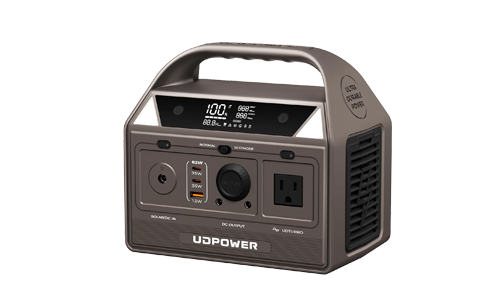
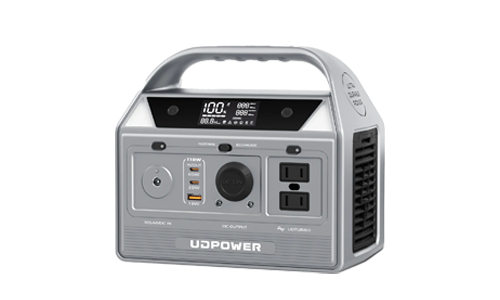
UDPOWER C600
Battery: 596Wh LiFePO4
AC output: 600W rated, 1,200W peak
Weight: 12.3 lb
Battery life: 4,000+ cycles
The C600 is the most portable choice in this group. It is suitable for a standard CPAP or BiPAP used with the humidifier off or set relatively low.
At a 40W average load, the estimated runtime is about 13.4 hours. At a 90W heated load, the estimate falls to about six hours.
View UDPOWER C600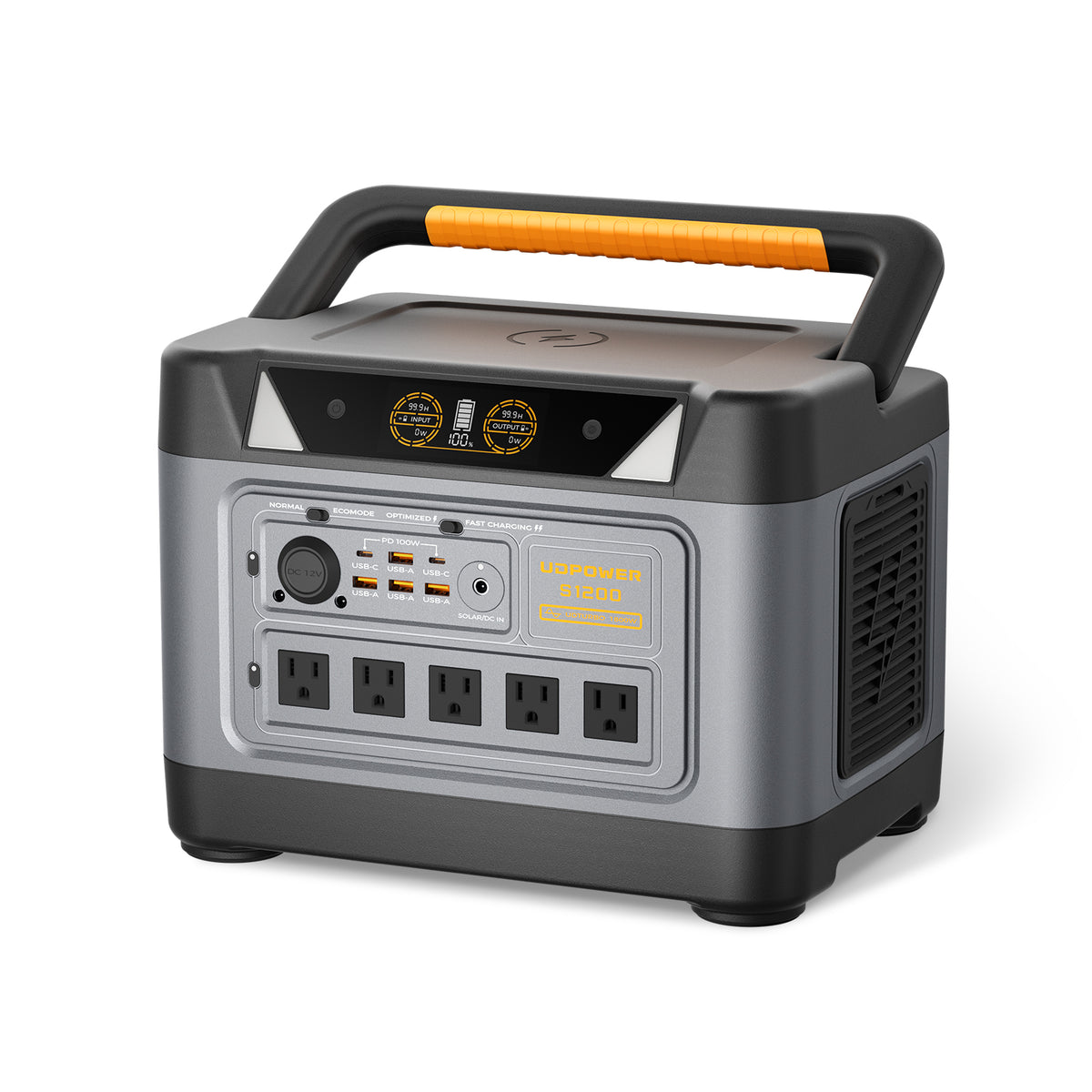
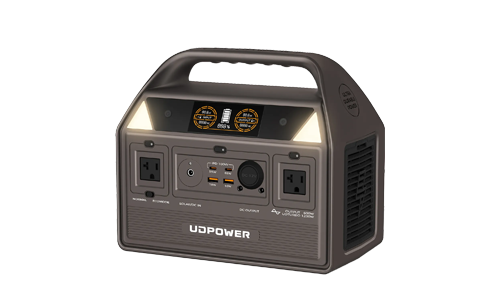
UDPOWER S1200
Battery: 1,190Wh LiFePO4
AC output: 1,200W rated, 1,800W surge
Weight: Approximately 26 lb
UPS transfer: Under 10ms
Battery life: 4,000+ cycles
The S1200 is the strongest overall choice for many home PAP backup plans. Its larger capacity provides more reserve for heated humidification, longer sleep periods, colder rooms, and conversion losses.
At a 60W load, the estimated runtime is about 17.9 hours. At 90W, it is about 11.9 hours.
View UDPOWER S1200
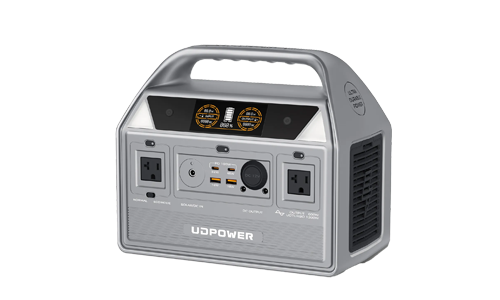
UDPOWER S2400
Battery: 2,083Wh LiFePO4
AC output: 2,400W rated, 3,000W surge
Weight: Approximately 40.8 lb
AC outlets: 6
UPS transfer: Under 10ms
Battery life: 4,000+ cycles
The S2400 is better suited to multi-night outages or situations where the same station must also power a router, lights, fan, phone, or other essential devices.
At a 60W PAP load, the estimated runtime is about 31.2 hours. At a 90W heated load, it is about 20.8 hours.
View UDPOWER S2400How to Build a Reliable CPAP or BiPAP Outage Setup
- Identify your exact machine. Record the model, adapter input and output, humidifier, heated tube, and any connected oxygen equipment.
- Measure real overnight wattage. Use a plug-in watt meter with your normal pressure, humidity, tube temperature, and mask.
- Calculate the required energy. Multiply average watts by operating hours and add a reserve for conversion losses and longer sleep.
- Use the original AC adapter or approved DC cable. A cable that physically fits may still have the wrong voltage or polarity.
- Test backup transfer before an emergency. Confirm whether the PAP continues running or restarts when wall power is disconnected.
- Complete an overnight test. Do not wait until a storm or camping trip to discover that the battery is too small.
- Keep the station ventilated. Do not cover its cooling vents with bedding or clothing.
- Recharge before severe weather. Fully charge the station and check all cables before the outage begins.
Frequently Asked Questions About CPAP vs BiPAP
Is BiPAP better than CPAP?
BiPAP is not universally better. CPAP or APAP is commonly preferred for routine obstructive sleep apnea. BiPAP may be more appropriate for people who cannot tolerate effective CPAP pressure or require additional breathing support.
Why would a doctor switch someone from CPAP to BiPAP?
A provider may recommend BiPAP when CPAP does not control breathing events adequately, when exhaling against treatment pressure remains difficult, or when the patient needs pressure support.
Can BiPAP be used for obstructive sleep apnea?
Yes. BiPAP can treat obstructive sleep apnea in selected patients, but it is not normally the first choice for uncomplicated OSA.
Is APAP the same as BiPAP?
No. APAP automatically changes CPAP pressure within a prescribed range. BiPAP delivers a higher pressure during inhalation and a lower pressure during exhalation.
Can CPAP and BiPAP use the same mask?
Many masks work with both types of machines, but compatibility depends on the mask, tubing, connector, pressure, and manufacturer instructions.
Does BiPAP use more power than CPAP?
It may use somewhat more power in certain settings, but there is no fixed difference. Heated humidification and heated tubing often have a larger effect on battery runtime.
Can a portable power station run a BiPAP machine?
Yes, provided the station offers compatible pure sine wave AC power or approved DC output and has enough battery capacity for the planned operating time.
What size battery is needed for one night?
A low-power setup without heat may need roughly 200–400Wh for eight hours. A heated setup may require 500–800Wh or more. Measure the exact machine before choosing a battery.
Should I turn off the humidifier to save battery?
Turning off or lowering heated humidification can significantly extend runtime. Test lower settings before an emergency so treatment remains comfortable enough to use.
Choose Backup Power Based on Your Real PAP Load
Start with the watts used by your exact CPAP or BiPAP, decide whether heated humidification must remain on, and choose enough battery capacity for the required hours plus a practical reserve.
Medical and Technical Sources
Related Articles


