
What is a Portable Power Station? A Beginner's Guide
A portable power station is a rechargeable battery system that provides AC, USB, and DC power during outages, camping trips, RV travel, and other off-grid situations. This beginner-friendly guide explains how portable power stations work, key specifications, runtime calculations, solar charging, safety, and how to choose the right model.
Last updated: June 17, 2026

What Is a Portable Power Station?
A portable power station is a rechargeable battery system with built-in outlets and charging ports. It stores electricity and later supplies it through AC outlets, USB ports, and 12-volt DC outputs.
Unlike a gas generator, it does not burn fuel or create electricity while operating. You charge it ahead of time from a wall outlet, vehicle outlet, compatible solar panel, or generator, then use the stored energy when grid power is unavailable.
The two numbers beginners need to understand are:
- Watts (W): determine which devices the power station can run at one time.
- Watt-hours (Wh): help determine how long those devices can run.
A good buying decision must also account for startup surge, charging speed, solar input limits, battery type, ports, weight, and your plan for recharging.
What a Portable Power Station Is—and What It Is Not
The simplest description is “a large rechargeable battery with household-style outlets.” Inside the case, however, several systems work together to store electricity, convert it into usable power, control charging, and protect the battery.
A portable power station is:
- A rechargeable source of stored electricity.
- A portable way to run phones, laptops, lights, routers, CPAP machines, fans, coolers, and compatible appliances.
- An indoor-friendly alternative for essential loads because it does not produce combustion exhaust.
- A power source that can usually be recharged from AC, a vehicle, or compatible solar panels.
- A practical backup system for selected devices rather than every electrical circuit in a home.
A portable power station is not:
- An unlimited energy source. Once its battery is empty, it must be recharged.
- A gas generator. A generator creates electricity from fuel; a power station releases electricity stored in its battery.
- A solar panel. Solar panels collect energy, while the power station stores and distributes it.
- Automatically a whole-home system. Most portable units provide 120-volt output and are intended for selected loads.
- Waterproof by default. Unless a manufacturer states otherwise, keep the unit protected from rain, standing water, and excessive moisture.
How Does a Portable Power Station Work?
Electricity enters the power station through a charging input, is stored in the battery, and is delivered to your devices through the appropriate output. Five main components make this possible.
-
1 Battery cells store the energy.
Capacity is listed in watt-hours. Many current portable power stations use lithium iron phosphate, commonly called LiFePO4 or LFP. -
2 The inverter creates household-style AC power.
Batteries store DC electricity. The inverter converts that DC electricity into the 120-volt AC electricity used by common U.S. appliances. -
3 The battery management system monitors operation.
The BMS monitors factors such as voltage, current, charging, discharging, and temperature to help protect the battery and connected equipment. -
4 The charge controller manages incoming energy.
It controls electricity entering from a wall charger, vehicle outlet, or solar panel. Solar-compatible models may use an MPPT controller to manage variable solar input. -
5 The output system powers connected devices.
AC outlets, USB-C, USB-A, 12-volt car outlets, DC barrel ports, and wireless charging each deliver power in different ways.
For a deeper look at the battery, inverter, charging path, and BMS, read How Does a Power Station Work?
Power Station vs. Power Bank, Generator, and UPS
| Device | What It Does | Best For | Main Limitation |
|---|---|---|---|
| Phone power bank | Stores a small amount of DC energy for USB devices | Phones, earbuds, tablets, and other small electronics | Usually lacks AC outlets and enough capacity for appliances |
| Portable power station | Stores electricity and supplies AC, USB, and DC power | Outages, camping, RV trips, CPAP, laptops, routers, and selected appliances | Runtime ends when the battery is depleted |
| Gas generator | Creates electricity by burning fuel | Long outages, heavy tools, pumps, and larger continuous loads | Exhaust, carbon monoxide risk, noise, fuel storage, and engine maintenance |
| Dedicated UPS | Provides immediate short-duration backup when grid power fails | Computers, network equipment, servers, and equipment that cannot reboot | Usually offers less runtime and less portable capacity |
| Solar generator kit | Combines a portable power station with one or more solar panels | Camping, RV use, and outages where daytime recharging is needed | Solar production changes with weather, shade, season, and panel position |
A portable power station is often the easiest choice for quiet indoor essentials. A fuel generator may be more suitable when high-wattage equipment must run for long periods and fuel is available.
See the detailed portable power station vs. generator comparison for power outages before choosing between the two.
Portable Power Station Specifications Explained
Product pages contain many numbers, but a beginner does not need to memorize all of them. Start with the specifications below.
| Specification | What It Means | Why It Matters | Common Mistake |
|---|---|---|---|
| Battery capacity in Wh | The amount of energy stored in the battery | Helps estimate runtime | Assuming every rated watt-hour reaches the appliance |
| Continuous output in W | The total power the inverter can supply continuously | Determines which devices can run at the same time | Looking only at battery capacity |
| Surge or peak output | Short-duration output for startup demand | Important for refrigerators, pumps, compressors, and some tools | Checking running watts but ignoring startup demand |
| Solar input voltage range | The acceptable voltage window for connected solar panels | Prevents an incompatible or unsafe panel configuration | Matching panel watts but not checking open-circuit voltage |
| Maximum charging input | The highest charging power the station can accept | Limits real charging speed even if the panel or charger is larger | Assuming a larger panel always charges proportionally faster |
| Battery chemistry | The cell type used inside the station | Affects cycle life, weight, durability, and operating characteristics | Comparing price without comparing battery type |
| UPS or transfer time | How quickly supported models switch to battery power | Important for devices that may reboot during an interruption | Assuming every power station functions as a UPS |
| Port type and output | The connector and power available at each port | Determines device compatibility and charging speed | Counting ports without checking their individual watt ratings |
Watts and watt-hours are not interchangeable
A 1,200W output rating does not mean the battery stores 1,200Wh. One number describes power delivery; the other describes stored energy.
- A 1,200W inverter may be able to run a device drawing 1,000W.
- A 1,190Wh battery helps estimate how long the connected load can run.
A station can have a large battery but a relatively low output limit, or a powerful inverter paired with a smaller battery. Both numbers must fit your use case.
The Three Power Budgets Every Buyer Should Calculate
Most buying guides focus on one number. A more reliable method is to calculate three separate budgets.
1. Output budget: Can it run the devices?
Add the running wattage of every device you may use at the same time. The total must remain below the station’s continuous output rating.
Example: a 60W laptop, 20W internet setup, 35W fan, and 15W light create a combined running load of 130W.
2. Energy budget: How long must they run?
Multiply each device’s wattage by the number of hours it will operate. Add the results to estimate the watt-hours your plan requires.
Example: a 20W router and modem operating for 10 hours require about 200Wh before conversion losses.
3. Recharge budget: How will you refill the battery?
Decide whether you will recharge from a wall outlet, vehicle, solar panels, or an outdoor generator. A large battery without a realistic recharge method may still fail during a long outage.
How to Calculate Portable Power Station Runtime
The 90% factor is a practical planning estimate for UDPOWER units. Actual results can change with AC or DC output, device efficiency, temperature, battery condition, standby consumption, cycling appliances, and the load level.
Example: a 60W laptop on a 596Wh station
596Wh × 0.90 ÷ 60W = approximately 8.9 hours.
This does not guarantee 8.9 hours of active laptop use. The laptop may change its power draw depending on screen brightness, battery charging state, processor workload, and connected accessories.
Estimated runtime by UDPOWER model
| Example Load | Planning Wattage | C400 256Wh |
C600 596Wh |
S1200 1,190Wh |
S2400 2,083Wh |
How to Verify |
|---|---|---|---|---|---|---|
| Router and modem | 20W | 11.5 hours | 26.8 hours | 53.5 hours | 93.7 hours | Check both power adapters and add their wattage |
| CPAP without heated humidifier | 40W | 5.8 hours | 13.4 hours | 26.8 hours | 46.9 hours | Use the CPAP label, manufacturer data, or a watt meter |
| Laptop during light use | 60W | 3.8 hours | 8.9 hours | 17.9 hours | 31.2 hours | Check the charger rating and measure actual use |
| Portable fan | 35W | 6.6 hours | 15.3 hours | 30.6 hours | 53.6 hours | Measure at the speed setting you normally use |
| Refrigerator equivalent average | 80W | 2.9 hours | 6.7 hours | 13.4 hours | 23.4 hours | Measure energy over several hours because a refrigerator cycles. Energy.gov measurement guidance |
These figures are planning estimates, not guaranteed runtimes. Use the UDPOWER portable power station runtime calculator with the wattage of your own equipment.
Why refrigerator runtime is harder to predict
A refrigerator does not usually draw its full rated wattage every minute. Its compressor turns on and off, and startup may briefly require much more power than normal operation.
Room temperature, thermostat setting, door openings, insulation, food load, and compressor condition all affect energy use. For the best estimate, connect the refrigerator to a watt meter for several hours and record both startup behavior and total energy consumption.
What Can a Portable Power Station Run?
A portable power station can run a device when all three conditions are met:
- The device’s running wattage is below the station’s continuous output.
- Any startup surge is within the station’s supported limit.
- The battery contains enough usable energy for the desired runtime.
| Device Category | Usually a Good Match? | What to Check | Planning Advice |
|---|---|---|---|
| Phones, tablets, cameras | Yes | USB type and charging wattage | Use USB or USB-C directly when possible |
| Laptops and monitors | Yes | Combined wattage and USB-C PD requirements | Heavy gaming or rendering increases consumption |
| Wi-Fi router and modem | Yes | Total draw of every network device | Test low-load auto-shutoff behavior before an outage |
| LED lights | Yes | Total bulb wattage | LED lighting provides long runtime for relatively little energy |
| CPAP | Often | Pressure setting, heated hose, humidifier, and AC or DC use | Test a complete overnight setup before relying on it |
| Portable refrigerator or cooler | Often | Running watts, startup surge, and daily energy consumption | A direct 12V connection may reduce conversion loss when supported |
| Household refrigerator | Model dependent | Startup surge and compressor cycling | Measure the actual appliance rather than relying only on the nameplate |
| Microwave or coffee maker | Only on higher-output models | Actual input wattage, not cooking wattage alone | Short operating periods may be practical even though the load is high |
| Hair dryer, kettle, or space heater | Usually inefficient for battery backup | High continuous wattage | Even when output is sufficient, the battery may drain quickly |
| Central air conditioner, electric dryer, or electric range | Usually no | 240V requirement and very high startup or continuous demand | These generally require a larger installed backup system |
How Do You Recharge a Portable Power Station?
Most modern stations support more than one charging method. Charging speed depends on battery capacity, maximum input power, the charger or panel, and environmental conditions.
| Charging Method | Best Use | Main Advantage | Main Limitation |
|---|---|---|---|
| AC wall outlet | Home charging before a trip or storm | Fast and predictable | Requires grid power or an outdoor generator |
| 12V vehicle outlet | Road trips and gradual charging while driving | Convenient during travel | Usually slower than wall charging |
| Portable solar panel | Camping, RV use, and extended outages | Can replenish energy without fuel | Output changes with sunlight, angle, temperature, and shade |
| Fuel generator through AC charging | Hybrid backup during long outages | Can recharge the battery in scheduled outdoor charging windows | The generator must be operated safely outdoors |
| Dual-input charging on supported models | Faster charging when the model permits two compatible inputs | Can shorten recharge time | Only use combinations specifically supported by the manufacturer |
Recharge time should be considered together with battery size. A 2,000Wh-class battery stores more energy than a 500Wh battery, but it also needs substantially more incoming energy to refill.
How Does Solar Charging Work?
A “solar generator” is normally a portable power station paired with one or more solar panels. The panel produces electricity in sunlight, and the station stores that electricity for later use.
Solar compatibility is not determined by connector shape alone. You must check:
- Panel open-circuit voltage, commonly shown as Voc.
- Panel operating voltage and current.
- The power station’s accepted input voltage and current.
- The station’s maximum solar input wattage.
- Connector type and cable polarity.
- Whether panels are connected in series or parallel.
Current UDPOWER solar input limits
| Model | Solar Input Range | Maximum Solar Input | Planning Note | Official Source |
|---|---|---|---|---|
| UDPOWER C400 | 11–28V | Up to 150W | A 100W–120W portable panel is a simple starting point | C400 specifications |
| UDPOWER C600 | 11–28V | Up to approximately 240W | Verify voltage before combining multiple panels | C600 specifications |
| UDPOWER S1200 | 12–75V, 12A | 400W maximum | The wider voltage range offers flexibility, but the maximum voltage remains a hard limit | S1200 specifications |
| UDPOWER S2400 | 12–50V, 10A | Up to 400W | Check combined panel Voc carefully before making a series connection | S2400 specifications |
A panel rarely produces its full nameplate rating all day. Shade on even part of a portable panel, poor angle, cloud cover, high panel temperature, dirty surfaces, cable loss, and the station’s input limit can reduce charging power.
Use the station’s live input display while adjusting the panel. Position the entire panel in direct sunlight and change its angle until the displayed wattage is as high as conditions allow.
For regional solar estimates, use the NREL PVWatts Calculator. You can also browse current UDPOWER solar panels and solar generator kits.
Portable Power Station Ports Explained
| Port | Common Uses | What to Check |
|---|---|---|
| 120V AC outlet | Household plugs, laptop chargers, lamps, CPAP adapters, appliances | Total continuous output and startup surge |
| USB-C Power Delivery | Modern laptops, tablets, phones, cameras, handheld devices | Port wattage such as 35W, 65W, or 100W |
| USB-A | Phones, lights, small accessories, older cables | Standard versus fast-charging output |
| 12V car outlet | Portable refrigerators, air pumps, travel accessories | Voltage, maximum current, and combined DC limit |
| DC barrel output | Routers, cameras, radios, and compatible 12V equipment | Connector size, voltage, polarity, and current |
| Wireless charging pad | Compatible phones and earbuds | DC output may need to be switched on first |
| Solar or DC input | Solar panels and vehicle charging cables | Input voltage range, current limit, polarity, and connector type |
More ports do not automatically make a station better. A buyer who mainly charges laptops may value a 100W USB-C port more than several basic USB-A ports. Someone running a refrigerator and several household devices may care more about AC outlet count and inverter output.
How to Choose the Right Portable Power Station Size
-
1 List only the devices that truly matter.
Start with communication, lighting, refrigeration, medical comfort, work equipment, or essential camping gear. -
2 Record each device’s wattage.
Check its label or manual. When only volts and amps are listed, estimate watts by multiplying volts by amps. -
3 Calculate the highest simultaneous load.
Add devices that may run at the same time and leave reasonable output headroom. -
4 Calculate required energy.
Multiply watts by operating hours for each device, add the totals, and account for conversion loss. -
5 Check startup surge.
Refrigerators, compressors, pumps, and some tools may draw much more power for a brief moment when starting. -
6 Choose a recharge plan.
Decide whether AC charging alone is sufficient or whether vehicle and solar charging are necessary. -
7 Consider weight and portability.
A larger station is useful only if you can move and store it where it is needed. -
8 Test the final setup.
Run the real devices before a storm, trip, or medical need makes the test urgent.
Three realistic sizing examples
| Scenario | Example Energy Plan | Approximate Device Energy | Battery Needed at 90% Efficiency | Practical UDPOWER Starting Point |
|---|---|---|---|---|
| Day trip and mobile work | Phone charging, camera batteries, LED light, and short laptop use | About 130Wh | About 145Wh | C400 provides useful margin and stronger output than the minimum calculation |
| Basic overnight CPAP setup | 40W CPAP for 8 hours, small light, and phone charging | About 380Wh | About 422Wh | C600 for a tested no-heat setup; S1200 for more margin or additional loads |
| Home outage essentials | Router, refrigerator cycling, several hours of lighting, phones, and limited laptop use | About 1,150Wh | About 1,280Wh | S2400 offers more capacity and output margin for a mixed essential-load plan |
These examples are not universal packages. They demonstrate why a device list and runtime plan are more useful than buying only by a label such as “500W,” “1000W,” or “2000W.”
Recommended UDPOWER Portable Power Stations for Beginners
The best model depends on whether your priority is portability, overnight runtime, home outage essentials, or higher-wattage appliances. The specifications below are taken from current official UDPOWER product pages.

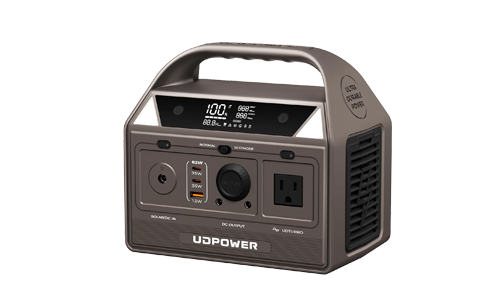
UDPOWER C400: Best for Lightweight Trips and Compact Backup
The C400 is designed for people who prioritize low weight and simple power needs. It is suitable for phones, laptops, lights, cameras, routers, many CPAP setups, portable coolers within its limits, and roadside emergency use.
- Capacity: 256Wh
- Rated output: 400W pure sine wave
- Surge support: Up to 800W
- Battery: LiFePO4
- Weight: Approximately 6.88 lbs
- Solar input: Up to 150W
- Special use: Integrated 12V vehicle jump-start capability with the proper cable
Choose it when: portability matters more than long appliance runtime.
Do not choose it for: space heaters, hair dryers, large microwaves, or long refrigerator backup.
View the UDPOWER C400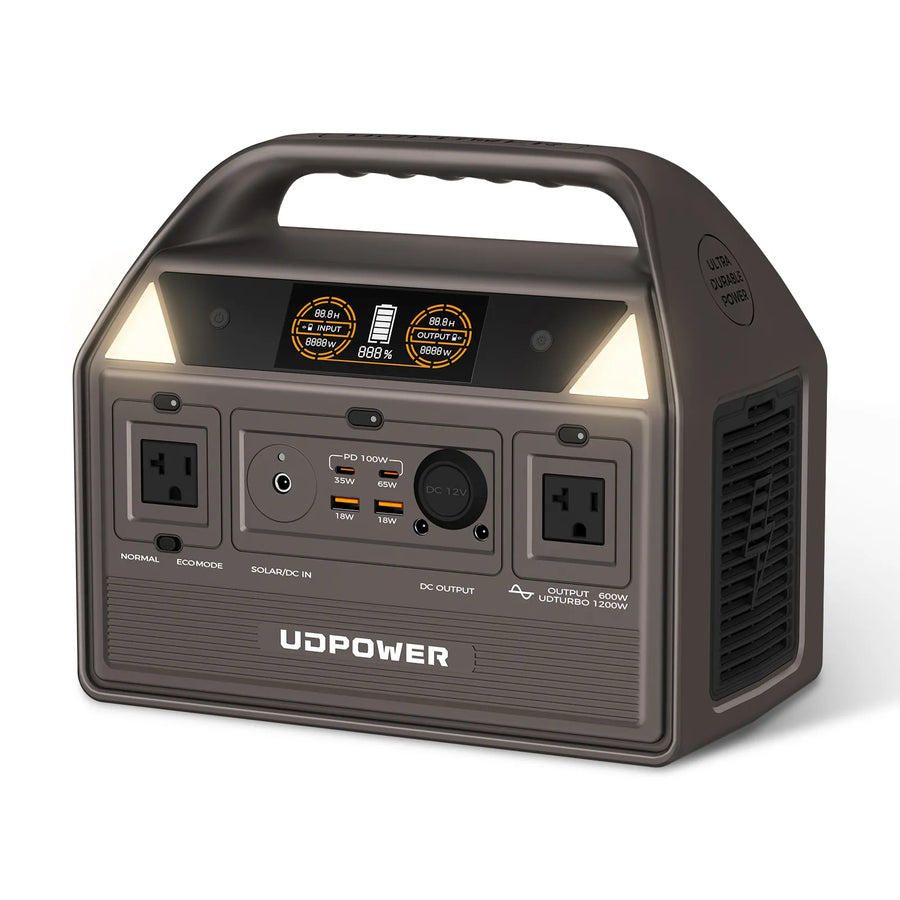
UDPOWER C600: Best Balance for Weekend Camping
The C600 adds substantially more battery capacity while remaining easy to transport. It is a practical option for weekend campsites, laptops, cameras, lighting, routers, portable refrigerators, projectors, and tested overnight equipment.
- Capacity: 596Wh
- Rated output: 600W pure sine wave
- Surge support: Up to 1,200W
- Battery: LiFePO4
- Weight: Approximately 12.3 lbs
- Solar input: 11–28V, up to approximately 240W
- AC outlets: Two
Choose it when: you want more than a day-trip battery but still need one-person portability.
Important: the C600 is not listed as a UPS model. Do not assume it will provide uninterrupted transfer for sensitive equipment.
View the UDPOWER C600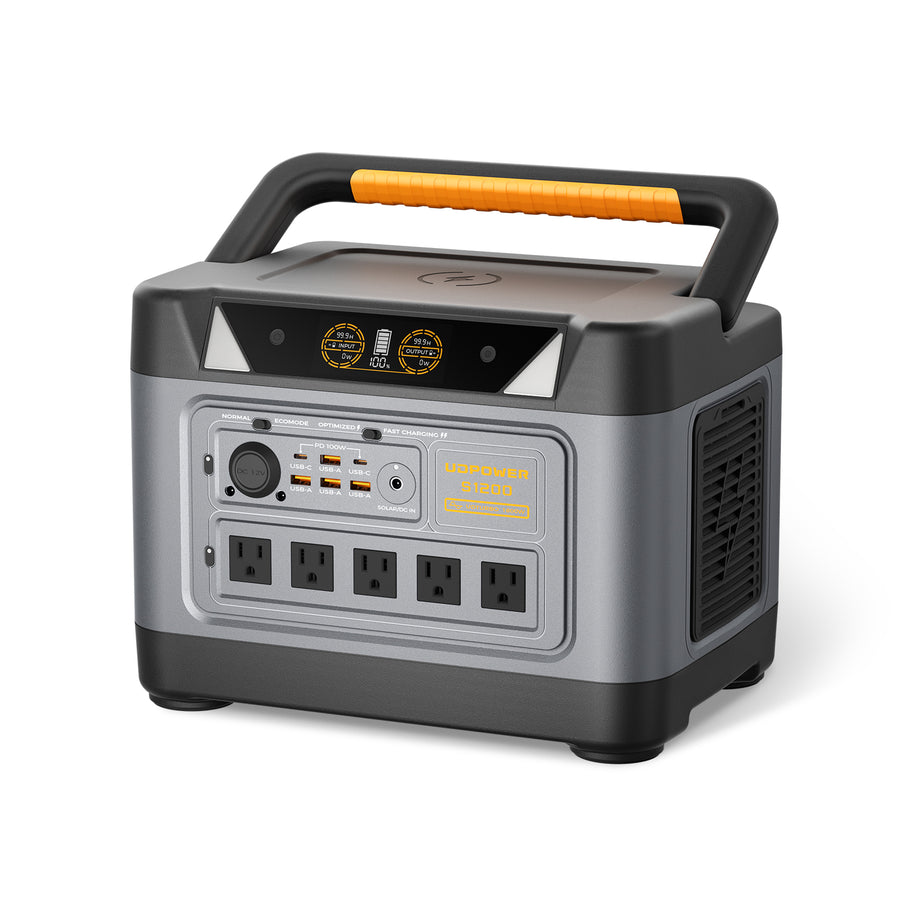
UDPOWER S1200: Best Starting Point for Home Essentials
The S1200 is a stronger match for users who want meaningful outage runtime without moving into the largest portable category. Its output and battery capacity are suited to internet equipment, lighting, laptops, many refrigerators, CPAP setups, TVs, and several devices operating together.
- Capacity: 1,190Wh
- Rated output: 1,200W pure sine wave
- Surge support: Up to 1,800W
- Battery: LiFePO4
- Weight: Approximately 26.0 lbs
- Solar input: 12–75V, 12A, 400W maximum
- UPS transfer: Less than 10 milliseconds on the supported model
- Outputs: Five AC outlets plus USB, DC, car outlet, and wireless charging outputs
Choose it when: you need overnight backup, refrigerator support, medical comfort equipment, or a more serious camping and RV setup.
Watch the limit: 1,200W continuous output still makes high-wattage heating appliances impractical or incompatible.
View the UDPOWER S1200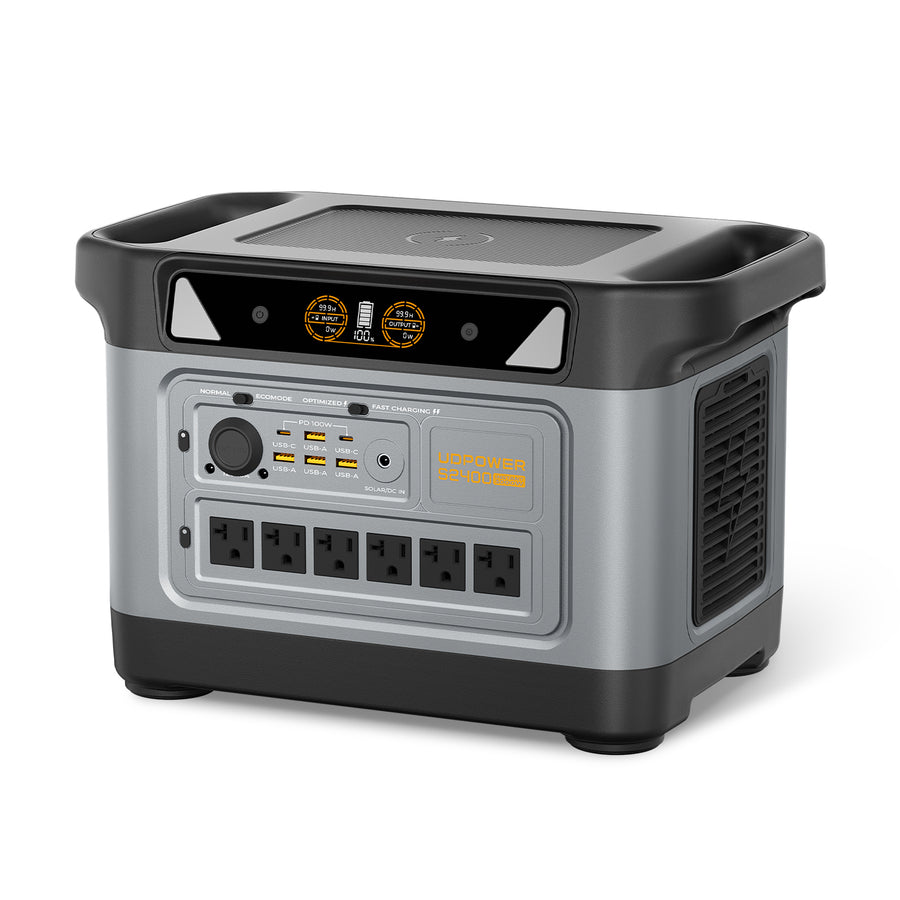
UDPOWER S2400: Best for Higher-Wattage and Longer Backup Plans
The S2400 provides substantially more output and stored energy for users who need to combine refrigerator backup, internet equipment, lighting, laptops, CPAP, TVs, kitchen appliances used in short intervals, or larger RV loads.
- Capacity: 2,083Wh
- Rated output: 2,400W pure sine wave
- Surge support: Up to 3,000W
- Battery: LiFePO4
- Weight: Approximately 40.8 lbs
- Solar input: Up to 400W
- UPS transfer: 10 milliseconds or less on the supported model
- Outputs: Six AC outlets plus USB, DC, car outlet, and wireless charging outputs
Choose it when: output headroom and longer mixed-device runtime matter more than one-hand portability.
Remember: it is still a portable 120V backup system, not an automatic replacement for a professionally installed whole-home system.
View the UDPOWER S2400What to Do When Your Portable Power Station Arrives
Do not leave a new backup battery in its box until the next outage. A short test reveals compatibility problems while there is still time to solve them.
-
1 Inspect the station and accessories.
Check for shipping damage and confirm that the expected charging cables are included. -
2 Read the charging and temperature guidance.
Confirm the correct input, cable, storage range, and operating environment for your model. -
3 Charge the station fully.
Use the approved wall charging method and keep the ventilation openings clear. -
4 Test low-watt essentials.
Connect the router, modem, lights, phones, and laptop. Record the total displayed output. -
5 Test motor-driven appliances separately.
Watch for overload warnings when a refrigerator, cooler, pump, or compressor starts. -
6 Run an overnight test for CPAP or medical comfort equipment.
Use the exact hose, humidifier, adapter, pressure setting, and accessories planned for an outage. -
7 Test the recharge method.
Confirm wall, car, and solar charging before depending on them away from home. -
8 Write down a priority list.
Decide in advance which devices receive power first when battery capacity is limited.
Portable Power Station Safety and Battery Care
Portable power stations do not produce gasoline-engine exhaust, but they still contain a high-energy battery and power electronics. Use them carefully.
- Keep the unit dry and away from standing water.
- Do not cover cooling vents or place the station in an enclosed cabinet while charging or under load.
- Do not exceed the listed continuous output, surge support, or input voltage.
- Use the supplied charger or an accessory confirmed as compatible.
- Do not use damaged cables, loose connectors, or visibly damaged solar panels.
- Allow the unit to reach an acceptable temperature before charging after extreme heat or cold.
- Keep it away from open flames, heaters, and hot vehicle interiors.
- Do not disassemble, puncture, crush, or modify the battery enclosure.
- Follow the manufacturer’s storage instructions and check the battery periodically.
- Stop using the unit if it develops unusual swelling, severe overheating, smoke, or a strong abnormal odor.
Portable power pack safety testing may include standards such as UL 2743. Learn more from UL Solutions’ portable power pack testing overview.
Can a portable power station be used indoors?
Yes, a battery power station can generally be used indoors because it does not burn fuel or produce engine exhaust. It still needs a dry location, clear ventilation openings, adequate space for cooling, and operation within the manufacturer’s temperature limits.
This is different from a gasoline, propane, or dual-fuel generator, which must be operated outdoors in accordance with generator safety instructions.
Common Portable Power Station Mistakes
Buying by watts alone
Output watts determine what can run, but battery watt-hours determine runtime. A powerful inverter paired with a small battery may run a large appliance briefly and then deplete quickly.
Buying by capacity alone
A large battery is not useful when the inverter cannot start or continuously power the intended appliance.
Ignoring combined load
The output limit applies to the total load, not each AC outlet separately. Several individually compatible appliances may overload the station when used together.
Ignoring startup surge
Refrigerators, pumps, compressors, and tools may require a brief startup burst that is much higher than normal running wattage.
Expecting full rated capacity at the AC outlet
The inverter, internal electronics, cooling system, and connected equipment consume some energy. Runtime calculations should include a realistic efficiency factor.
Assuming every solar panel is compatible
Connector fit does not prove electrical compatibility. Always check open-circuit voltage, current, polarity, and the station’s permitted input range.
Planning to run electric heat for hours
Space heaters, kettles, hot plates, and hair dryers turn battery energy into heat at a very high rate. They can drain even a large station quickly.
Never testing the setup
A storm warning is not the right time to discover that a refrigerator overloads the inverter, a CPAP adapter is missing, or a solar cable does not fit.
Confusing a power station with whole-home backup
Most portable units are designed for selected plug-in devices. Never attempt to energize home wiring by plugging a power station into a wall outlet. Home circuit backup requires approved equipment and proper installation.
Frequently Asked Questions
1. What is the main purpose of a portable power station?
Its main purpose is to store electricity and provide portable AC, USB, or DC power when a wall outlet is unavailable. Common uses include outages, camping, RV trips, remote work, photography, CPAP backup, and emergency communication.
2. Is a portable power station the same as a solar generator?
The power station is the battery and inverter system. It is commonly marketed as a solar generator when bundled with or charged by solar panels.
3. Can a portable power station run a refrigerator?
Many medium and large models can, but the station must support the refrigerator’s startup surge and normal running load. Runtime depends on battery capacity and how frequently the compressor operates.
4. Can I use a portable power station indoors?
Yes. Battery power stations do not produce combustion exhaust. Keep the unit dry, leave cooling vents unobstructed, and follow the product’s operating and charging instructions.
5. How long will a portable power station last on one charge?
Divide usable battery energy by the total connected wattage. For UDPOWER planning, use capacity × 90% ÷ load watts. Cycling appliances and changing loads require actual measurement for a better estimate.
6. What size portable power station do I need for an outage?
List your essential devices, calculate their simultaneous wattage, estimate required runtime, check startup surge, and decide how the battery will be recharged. Many basic communication plans fit a smaller station, while refrigerator and overnight backup usually require more capacity.
7. Can a portable power station run a space heater?
A sufficiently powerful model may run some heaters within its output limit, but electric resistance heat drains batteries very quickly. Portable power stations are usually better reserved for communication, lighting, refrigeration, fans, and essential electronics.
8. Can I charge and use a portable power station at the same time?
Some models support pass-through operation, but capabilities vary. Check the product manual, avoid exceeding input or output limits, and remember that high simultaneous charging and discharging can create more heat.
9. Does a higher-watt solar panel always charge faster?
No. Charging is limited by sunlight, panel voltage and current, cable loss, temperature, and the station’s maximum solar input. A larger panel cannot force the station to accept more than its input limit.
10. Can I use a third-party solar panel?
Possibly, but the panel’s open-circuit voltage, current, connector, polarity, and wiring configuration must match the power station’s input requirements. Do not connect a panel based only on its advertised wattage.
11. Is LiFePO4 better for a portable power station?
LiFePO4 batteries are widely used in current portable power stations because they offer long cycle life and strong thermal stability. The complete product design, BMS, inverter, cooling, warranty, and charging system still matter.
12. Can I take a portable power station on an airplane?
Most portable power stations exceed ordinary airline battery limits and cannot be carried onto a passenger aircraft. Check the exact watt-hour rating and current airline and transportation rules before travel.
13. Can a portable power station power an entire house?
Most portable units are intended for selected 120V devices rather than an entire house. Whole-home loads, central HVAC, electric water heating, dryers, and ranges generally require a larger installed system and proper electrical integration.
14. What is the easiest way to avoid buying the wrong size?
Measure the devices you already own. Record running watts, startup behavior, and the hours you need them. Then compare those numbers with the station’s continuous output, surge support, usable capacity, and recharge rate.
Sources and Measurement Guidance
- U.S. Department of Energy: Estimating Appliance and Home Electronic Energy Use
- Silicon Valley Power: Appliance Energy Use Chart
- National Renewable Energy Laboratory: PVWatts Calculator
- UL Solutions: Portable Power Pack Testing
- Google Search Central: Optimizing for Generative AI Features
- UDPOWER official model and solar kit comparison
Appliance wattages and runtimes in this guide are planning examples. For the most accurate result, use the label or manual for your exact device and verify actual consumption with a compatible electricity usage monitor.
Choose a Portable Power Station with Real Numbers
Start with the devices you need to run, calculate their combined wattage and runtime, then compare models with enough output, battery capacity, and charging capability.
Compare UDPOWER Models View Portable Power Stations Calculate Your Estimated RuntimeRelated Articles


2 comments
Well…a power station of 4,000kWh will power your:
- 3.5ton AC unit for 1hr pure running time (the actual usage time depends on your duty cycle dictated by how your house is insulated, how hot the weather is and what temperature you set)
- Your fridge for 40hrs pure time
- Your furnace blower for 6hrs pure time (see about A/C)
- Electric heater – yes it will, but again, if it is baseboard in the whole house, this will be 30 minutes pure time. A spaceheater of 1.5kW – about 3 hrs. Again, see above about the A/C.
Whe using these appliances with the station, set the temperature to minimally acceptable. It is a survival mode, not usual life.
Can indoor powerstation run a electric heater ?