Are Solar Panels Worth It for Camping?
Solar panels can transform camping by providing clean, quiet, and reliable power for everything from phones to fridges. This article explains how portable solar works, its key benefits and limitations, real-life use cases, and practical sizing tips. It also highlights the UDPOWER S1200 portable power station—an ideal solar-ready choice for campers seeking true off-grid independence.
A field-tested, data-backed look at portable solar for campers—how it works, where it shines, where it struggles, and how to size a practical setup. Includes a solar-ready UDPOWER S1200 product recommendation.
Camping used to mean going fully off-grid—but many of us now rely on phones for maps, cameras for memories, a cooler or mini-fridge for food safety, and sometimes medical gear like a CPAP. After several seasons comparing power banks, gas generators, and portable solar kits, my verdict is simple: solar is worth it for a lot of campers, provided you size it realistically and understand the trade-offs.

Why Campers Consider Solar
- Reliability away from hookups: Keep phones, lights, fans, and fridges running miles from the nearest outlet.
- Silence & clean air: No engine noise or fumes versus gas generators.
- True independence: Harvest energy as you camp—perfect for boondocking.
- Lower long-term cost: One purchase can serve seasons of trips with minimal upkeep.
Personal note: on a week in the Utah desert, our group ran a 12V fridge, lights, phones, and a laptop—all on solar. We never touched campground power.
How Camping Solar Works
Portable panels convert sunlight into electricity, which a charge controller feeds into a battery—usually inside an all-in-one portable power station (AC/DC output, inverter, BMS, display). You then plug your gear into the power station.
Panel Types
- Foldable — Light, compact, easy to aim at the sun. Ideal for car campers.
- Rigid — Heavier but durable and efficient; good for fixed roof racks.
Connections
- Panel → Power Station via MC4/XT60/DC5521 (check compatibility).
- Power Station → Devices via AC outlets, USB-A/C, 12V car port, etc.
Benefits of Solar for Camping
Quiet & Eco-Friendly
No roaring engine—just crickets. Great for leave-no-trace trips.
Scalable
Start with 100W and a mid-size power station; add panels as needs grow.
Cost-Effective Over Time
After the upfront cost, sunlight is free. Minimal maintenance needed.
Limitations & What to Watch
- Weather dependence: Cloud/shade cuts output to 10–30% of panel rating.
- Slower than wall charging: Solar is steady trickle, not a blast fill.
- Bulk vs. power: Larger arrays = more to pack and position.
- Input limits: Your power station caps solar intake—check its max input spec.
When Solar Panels Are Worth It
Absolutely Worth It If…
- Trips run 3–4+ days off-grid.
- You camp in sunny regions or open sites.
- You need to run a fridge/CPAP or multiple devices daily.
- You value silence and low maintenance.
Maybe Not Worth It If…
- It’s a short, 1–2 night weekend with minimal loads.
- You’re under dense canopy or frequent rain.
- A small power bank already covers your needs.
How to Choose & Size a Camping Solar Setup
-
List your devices & hours. Example daily loads:
- 12V compressor cooler: 60 W × 8 h = 480 Wh
- LED lights: 10 W × 4 h = 40 Wh
- CPAP (no humidifier): 40 W × 8 h = 320 Wh
- Phones (2×): ~20 Wh total
- Right-size the battery (Wh). As a rule of thumb, usable energy ≈ capacity × 0.85 (to account for inverter/other losses).
- Pick panel wattage. Daily harvest ≈ panel W × peak-sun-hours × 0.75 (system efficiency).
- Check your station’s max solar input (don’t over-panel beyond what it accepts).
Example: What solar wattage supports a ~860 Wh/day camp?
Assume 5 peak sun hours (typical summer in many U.S. locations) and ~75% system efficiency.
| Panel Array | Daily Solar (Wh) | Net vs. 860 Wh/day |
|---|---|---|
| 100 W | 100×5×0.75 = 375 Wh | −485 Wh (deficit) |
| 200 W | 200×5×0.75 = 750 Wh | −110 Wh (slight deficit) |
| 300 W | 300×5×0.75 = 1125 Wh | +265 Wh (surplus) |
Takeaway: Around 300 W of solar keeps this itinerary comfortably net-zero in good sun.
Real-Life Use Cases
- Weekend, light loads: A 100 W panel + ~500–600 Wh station kept phones, lights, and a fan covered. No generator needed.
- Week-long boondock: 200–300 W solar + ~1200 Wh station ran a 12V fridge, lights, and daily device charging.
- CPAP overnight: With a ~1200 Wh station, a 40 W CPAP ran ~25.3 hours total usable (1190 Wh × 0.85 ≈ 1011.5 Wh; 1011.5÷40 ≈ 25.3 h).
UDPOWER S1200: Solar-Ready Camping Powerhouse
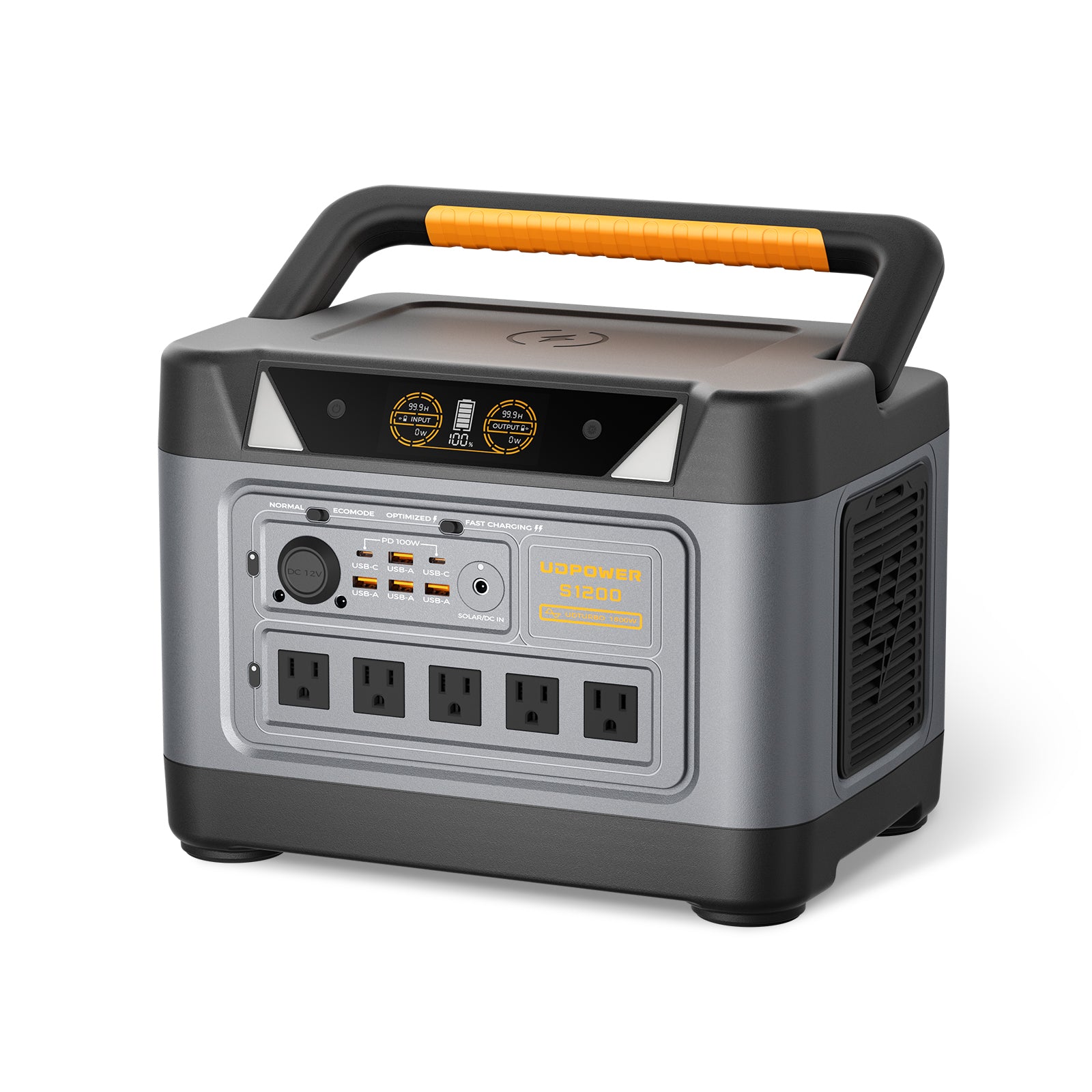
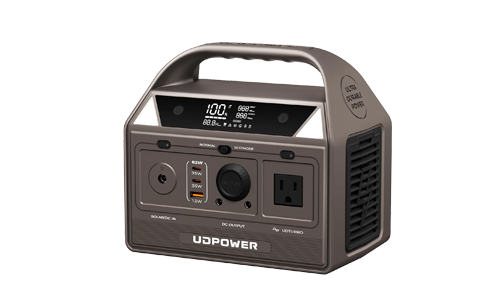
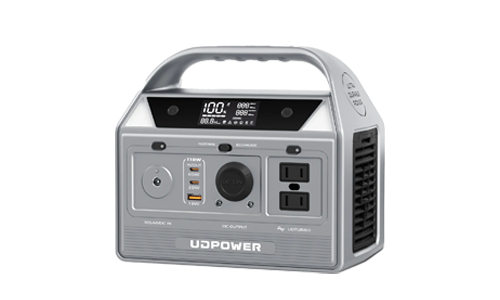
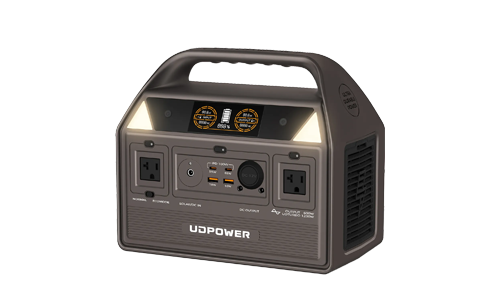
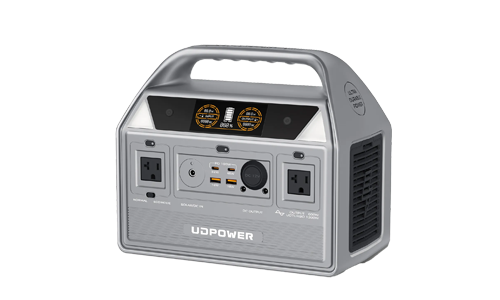
UDPOWER S1200 Portable Power Station (≈1190 Wh)
Balanced capacity for multi-day trips, whisper-quiet operation, and solar-ready inputs—built for serious camping and off-grid needs.
Main Features
- 1200 W rated, 1800 W surge for appliances.
- 1190 Wh LiFePO4 capacity (≈1010 Wh usable).
- 5× AC outlets, 4× USB-A, 2× USB-C, 2× DC5521, car port, wireless charger.
- <10 ms UPS switchover, <25 dB ultra-quiet.
- ~26 lbs, compact and lighter than many in its class.
Estimated Runtime (One Full Charge)
| Device | Power Draw | Runtime |
|---|---|---|
| 12V cooler | 60 W | ~16.9 h |
| CPAP (no humidifier) | 40 W | ~25.3 h |
| Camp fan | 20 W | ~50.6 h |
| LED lights | 10 W | ~101 h |
Solar Recharging Estimates
Assumes 5 peak-sun-hours/day, 75% efficiency.
| Panel Array | Daily Harvest | Full Charge (≈1190 Wh) |
|---|---|---|
| 100 W | ~375 Wh | ~3.2 days |
| 200 W | ~750 Wh | ~1.6 days |
| 300 W | ~1125 Wh | ~1.1 days |
FAQs
How many panels do I really need?
Match panel watts to your daily energy use and local sun. Many campers start at 100–200 W; heavy users (fridge/CPAP) often benefit from ~300 W.
Can solar keep a fridge running?
Yes—pair a mid/large station (e.g., ~1200 Wh) with enough panel wattage to replace daily use. A 60 W average fridge uses ~480 Wh/day; 300 W of solar in good sun typically covers that.
Do panels work in clouds?
They do, but expect ~10–30% of rated output in heavy overcast. Plan a margin or bring a backup charge source.
Solar generator vs. gas generator?
Solar is silent, clean, and maintenance-light. Gas is weather-agnostic and fast to refill. Some campers carry both.
How long do camping panels last?
Quality panels can last a decade or more if handled and stored properly.
Methodology & Assumptions
- Energy math: Runtime (h) ≈ usable Wh ÷ device W, where usable Wh ≈ capacity × 0.85 to reflect real-world conversion losses.
- Solar math: Daily harvest (Wh) ≈ panel W × peak-sun-hours × 0.75 (array, controller, and angle losses).
- Examples are based on practical field use over multiple seasons; your results vary with weather, shading, and device duty cycles.
Tip: Keep a simple log of your daily watt-hours used and harvested—two trips of data will dial your setup in perfectly.
Related Articles