

Best Affordable Portable Power Stations in 2026
Last updated: November 24, 2026
Direct answer: For most U.S. households, the best affordable portable power station in 2026 is a 1,000Wh–1,200Wh LiFePO4 model with at least 1,200W of rated AC output, such as the UDPOWER S1200 (1,190Wh / 1,200W). At 90% conversion efficiency, 1,190Wh delivers about 10.7 hours at a constant 100W AC load before inverter idle draw—enough for an 8-hour remote-work outage or half a day of refrigerator backup without paying for a 2,000Wh+ system. Choose a 200Wh–600Wh budget model only when your load stays under 400W–600W and easy carrying for camping or travel CPAP outweighs overnight appliance runtime.
Buying the lowest-priced power station on a product page often costs more over time. Undersized inverters trip on kitchen appliances, small batteries run dry halfway through overnight outages, and older lithium-ion cells degrade years faster than LiFePO4 packs. This 2026 portable power station buying guide breaks down the three numbers that determine real value: watt-hour per dollar, continuous AC wattage, and lifetime cost per charge cycle.

How to Measure Value: Watt-Hour per Dollar and LiFePO4 Cycle Life
Sticker price alone hides two major expenses: how many watt-hours you get per dollar today, and how many full charge cycles the battery lasts before losing usable capacity. Comparing both upfront cost per watt-hour ($/Wh) and cost per cycle ($/cycle) separates the best value LiFePO4 portable power stations from short-lived budget electronics.
Value Formulas
Upfront Cost per Wh = Purchase Price ($) ÷ Rated Capacity (Wh)
Cost per Cycle = Purchase Price ($) ÷ Rated Cycles to 80% Capacity
Battery chemistry is the single biggest driver of long-term affordability. Older nickel-manganese-cobalt (NCM) portable power stations are commonly rated around 500 full cycles to 80% remaining capacity. Modern lithium iron phosphate (LiFePO4) stations with long cycle life—including UDPOWER models—carry benchmarks of 80% remaining capacity after 3,000 cycles and 70% after 4,000 cycles. Even when a LiFePO4 unit costs $50 more upfront, its cost per cycle drops by 80%.
| Battery Type | Price | Cycles | Cost/Cycle |
|---|---|---|---|
| 500Wh NCM | $250 | 500 | $0.50 |
| 500Wh LiFePO4 | $300 | 3,000 | $0.10 |
Based on rated cycles to 80% remaining capacity. Lifetime throughput cost is $1.00/kWh for NCM vs. $0.20/kWh for LiFePO4, excluding grid charging electricity.
Buying rule: Skip NCM cells in 2026 unless ultralight carrying weight is your top priority and you expect fewer than 30 cycles per year. For weekend camping, apartments and renters, or regular home backup, LiFePO4 is the financially sound baseline.
2026 Buying Guide: Sizing for Camping, CPAP, and Home Outages
Before comparing budget and mid-range models, check two separate limits: continuous rated AC output (watts) determines whether an appliance will run, while battery capacity (watt-hours) determines how long it stays on. Every AC inverter loses energy converting DC battery power to 120V AC. For UDPOWER planning, calculate required capacity at 90% conversion efficiency.
Minimum Battery Capacity Formula
Required Capacity (Wh) = AC Load (W) × Operating Hours (h) ÷ 0.90
Add the wattage of every device you plan to run simultaneously, confirm the total stays below the station's continuous rated AC output, and calculate watt-hours over your target duration. For cycling appliances like a home refrigerator, use the daily kWh consumption rate instead of multiplying running compressor watts by 24 hours, and verify compressor startup demand separately.
| Use Case | Load & Time | Min. Wh | Recommended Tier |
|---|---|---|---|
| Phones, cameras & Wi-Fi day trip | 50W × 4h | 222Wh | 250Wh–300Wh (400W AC) |
| Overnight travel CPAP (AC, no heat) | 40W × 8h | 356Wh | 500Wh–600Wh (600W AC) |
| Remote work (laptop + monitor + Wi-Fi) | 100W × 8h | 889Wh | 1,000Wh–1,200Wh (1,200W AC) |
| Refrigerator backup (1.2kWh/day) | 50W avg × 12h | 667Wh | 1,000Wh–1,200Wh (1,200W AC) |
| 24-hour fridge + lights & router | 75W avg × 24h | 2,000Wh | 2,000Wh+ (2,400W AC) |
Minimum Wh is calculated at 90% conversion efficiency (W × h ÷ 0.90), excluding additional inverter idle draw. Add 15%–20% headroom for overnight outages.
Check peak power carefully: On applicable UDPOWER models, manufacturer-defined peak power can sustain loads above rated AC output, but it operates at reduced conversion efficiency compared with rated mode. Size your primary appliances within continuous rated AC output rather than relying on peak mode for daily operation.
AC Runtime Comparison: Budget, Mid-Range, and 2,000Wh Tiers
Comparing identical constant AC loads across capacity tiers shows exactly what stepping up from a compact 200Wh–600Wh unit to a 1,000Wh or 2,000Wh station buys you. Doubling a constant load from 100W to 200W cuts runtime in half at the same battery capacity and conversion efficiency.
| AC Load | C200 | C400 | C600 | S1200 | S2400 |
|---|---|---|---|---|---|
| 50W | 3.5 h | 4.6 h | 10.7 h | 21.4 h | 37.5 h |
| 100W | 1.7 h | 2.3 h | 5.4 h | 10.7 h | 18.7 h |
| 200W | 0.9 h | 1.2 h | 2.7 h | 5.4 h | 9.4 h |
| 300W | — | 0.8 h | 1.8 h | 3.6 h | 6.2 h |
| 500W | — | — | 1.1 h | 2.1 h | 3.7 h |
| 1,000W | — | — | — | 1.1 h | 1.9 h |
Rated capacities: C200 (192Wh/200W), C400 (256Wh/400W), C600 (596Wh/600W), S1200 (1,190Wh/1,200W), S2400 (2,083Wh/2,400W). Calculated as Wh × 0.90 ÷ W, excluding inverter idle draw. "—" indicates the load exceeds the model's continuous rated AC output.
Best Budget and Value UDPOWER Portable Power Stations in 2026
All five UDPOWER models below use LiFePO4 cells (80% capacity remaining after 3,000 cycles; 70% after 4,000 cycles), bonded neutral ground, and ship with a user manual, warranty card, charging cable, and car charging cable. Choose the smallest tier that clears your continuous wattage and runtime target with at least 15% headroom.
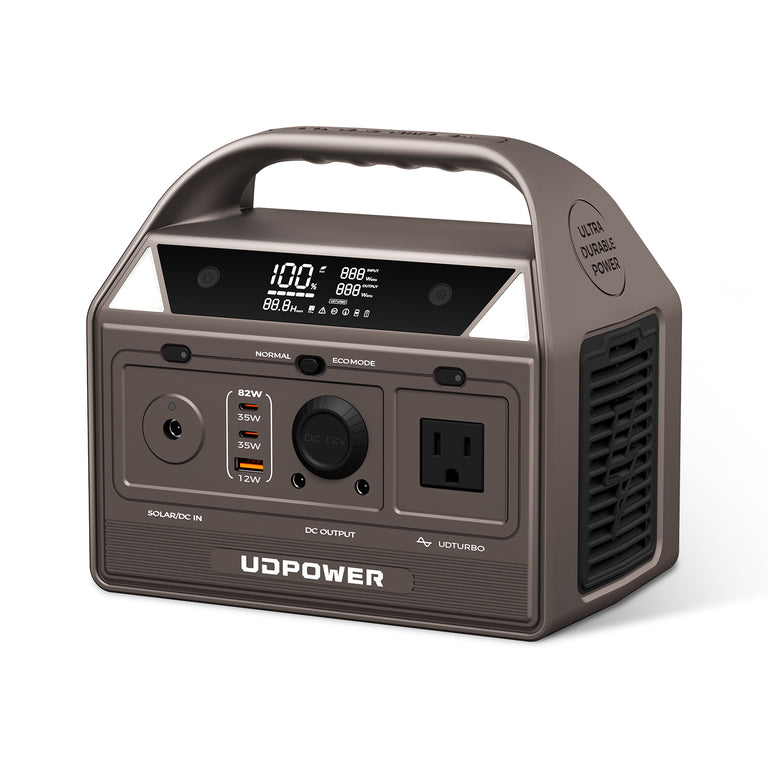
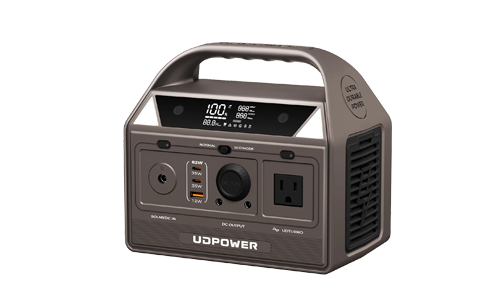
UDPOWER C200
The C200 is the entry-level choice for charging phones, cameras, tablets, and a 15W–25W Wi-Fi router during brief outages or outdoor photography trips. At a constant 50W AC load and 90% conversion efficiency, 192Wh delivers about 3.5 hours before inverter idle draw.
Choose another option if: You need to power appliances above 200W, cover an 8-hour remote-work shift, or run an overnight CPAP machine.
View C200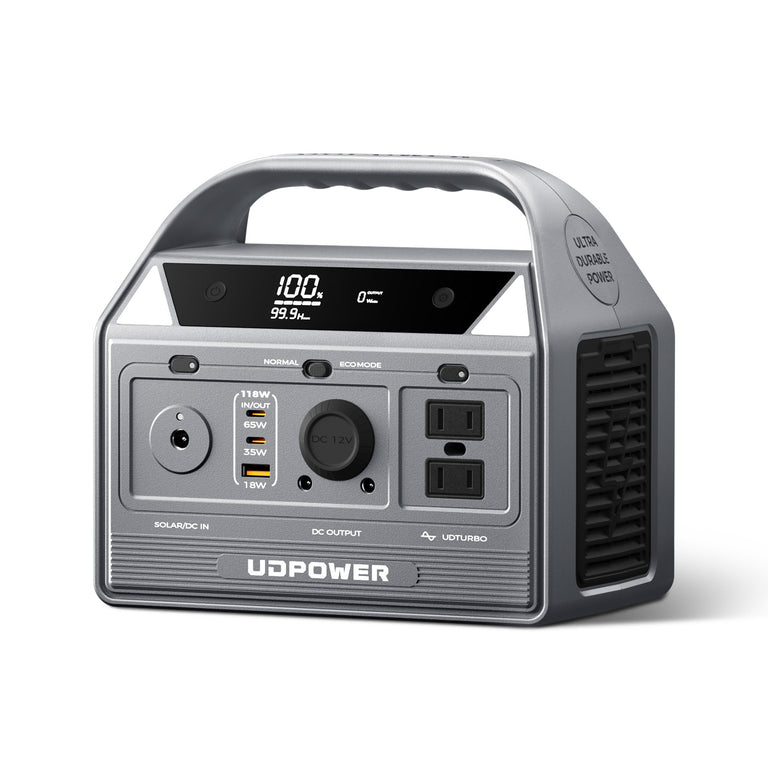
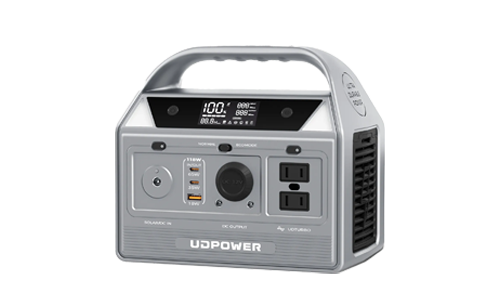
UDPOWER C400
The C400 doubles the rated AC output of the C200 to 400W and includes car jump-start cables in the box, making it a compact trunk backup for road trips and laptop charging. At 90% conversion efficiency, 256Wh runs a constant 50W AC load for about 4.6 hours or a 100W load for about 2.3 hours before idle draw.
Choose another option if: You need multi-day weekend camping power or more than 4 hours of runtime at 100W.
View C400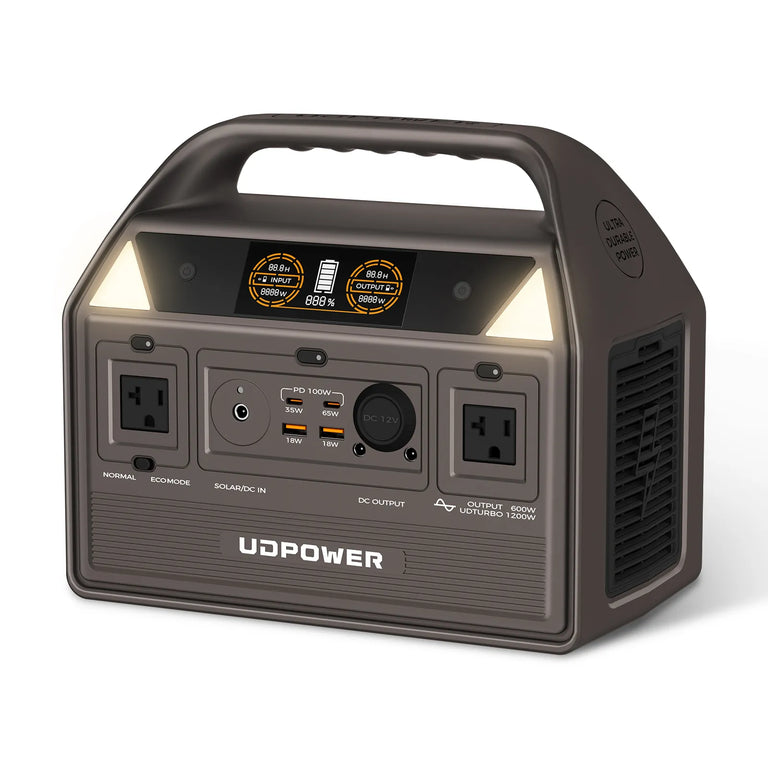
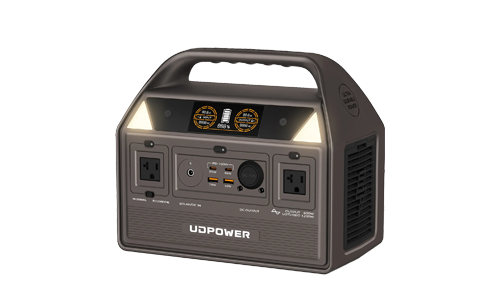
UDPOWER C600
With 596Wh and 600W of rated AC output, the C600 fits weekend camping, 12V electric coolers, and overnight CPAP backup. At 90% conversion efficiency, it supplies a constant 40W AC load for about 13.4 hours or a 100W load for about 5.4 hours before idle draw.
Choose another option if: You plan to run 1,000W+ kitchen appliances, back up a full-size home refrigerator overnight, or pair with the UDPOWER 210W solar panel (use a compatible panel within the C600's solar input limits).
View C600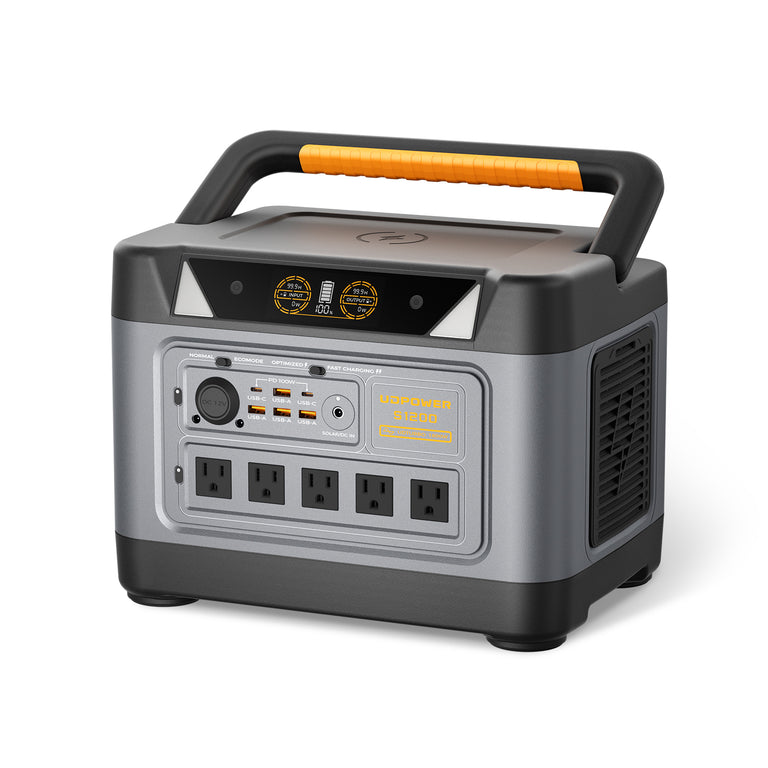
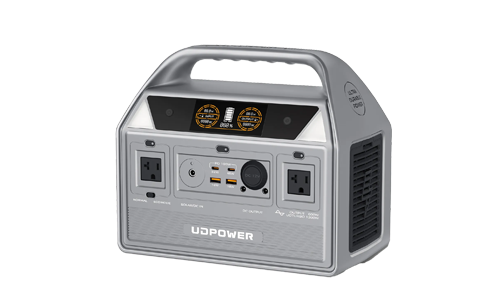
UDPOWER S1200 (5-AC)
For apartments, renters, and home-office backup, the S1200 hits the sweet spot between budget and real outage runtime. Its 1,190Wh LiFePO4 pack delivers about 10.7 hours at a constant 100W AC load or about 2.1 hours at 500W (at 90% conversion efficiency, before idle draw), while five AC outlets power a router, laptop, monitor, and lamp simultaneously. S-series units do not include wireless charging.
Choose another option if: You need to run 1,500W–1,800W microwaves, coffee makers, or space heaters continuously, or run a refrigerator for 24+ hours without recharging.
View S1200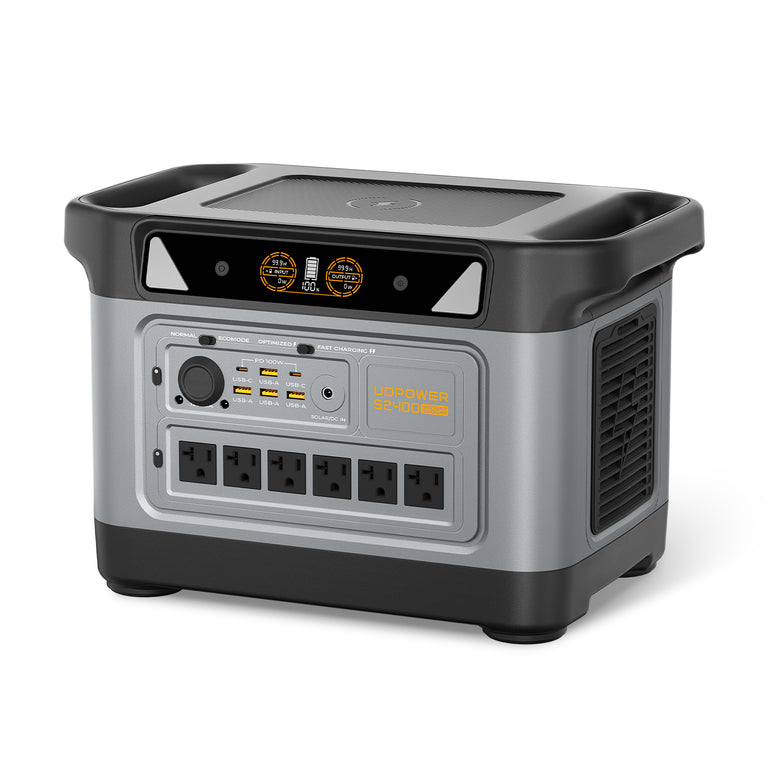
UDPOWER S2400
When your emergency plan includes a full-size refrigerator, microwave, or power tools, the S2400's 2,400W rated AC output prevents overload trips that stop smaller units. At 90% conversion efficiency, 2,083Wh runs a constant 100W AC load for about 18.7 hours or a 500W load for about 3.7 hours before idle draw. Maximum recommended solar input is 420W (the DC7909 and rear XT60 solar inputs do not combine; the station uses the higher input). S-series models do not include wireless charging. Check the product page for current UDPOWER S2400 price and bundle availability.
Choose another option if: You need a lightweight unit for frequent tent-camping carries or only back up low-wattage electronics under 600W.
View S2400Four Budget Mistakes That Waste Money
- Buying by peak wattage instead of continuous rated AC output. Microwaves, coffee makers, and power tools draw sustained high wattage. Match your heaviest appliance to the continuous rated AC output rather than relying on peak output ratings.
- Ignoring inverter idle drain on small loads. Leaving the AC inverter turned on to charge a 15W phone or run a small router wastes battery capacity to overhead. Use USB-C and 12V DC ports for phones, laptops, cameras, and DC-compatible CPAP machines whenever possible so the AC inverter stays off.
- Assuming two solar ports double charging input. On models with dual solar connectors—such as the S2400's DC7909 and rear XT60 inputs—the ports do not combine charging power; the station uses whichever input supplies more power. Confirm the maximum recommended solar input (420W on S2400) before buying extra solar panels.
- Assuming bonded neutral ground means plug-and-play home wiring. UDPOWER C200, C400, C600, S1200, and S2400 stations use bonded neutral ground, which helps with certain GFCI-sensitive loads, but neutral-ground bonding alone does not establish compatibility with a home transfer switch or RV shore-power system. Verify electrical code and transfer-switch requirements with a licensed electrician before connecting to household wiring.
Frequently Asked Questions
How do I find the best watt-hour per dollar portable power station in 2026?
Divide the live sale price by rated watt-hours ($/Wh) and compare only models using the same battery chemistry. Mid-range 1,000Wh–2,000Wh stations typically deliver a lower cost per watt-hour than 200Wh–300Wh units because the inverter and casing represent a smaller share of the total cost. Always compare 3,000-cycle LiFePO4 units against each other rather than against 500-cycle NCM models.
What is the best budget portable power station for a refrigerator during outages?
Choose at least a 1,000Wh–1,200Wh unit for half-day outages or a 2,000Wh+ unit for full-day refrigerator backup. A refrigerator consuming 1.2kWh per day uses 600Wh over 12 hours, requiring at least 667Wh of battery capacity at 90% conversion efficiency before inverter idle draw. The 1,190Wh S1200 covers 12+ hours with margin, while the 2,083Wh S2400 covers roughly 24 hours at that daily rate—verify your fridge's compressor startup draw separately.
Which affordable power station works best for CPAP camping or overnight outages?
A 500Wh–600Wh station like the UDPOWER C600 (596Wh / 600W) is the practical baseline for overnight CPAP use. At a constant 40W AC load (without a heated hose or humidifier) and 90% conversion efficiency, 596Wh provides about 13.4 hours before idle draw. Using a 12V DC adapter for your CPAP avoids AC inverter losses and extends runtime further.
Are portable power stations safe for apartments and renters?
Yes. Unlike gas generators, LiFePO4 portable power stations produce zero exhaust fumes or carbon monoxide, making them safe to operate indoors inside apartments during power outages. For apartment backup covering a Wi-Fi router, laptop, lights, and short refrigerator runs, a 1,190Wh unit like the S1200 balances indoor portability with practical runtime.
How much solar input do I need for a budget portable power station?
Match panel wattage to both your battery size and the station's electrical input limits. At 100W of effective solar input, adding 500Wh takes about 5 hours before charging losses; at 200W of effective input, adding 1,000Wh takes about 5 hours before charging losses. Always verify model-specific panel compatibility—for example, do not pair the 210W solar panel with the C600, and keep S2400 solar setups within its 420W maximum recommended input.
Where can I check current UDPOWER S2400 price or confirm appliance compatibility?
Check each model's product page for current USD pricing, promotions, and stock status. If you want to confirm whether a specific appliance or solar panel matches a UDPOWER station before buying, email support@udpwr.com with your device's nameplate wattage and voltage.
Pick Your Capacity Tier and Verify Your Load
Add up your simultaneous AC watts, multiply by your target hours, and divide by 0.90 to find your minimum battery capacity. For most households balancing budget and real outage protection, start with the 1,190Wh S1200; step down to the C600 or C400 for camping, CPAP, and trunk backup, or up to the S2400 for 24-hour refrigerator and heavy appliance backup.
Compare UDPOWER Power StationsRelated Articles


