

How Much Does It Cost to Run a Light? 2026 Cost Guide
Last updated: June 30, 2026
How Much Does It Cost to Run a Light?
At the April 2026 U.S. residential average electricity rate of 18.83 cents per kilowatt-hour, one typical 9-watt LED bulb costs about 0.17 cents per hour.
If that bulb runs four hours a day, it costs approximately $0.20 per month or $2.47 per year. A 60-watt incandescent bulb used for the same amount of time costs about $16.50 per year.
The honest answer is that one LED bulb has very little effect on a normal electric bill. Lighting becomes more noticeable when a home has many bulbs, older high-wattage bulbs, outdoor lights running all night, or lights left on around the clock.

Lighting Cost at a Glance
The table below uses the April 2026 national residential average of 18.83 cents per kWh and assumes each bulb operates four hours per day. Your actual cost may be higher or lower depending on your local utility rate.
| Bulb wattage | Typical use | Cost per hour | Cost per month | Cost per year |
|---|---|---|---|---|
| 4W | Small LED night-light or decorative bulb | 0.075¢ | $0.09 | $1.10 |
| 5W | Low-output LED bulb | 0.094¢ | $0.11 | $1.37 |
| 7W | LED replacement for some 40W bulbs | 0.132¢ | $0.16 | $1.92 |
| 9W | Common LED replacement for a 60W bulb | 0.169¢ | $0.20 | $2.47 |
| 12W | Brighter household LED | 0.226¢ | $0.27 | $3.30 |
| 15W | High-output LED or compact fluorescent bulb | 0.282¢ | $0.34 | $4.12 |
| 43W | Energy-saving halogen replacement bulb | 0.810¢ | $0.97 | $11.82 |
| 60W | Traditional incandescent bulb | 1.130¢ | $1.36 | $16.50 |
| 75W | Bright incandescent bulb | 1.412¢ | $1.69 | $20.62 |
| 100W | High-output incandescent bulb | 1.883¢ | $2.26 | $27.49 |
Source: U.S. Energy Information Administration residential electricity prices. Monthly estimates use 30 days; annual estimates use 365 days.
How to Calculate the Cost of Running a Light
You need three numbers: the light's wattage, how long it operates, and your electricity price.
Daily kWh = Bulb watts × Number of bulbs × Hours per day ÷ 1,000Daily cost = Daily kWh × Electricity rate in dollars per kWhExample: One 9-Watt LED Used Four Hours per Day
- 9 watts × 1 bulb × 4 hours = 36 watt-hours.
- 36 ÷ 1,000 = 0.036 kWh per day.
- 0.036 kWh × $0.1883 = $0.00678 per day.
- $0.00678 × 365 days = approximately $2.47 per year.
For multiple lights, add their wattages or multiply the bulb wattage by the number of identical bulbs before applying the formula.
Not sure how many watts your light uses? See How Many Watts Does a Light Bulb Use? for common LED, incandescent, fluorescent, halogen, and smart-bulb wattages.
Real-World Lighting Cost Examples
A per-hour number can look too small to matter. These examples show what happens when operating time and the number of bulbs increase.
Leaving One 9W LED On All Night
If “all night” means eight hours, one 9W LED uses 0.072 kWh and costs about 1.36 cents per night.
- Monthly cost: approximately $0.41
- Annual cost: approximately $4.95
Leaving One Light On 24 Hours a Day
A low-wattage LED is still inexpensive, but a traditional incandescent bulb becomes much more noticeable when it never turns off.
| Bulb | Daily cost | Monthly cost | Annual cost |
|---|---|---|---|
| 5W LED | $0.023 | $0.68 | $8.25 |
| 9W LED | $0.041 | $1.22 | $14.85 |
| 15W LED | $0.068 | $2.03 | $24.74 |
| 60W incandescent | $0.271 | $8.13 | $98.97 |
| 100W incandescent | $0.452 | $13.56 | $164.95 |
Lighting Several Rooms for Five Hours per Day
| Number of bulbs | Combined load | Daily energy | Monthly cost | Annual cost |
|---|---|---|---|---|
| 1 bulb | 9W | 0.045 kWh | $0.25 | $3.09 |
| 4 bulbs | 36W | 0.180 kWh | $1.02 | $12.37 |
| 8 bulbs | 72W | 0.360 kWh | $2.03 | $24.74 |
| 12 bulbs | 108W | 0.540 kWh | $3.05 | $37.11 |
| 20 bulbs | 180W | 0.900 kWh | $5.08 | $61.86 |
By comparison, twelve 60W incandescent bulbs running five hours per day would cost about $20.34 per month or $247.43 per year. Replacing them with 9W LEDs reduces the estimated annual electricity cost by about $210.31.
Porch and Security Lights
Outdoor lighting is often used longer than indoor lighting. Two 9W LED porch lights operating 12 hours every night cost about $1.22 per month or $14.85 per year at the national average rate.
The same schedule with two 60W incandescent bulbs would cost about $8.13 per month or $98.97 per year. A dusk-to-dawn sensor can prevent the lights from continuing to run after sunrise.
LED vs. Incandescent: Which Costs Less?
LED bulbs use substantially less electricity to produce a similar amount of light. The U.S. Department of Energy states that residential LED products use at least 75% less energy and can last up to 25 times longer than traditional incandescent lighting.
When replacing a bulb, compare lumens, not only watts. Lumens describe how much visible light the bulb produces. Watts describe how much electricity it consumes.
| Light output | Incandescent wattage | Typical LED wattage | Incandescent annual cost | LED annual cost |
|---|---|---|---|---|
| About 450 lumens | 40W | 4.5W–7W | $11.00 | $1.24–$1.92 |
| About 800 lumens | 60W | 5.9W–10.5W | $16.50 | $1.62–$2.89 |
| About 1,100 lumens | 75W | 9.5W–14W | $20.62 | $2.61–$3.85 |
| About 1,600 lumens | 100W | 10.5W–18W | $27.49 | $2.89–$4.95 |
Assumes four hours of use per day at 18.83 cents per kWh. Wattage ranges are based on U.S. Department of Energy lumen guidance. Always check the actual wattage printed on the bulb package.
How Quickly Can an LED Bulb Pay for Itself?
The fixtures used most often should be replaced first. The following example compares one 9W LED with one 60W incandescent bulb producing roughly similar household light output.
| Daily use | 9W LED annual cost | 60W bulb annual cost | Annual savings | Example payback on a $3 LED |
|---|---|---|---|---|
| 1 hour | $0.62 | $4.12 | $3.51 | About 10.3 months |
| 4 hours | $2.47 | $16.50 | $14.02 | About 2.6 months |
| 8 hours | $4.95 | $32.99 | $28.04 | About 1.3 months |
| 12 hours | $7.42 | $49.49 | $42.06 | Less than 1 month |
| 24 hours | $14.85 | $98.97 | $84.12 | Less than 1 month |
The payback example considers electricity savings only. Bulb prices, rebates, operating hours, and local electricity rates vary.
How Much Does It Cost to Run a Light in Each State?
Electricity prices differ considerably across the United States. The following estimates use each state's April 2026 average residential electricity price and assume one bulb runs four hours per day.
View the complete state-by-state lighting cost table
| State | Residential rate | 9W LED annual cost | 60W bulb annual cost | Annual LED savings |
|---|---|---|---|---|
| U.S. average | 18.83¢ | $2.47 | $16.50 | $14.02 |
| Alabama | 17.41¢ | $2.29 | $15.25 | $12.96 |
| Alaska | 27.35¢ | $3.59 | $23.96 | $20.36 |
| Arizona | 15.48¢ | $2.03 | $13.56 | $11.53 |
| Arkansas | 14.16¢ | $1.86 | $12.40 | $10.54 |
| California | 35.25¢ | $4.63 | $30.88 | $26.25 |
| Colorado | 16.54¢ | $2.17 | $14.49 | $12.32 |
| Connecticut | 32.24¢ | $4.24 | $28.24 | $24.01 |
| Delaware | 18.79¢ | $2.47 | $16.46 | $13.99 |
| District of Columbia | 25.41¢ | $3.34 | $22.26 | $18.92 |
| Florida | 15.38¢ | $2.02 | $13.47 | $11.45 |
| Georgia | 15.37¢ | $2.02 | $13.46 | $11.44 |
| Hawaii | 46.62¢ | $6.13 | $40.84 | $34.71 |
| Idaho | 12.70¢ | $1.67 | $11.13 | $9.46 |
| Illinois | 20.47¢ | $2.69 | $17.93 | $15.24 |
| Indiana | 17.90¢ | $2.35 | $15.68 | $13.33 |
| Iowa | 13.86¢ | $1.82 | $12.14 | $10.32 |
| Kansas | 15.78¢ | $2.07 | $13.82 | $11.75 |
| Kentucky | 15.02¢ | $1.97 | $13.16 | $11.18 |
| Louisiana | 14.44¢ | $1.90 | $12.65 | $10.75 |
| Maine | 28.42¢ | $3.73 | $24.90 | $21.16 |
| Maryland | 22.07¢ | $2.90 | $19.33 | $16.43 |
| Massachusetts | 29.45¢ | $3.87 | $25.80 | $21.93 |
| Michigan | 21.39¢ | $2.81 | $18.74 | $15.93 |
| Minnesota | 16.39¢ | $2.15 | $14.36 | $12.20 |
| Mississippi | 16.76¢ | $2.20 | $14.68 | $12.48 |
| Missouri | 14.01¢ | $1.84 | $12.27 | $10.43 |
| Montana | 13.90¢ | $1.83 | $12.18 | $10.35 |
| Nebraska | 13.28¢ | $1.74 | $11.63 | $9.89 |
| Nevada | 14.29¢ | $1.88 | $12.52 | $10.64 |
| New Hampshire | 27.24¢ | $3.58 | $23.86 | $20.28 |
| New Jersey | 23.53¢ | $3.09 | $20.61 | $17.52 |
| New Mexico | 15.15¢ | $1.99 | $13.27 | $11.28 |
| New York | 29.45¢ | $3.87 | $25.80 | $21.93 |
| North Carolina | 16.25¢ | $2.14 | $14.23 | $12.10 |
| North Dakota | 12.35¢ | $1.62 | $10.82 | $9.20 |
| Ohio | 19.49¢ | $2.56 | $17.07 | $14.51 |
| Oklahoma | 13.31¢ | $1.75 | $11.66 | $9.91 |
| Oregon | 15.78¢ | $2.07 | $13.82 | $11.75 |
| Pennsylvania | 21.47¢ | $2.82 | $18.81 | $15.99 |
| Rhode Island | 28.30¢ | $3.72 | $24.79 | $21.07 |
| South Carolina | 17.06¢ | $2.24 | $14.94 | $12.70 |
| South Dakota | 14.52¢ | $1.91 | $12.72 | $10.81 |
| Tennessee | 14.94¢ | $1.96 | $13.09 | $11.12 |
| Texas | 16.99¢ | $2.23 | $14.88 | $12.65 |
| Utah | 13.29¢ | $1.75 | $11.64 | $9.90 |
| Vermont | 24.56¢ | $3.23 | $21.51 | $18.29 |
| Virginia | 17.38¢ | $2.28 | $15.22 | $12.94 |
| Washington | 14.36¢ | $1.89 | $12.58 | $10.69 |
| West Virginia | 16.06¢ | $2.11 | $14.07 | $11.96 |
| Wisconsin | 19.21¢ | $2.52 | $16.83 | $14.30 |
| Wyoming | 14.68¢ | $1.93 | $12.86 | $10.93 |
State rates are preliminary April 2026 residential averages published by the U.S. Energy Information Administration. Your utility plan, taxes, time-of-use pricing, and local delivery charges may produce a different result.
What Changes the Actual Cost of Running a Light?
1. The Bulb's Actual Wattage
Two bulbs can provide similar brightness while drawing very different amounts of power. Use the wattage printed on the bulb or package rather than assuming that all “60-watt equivalent” bulbs consume 60 watts. An LED labeled as a 60W equivalent may consume only about 6W to 11W.
2. The Number of Bulbs in the Fixture
A ceiling fixture with four 9W bulbs has a combined load of 36W. A vanity with eight identical bulbs uses 72W. Calculate the total fixture load, not only the wattage of one bulb.
3. Daily Operating Time
A closet light used for ten minutes a day has little effect on a bill. Porch lights, garage lights, grow lights, security lighting, and commercial signs may operate for eight to 24 hours and deserve more attention.
4. Your Local Electricity Rate
The same 9W LED costs less to operate in a lower-rate state and more in a high-rate state. Check your own utility bill whenever you need a precise household estimate.
5. Time-of-Use Pricing
Some utilities charge different prices during peak and off-peak periods. Outdoor lights that operate overnight may use mostly off-peak electricity, while kitchen and living-room lighting may overlap with higher evening rates.
6. Smart-Bulb Standby Power
A connected smart bulb may use a small amount of power while waiting for app or voice commands, even when the light output is off. Check the manufacturer's specifications if you are calculating the cost of a large smart-lighting system.
How to Lower Lighting Costs Without Making Your Home Dark
Replace the Longest-Running Bulbs First
Start with kitchen lights, living-room lamps, porch lights, hallway lights, and fixtures that remain on for several hours each day. Replacing a rarely used attic bulb will produce very little savings.
Choose Lumens Based on the Room
Avoid buying a higher-output bulb than the room needs. A focused task light can illuminate a desk or reading chair with less energy than lighting an entire room at maximum brightness.
Turn LEDs Off When They Are Not Needed
Frequent switching does not reduce the operating life of LED lighting in the same way it can affect some older fluorescent products. The U.S. Department of Energy recommends turning LED lights off when they are not needed.
Read the Department of Energy guidance on when to turn off lights for additional details.
Use Timers, Motion Sensors, and Dusk-to-Dawn Controls
Controls are especially useful in garages, closets, bathrooms, basements, hallways, and outdoor areas where lights are frequently left on by mistake.
Use Dimmers With Compatible LED Bulbs
Dimming a compatible LED reduces light output and energy consumption. Check that both the bulb and the dimmer are rated for LED use to avoid flickering or poor performance.
Can a Portable Power Station Run Lights During an Outage?
Yes. LED lights are among the easiest household devices to run from a portable power station because their wattage is low. Battery capacity usually matters more than maximum output when the only load is lighting.
A practical runtime estimate is:
Estimated runtime = Battery capacity in Wh × 90% ÷ Combined lighting wattsFor example, four 9W LED bulbs create a 36W load. A 596Wh power station provides an estimated:
596Wh × 0.90 ÷ 36W = approximately 14.9 hoursRuntime note: These figures are planning estimates. Actual runtime can be lower because of inverter standby consumption, battery temperature, battery condition, cable losses, light adapters, and other devices connected at the same time. Very small AC loads can also be affected more noticeably by the inverter's own power use.
| Model | Battery capacity | One 9W LED | Four 9W LEDs | Eight 9W LEDs |
|---|---|---|---|---|
| UDPOWER C400 | 256Wh | 25.6 hours | 6.4 hours | 3.2 hours |
| UDPOWER C600 | 596Wh | 59.6 hours | 14.9 hours | 7.5 hours |
| UDPOWER S1200 | 1,190Wh | 119 hours | 29.8 hours | 14.9 hours |
When choosing a battery, include every device you expect to use. Four lights may draw only 36W, but adding a Wi-Fi router, phones, a fan, a television, a CPAP machine, or a refrigerator changes both the required output and runtime.
For a general explanation of battery capacity, outlets, charging, and appliance compatibility, read What Is a Portable Power Station? A Beginner's Guide.
Recommended UDPOWER Power Stations for Emergency Lighting
You do not need a high-output model to run one LED lamp. Choose the battery size according to how many lights you need, how long the outage may last, and whether the station will also power other devices.

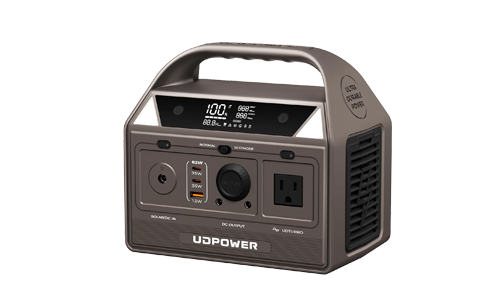
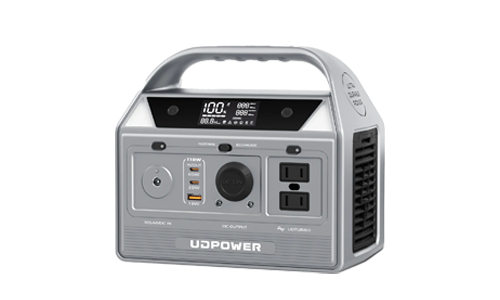
UDPOWER C400 Portable Power Station
The C400 is the most compact choice in this comparison. It is a practical fit for one room, a bedside lamp, phone charging, or a small group of LED lights during a short outage.
- Battery capacity: 256Wh
- Rated AC output: 400W
- Surge output: 800W
- Weight: 6.88 lb
- Estimated four-light runtime: About 6.4 hours with four 9W LEDs

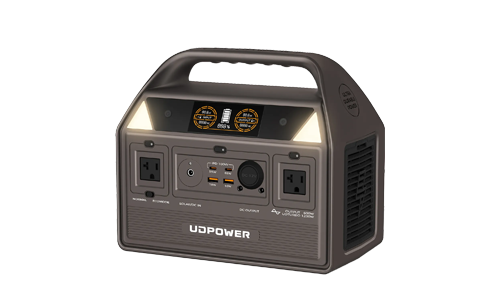
UDPOWER C600 Portable Power Station
The C600 provides more battery capacity while remaining portable. It is better suited to several LED lights plus phones, a router, or other small electronics.
- Battery capacity: 596Wh
- Rated AC output: 600W
- Surge output: 1,200W
- Weight: 12.3 lb
- Estimated four-light runtime: About 14.9 hours with four 9W LEDs
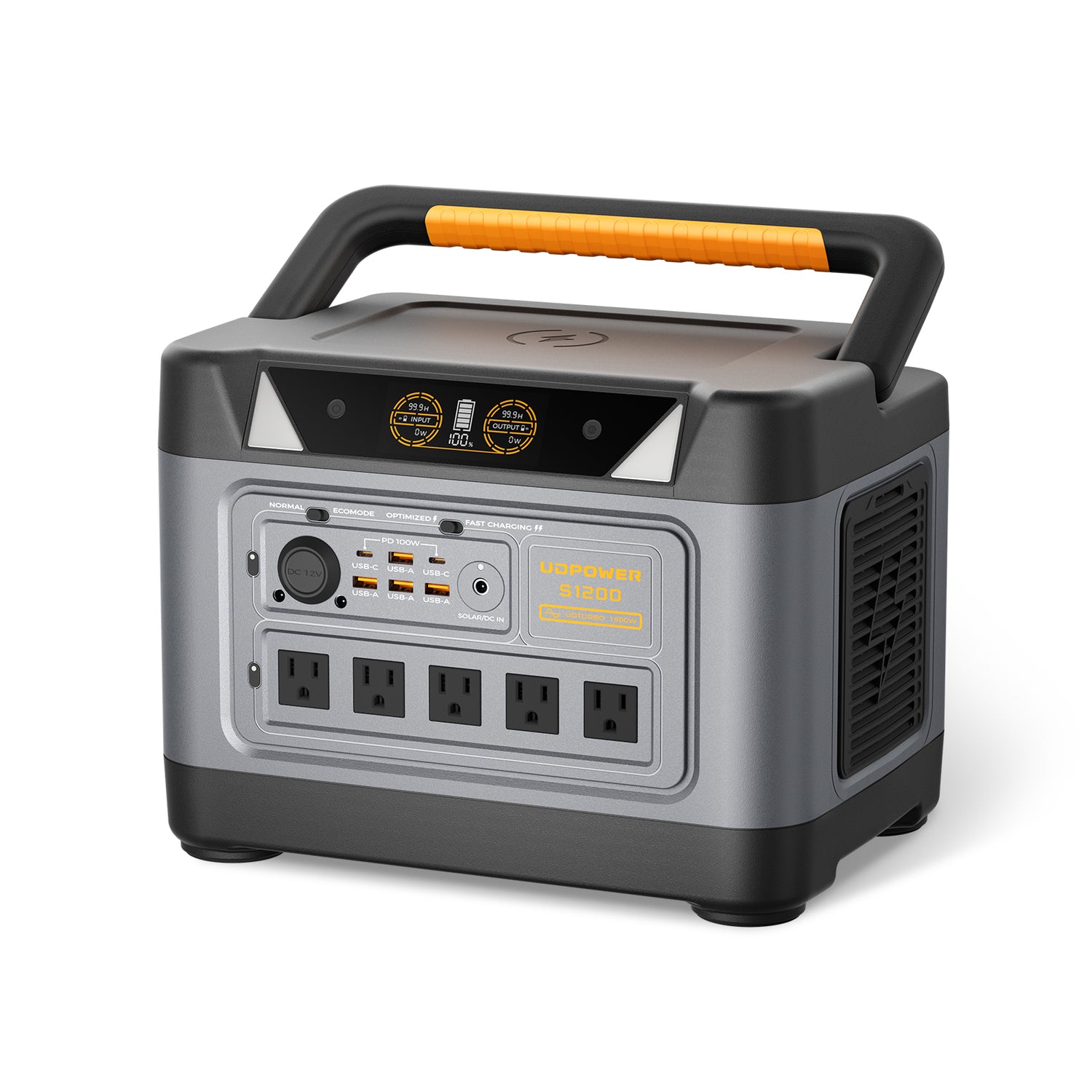
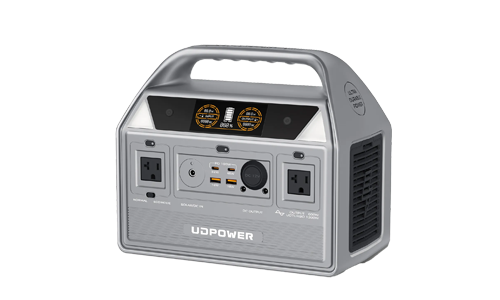
UDPOWER S1200 Portable Power Station
The S1200 makes more sense when lighting is only part of the backup plan. Its larger battery and output provide room for lights, phones, communications equipment, a television, a fan, or other compatible household devices.
- Battery capacity: Approximately 1,190Wh
- Rated AC output: 1,200W
- Surge output: 1,800W
- Weight: 26.0 lb
- Estimated four-light runtime: About 29.8 hours with four 9W LEDs
Simple selection rule: Choose the C400 for basic lighting and phone charging, the C600 for several rooms and small essentials, or the S1200 when lights are part of a broader home-backup setup.
Frequently Asked Questions
How much does it cost to run a light for one hour?
At 18.83 cents per kWh, a 9W LED costs about 0.17 cents per hour. A 60W incandescent bulb costs about 1.13 cents per hour, and a 100W bulb costs about 1.88 cents per hour.
How much does it cost to leave an LED light on all night?
A 9W LED running for eight hours costs about 1.36 cents per night, $0.41 per 30-day month, or $4.95 per year at the national average residential electricity rate.
How much does it cost to leave a light on 24/7?
One 9W LED running continuously costs approximately $1.22 per month or $14.85 per year. A 60W incandescent bulb on the same schedule costs about $8.13 per month or $98.97 per year.
Do LED lights really lower the electric bill?
Yes, especially when they replace high-wattage bulbs used for several hours per day. Replacing one 60W incandescent bulb with a 9W LED used four hours daily saves approximately $14.02 per year at 18.83 cents per kWh.
Does turning an LED light on and off use more electricity?
The brief startup demand is not large enough to justify leaving an LED on in an empty room. Turning an LED off when it is not needed reduces its total energy use.
Does a lamp cost more to run than a ceiling light?
Not necessarily. Cost depends on the combined wattage and operating time, not whether the light is in a lamp or ceiling fixture. A lamp with one 9W bulb uses less electricity than a ceiling fixture with four 9W bulbs.
How do I calculate the cost of several lights?
Multiply the wattage of one bulb by the number of bulbs, multiply that result by the daily operating hours, and divide by 1,000. Multiply the resulting kWh by your electricity rate.
Should I use watts or lumens when buying a replacement bulb?
Use lumens to compare brightness and watts to compare electricity use. Look for a bulb that provides the lumens you need while consuming the fewest watts.
Can one light noticeably increase my electric bill?
One normal LED used for a few hours per day usually has a very small effect. A high-wattage bulb running continuously, several outdoor lights, or a home filled with older incandescent bulbs can make a more noticeable difference.
What size portable power station do I need for lights?
For one or two LED lights, even a compact power station can provide several hours of runtime. Choose a larger battery if you need several rooms lit overnight or also plan to run phones, a router, a fan, a refrigerator, medical equipment, or other appliances.
Data Sources and Calculation Method
Electricity costs in this guide use the April 2026 U.S. residential average of 18.83 cents per kWh unless a state-specific rate is shown. Calculations use the rated wattage of the bulb and do not include fixed utility account charges.
Plan Your Emergency Lighting and Backup Power
Compare battery capacity, output, portability, and estimated runtime before choosing a power station. Remember to include every light and appliance you expect to use during an outage.
Compare Backup Power Options View Portable Power Stations Read the Portable Power Station GuideRelated Articles


