

How Much Does It Cost to Run a Fan? 2026 Cost Guide
Last updated:
Direct answer: Most household fans cost only a few cents to run through the night.
Using the latest available U.S. residential average electricity price of 18.44 cents per kilowatt-hour, a 35-watt ceiling fan costs about $0.05 for eight hours, a 55-watt tower or pedestal fan costs about $0.08, and a 75-watt box fan costs about $0.11.
At eight hours per day for 30 days, those examples cost approximately $1.55, $2.43, and $3.32 per month. Your exact result depends on the fan's measured wattage, speed setting, hours of use, light kit, and local electricity rate.

A fan is one of the least expensive household cooling devices to operate. However, “fans are cheap” is not precise enough when you are comparing a ceiling fan with a box fan, deciding whether to leave one on all night, or estimating the battery capacity needed during an outage.
The useful calculation is based on four numbers: the fan's wattage, daily runtime, number of operating days, and the variable electricity price on your utility bill. Fixed monthly customer charges generally do not increase because you run a fan, so they should not be included in the appliance-level calculation.
Quick Fan Cost Table
The following table uses a residential electricity rate of 18.44¢ per kWh. Costs are rounded, so your utility bill may differ slightly.
| Fan power | Cost per hour | Cost for 8 hours | 30 days at 8 hours/day | One year at 8 hours/day | 30 days running 24/7 |
|---|---|---|---|---|---|
| 10W | $0.0018 | $0.01 | $0.44 | $5.38 | $1.33 |
| 25W | $0.0046 | $0.04 | $1.11 | $13.46 | $3.32 |
| 35W | $0.0065 | $0.05 | $1.55 | $18.85 | $4.65 |
| 55W | $0.0101 | $0.08 | $2.43 | $29.61 | $7.30 |
| 75W | $0.0138 | $0.11 | $3.32 | $40.38 | $9.96 |
| 100W | $0.0184 | $0.15 | $4.43 | $53.84 | $13.28 |
Electricity-rate source: U.S. Energy Information Administration, Electric Power Monthly. The latest available monthly U.S. residential average at the time of this update was 18.44¢/kWh for May 2026.
How Many Watts Does a Ceiling Fan, Box Fan, or Electric Fan Use?
Fan wattage varies by motor design, blade size, airflow setting, lighting, controls, and added functions. A compact USB desk fan may use less than 10 watts, while a large box fan on high can approach or exceed 75 watts.
| Fan type | Useful planning range | Working value for estimates | Common use |
|---|---|---|---|
| USB or personal desk fan | 5W–15W | 10W | Desk, bedside table, tent, or close-range airflow |
| Small table fan | 15W–35W | 25W | Targeted airflow in a bedroom or office |
| Efficient ceiling fan | 15W–35W | 35W | Whole-room air movement with an efficient motor |
| Standard ceiling fan | 35W–75W | 55W | Bedroom, living room, or dining area |
| Tower or pedestal fan | 30W–65W | 55W | Direct or oscillating airflow |
| 20-inch box fan | 60W–100W | 75W | Window ventilation, garage, workshop, or stronger airflow |
| High-output floor fan | 80W–150W or more | 100W | Garage, workshop, drying, or commercial-style airflow |
These are planning ranges rather than universal specifications. The rating label on your fan is a better starting point, and a plug-in watt meter gives the most useful real-world result for portable fans.
Additional references: ENERGY STAR ceiling fan guidance and EPB household fan energy guidance.
Do not confuse watts with watt-hours. Watts describe how much power the fan is drawing right now. Watt-hours describe the total energy consumed over time. A 75W box fan running for eight hours uses 600Wh, or 0.6kWh.
How Much Does It Cost to Run a Fan All Night?
For cost calculations, “all night” usually means eight to twelve hours. Even a relatively powerful household fan remains inexpensive over one night, but the difference becomes more visible across an entire summer.
| Example fan | Watts | 8-hour night | 10-hour night | 12-hour night | 30 nights at 10 hours/night |
|---|---|---|---|---|---|
| Personal or USB fan | 10W | $0.01 | $0.02 | $0.02 | $0.55 |
| Small table fan | 25W | $0.04 | $0.05 | $0.06 | $1.38 |
| Efficient ceiling fan | 35W | $0.05 | $0.06 | $0.08 | $1.94 |
| Tower or pedestal fan | 55W | $0.08 | $0.10 | $0.12 | $3.04 |
| Box fan | 75W | $0.11 | $0.14 | $0.17 | $4.15 |
| High-output floor fan | 100W | $0.15 | $0.18 | $0.22 | $5.53 |
A 75W box fan used for ten hours every night costs about $4.15 over a 30-day month at the national average rate. The same fan may cost less than $3 in a low-rate area or more than $10 in a very high-rate market.
How Much Does It Cost to Leave a Fan On 24/7?
Continuous use triples the energy consumption of an eight-hour schedule. A 75W box fan running nonstop consumes 1.8kWh per day and 54kWh in a 30-day month.
| Fan wattage | Energy per day | Cost per day | Cost for 30 days | Cost for one year |
|---|---|---|---|---|
| 10W | 0.24kWh | $0.04 | $1.33 | $16.15 |
| 25W | 0.60kWh | $0.11 | $3.32 | $40.38 |
| 35W | 0.84kWh | $0.15 | $4.65 | $56.54 |
| 55W | 1.32kWh | $0.24 | $7.30 | $88.84 |
| 75W | 1.80kWh | $0.33 | $9.96 | $121.16 |
| 100W | 2.40kWh | $0.44 | $13.28 | $161.53 |
Running one fan continuously will not normally explain a dramatic jump in a household power bill. However, several fans left on around the clock can add a noticeable amount, especially in a location with expensive electricity.
Fans mainly create a cooling sensation by moving air across the skin. Unless a fan is being used for ventilation, drying, air filtration, or another specific purpose, leaving it on in an empty room generally provides little comfort benefit.
How to Calculate the Exact Cost of Running Your Fan
Example: A 75W Box Fan Used for 10 Hours a Day
- Convert watts to kilowatts: 75 ÷ 1,000 = 0.075kW.
- Calculate daily energy: 0.075kW × 10 hours = 0.75kWh.
- Convert 18.44 cents to dollars: 18.44¢ = $0.1844.
- Calculate daily cost: 0.75kWh × $0.1844 = about $0.14.
- Calculate a 30-day month: $0.1383 × 30 = about $4.15.
Where to Find Your Fan's Wattage
Look for a rating label on the fan's base, rear housing, motor cover, power adapter, plug, or underside. The label may show watts directly or list volts and amps.
For example, a fan labeled 120V and 0.5A has a theoretical input of approximately 60W. Actual power can be lower, especially on reduced speed settings, so a plug-in energy meter is more accurate.
Use the Variable Rate From Your Electric Bill
Many utility bills separate supply, generation, delivery, and other charges. For a practical appliance calculation, use the combined charges that increase as your kWh consumption increases. Do not divide the entire bill by kWh if the bill includes a large fixed monthly customer charge, because that fixed charge would exist even if the fan were not running.
Customers on time-of-use plans should use the rate that applies during the hours when the fan runs. A bedroom fan used overnight may be charged at a different rate from a fan used during a summer afternoon peak period.
Your Local Electricity Rate Can Matter More Than the Fan Type
The U.S. average is useful for comparison, but residential rates differ substantially by location. The table below uses May 2026 state averages reported by the U.S. Energy Information Administration.
| Location example | Residential rate | 35W fan, 8 hours/day | 55W fan, 8 hours/day | 75W fan, 8 hours/day |
|---|---|---|---|---|
| Idaho | 12.35¢/kWh | $1.04/month | $1.63/month | $2.22/month |
| U.S. average | 18.44¢/kWh | $1.55/month | $2.43/month | $3.32/month |
| California | 33.25¢/kWh | $2.79/month | $4.39/month | $5.99/month |
| Hawaii | 52.00¢/kWh | $4.37/month | $6.86/month | $9.36/month |
These figures illustrate why a nationwide answer cannot be exact for every household. They are state averages rather than a quote for a specific utility plan.
State-rate source: U.S. EIA average residential electricity prices by state, May 2026.
Ceiling Fan Only vs. Ceiling Fan With the Light On
When a ceiling fan includes a light kit, the motor and the light are separate loads. The light may consume as much power as the fan motor—or more—depending on the number and type of bulbs.
Consider a ceiling fan that draws 35W and an LED light kit that adds 18W:
| Operating mode | Total power | Cost for 8 hours | 30 days at 8 hours/day |
|---|---|---|---|
| Fan only | 35W | $0.05 | $1.55 |
| Light only | 18W | $0.03 | $0.80 |
| Fan and light together | 53W | $0.08 | $2.35 |
If you want airflow while sleeping but do not need room lighting, switching off the light kit reduces both electricity use and unwanted heat from the bulbs.
What Changes a Fan's Actual Electricity Use?
Speed Setting
High speed usually draws more power than medium or low speed. The reduction is not always proportional, because motor type and electronic controls differ. Do not assume that medium speed uses exactly two-thirds of the high-speed wattage.
Motor Design
Modern efficient motors can move the same amount of air with less electricity than older designs. ENERGY STAR reports that certified ceiling fans can be up to 44% more efficient than conventional fans.
Fan Size and Airflow
A larger fan does not automatically cost more to operate. A properly sized ceiling fan running at a lower setting may provide better whole-room comfort than a small fan that must remain on high.
Dust, Blocked Vents, and Mechanical Condition
Dust buildup on blades and motor vents can reduce useful airflow. Wobbling, grinding, a hot motor housing, or a damaged cord should be treated as a maintenance or safety issue rather than simply an energy-cost problem.
Extra Functions
Lights, heaters, air purification, humidification, displays, and smart controls add to the total load. A tower appliance with an electric heating mode is no longer operating as a low-watt cooling fan when the heater is active.
Is It Cheaper to Run a Fan or Air Conditioning?
A fan is much cheaper to operate because it moves air rather than using a compressor to remove heat and moisture from the room. The two devices do not provide the same result, so running-cost comparisons should be treated as energy examples rather than equal cooling comparisons.
| Cooling device | Example draw | Cost for 8 hours at full draw | What it does |
|---|---|---|---|
| Efficient ceiling fan | 35W | $0.05 | Moves room air and increases the cooling sensation |
| Tower or pedestal fan | 55W | $0.08 | Provides targeted or oscillating airflow |
| Box fan | 75W | $0.11 | Provides direct airflow or window ventilation |
| Room air conditioner | 1,000W example | $1.48 at continuous full draw | Removes heat and humidity from the indoor air |
Air conditioners normally cycle rather than draw their maximum wattage every minute, so actual AC cost depends on compressor runtime, outdoor temperature, insulation, thermostat setting, unit efficiency, and room size.
A practical strategy is to use a fan in an occupied room while raising the air conditioner thermostat. The U.S. Department of Energy states that a ceiling fan may allow the thermostat to be raised by about 4°F without reducing comfort.
Cooling guidance: U.S. Department of Energy summer energy-saving recommendations. For room air-conditioner wattage and backup-power planning, see How Many Watts Does a Window AC Use?
Important Extreme-Heat Safety Note
A fan is a comfort and air-movement device, not a substitute for adequate cooling during dangerous heat. The CDC advises using fans only when indoor temperatures are below 90°F. At higher indoor temperatures, a fan may increase body temperature and should not be relied on to prevent heat-related illness.
Use air conditioning or move to an air-conditioned location when conditions become unsafe. Seek urgent medical help for confusion, fainting, severe weakness, hot dry skin, or other signs of heat stroke.
Safety source: CDC heat and health guidance.
How to Lower Fan and Cooling Costs Without Feeling Hotter
Turn Off Comfort Fans in Empty Rooms
A ceiling, desk, tower, or pedestal fan mainly benefits someone who can feel the moving air. Turn it off when the room is unoccupied unless it is serving a specific ventilation, filtration, or drying purpose.
Use the Lowest Comfortable Speed
High speed is useful when entering a hot room, but a lower setting may be enough once you are comfortable. A timer or sleep mode can automatically reduce unnecessary overnight runtime.
Use Ceiling Fans in the Correct Summer Direction
In summer, most ceiling fans should rotate counterclockwise when viewed from below. This pushes air downward and creates a direct cooling breeze. Some models use different controls, so check the manufacturer's instructions.
Use Window Fans When Outdoor Air Is Actually Cooler
A box fan can exhaust warm indoor air or draw cooler outdoor air through a window. This is most useful during cooler evenings and mornings. Close the windows and shades when outdoor air becomes hotter than the indoor space.
Coordinate the Fan With the Thermostat
Running a fan while leaving the thermostat unchanged adds the fan's electricity use without necessarily reducing the AC load. The financial benefit comes from using the fan to stay comfortable at a higher thermostat setting.
Measure Instead of Guessing
A plug-in watt meter can show the actual draw at each speed. It is especially helpful for combination appliances, older fans, and models with displays, lights, heaters, or air-cleaning functions.
Can a Portable Power Station Run a Fan During an Outage?
Yes. Fans are relatively easy loads for a portable power station because their operating wattage is low. For this use case, battery capacity usually matters more than inverter output.
The estimates below use the following planning formula:
Real runtime may be lower because of inverter standby consumption, battery condition, temperature, fan startup behavior, low-load settings, and other devices connected at the same time.
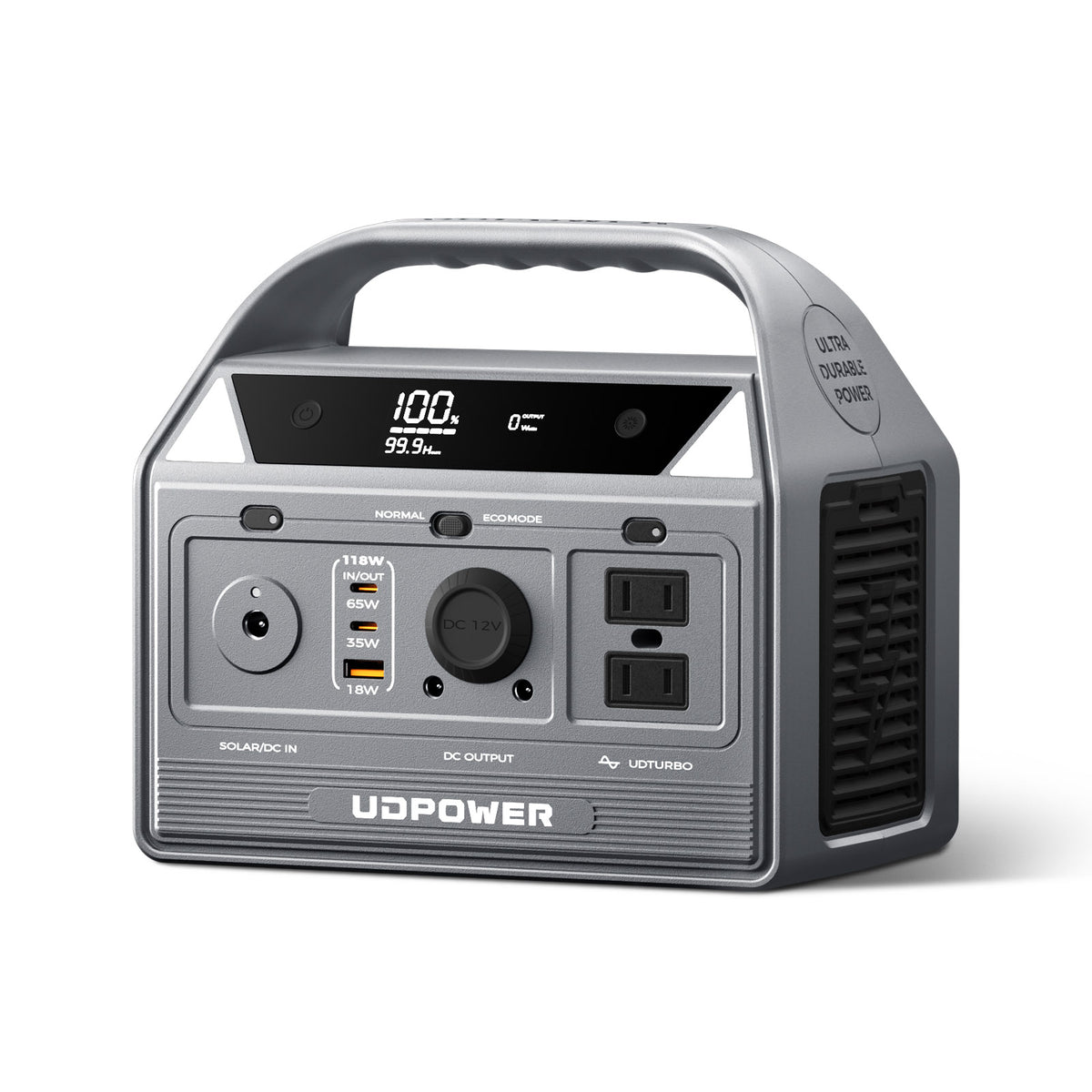
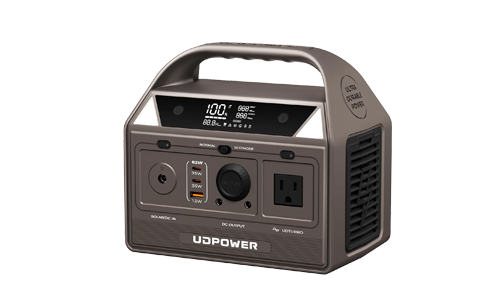
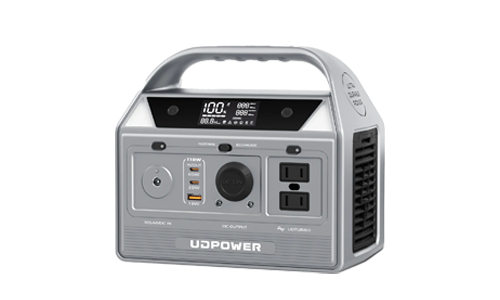
UDPOWER C400
- 256Wh battery capacity
- 400W rated AC output
- Approximately 6.88 lb
- Up to 150W solar input
- About 6.6 hours with a 35W fan
- About 4.2 hours with a 55W fan
- About 3.1 hours with a 75W box fan
The C400 makes sense for a personal fan, table fan, campsite, daytime outage, or short cooling window. It is not the best choice when a higher-wattage box fan must run continuously through the entire night.
View UDPOWER C400
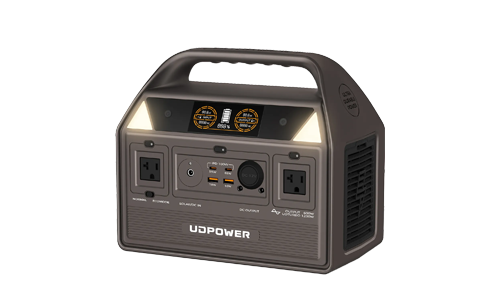
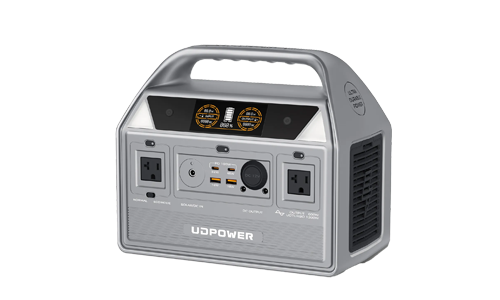
UDPOWER C600
- 596Wh battery capacity
- 600W rated AC output
- Approximately 12.3 lb
- Up to 240W solar input
- About 15.3 hours with a 35W fan
- About 9.8 hours with a 55W fan
- About 7.2 hours with a 75W box fan
The C600 is a practical match for a bedroom ceiling fan, tower fan, or pedestal fan. It can cover many overnight scenarios when the fan is efficient, although a 75W box fan may require a reduced speed or a shorter operating window to last a full night.
View UDPOWER C600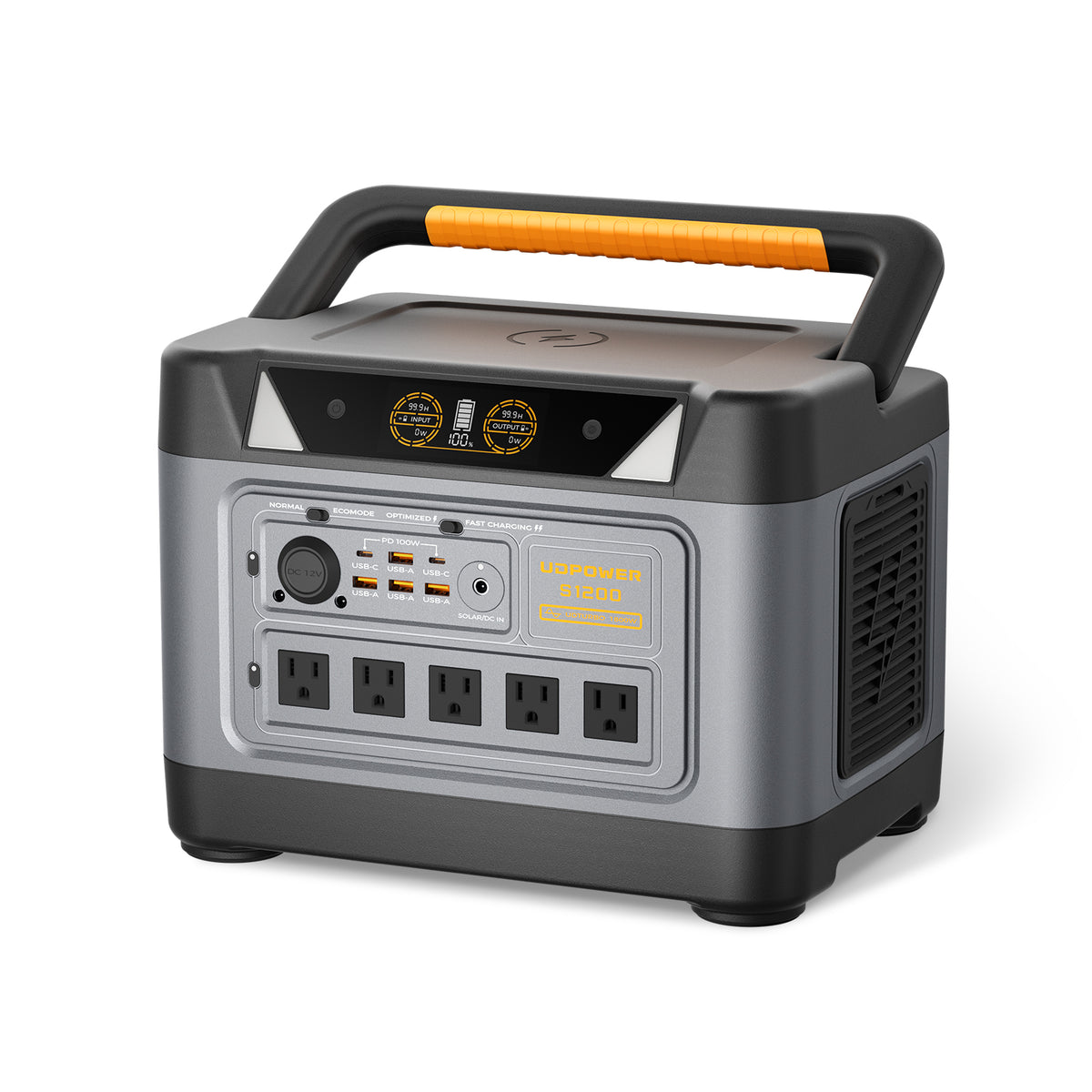
UDPOWER S1200
- 1,190Wh battery capacity
- 1,200W rated AC output
- Approximately 26 lb
- Up to 400W solar input
- About 30.6 hours with a 35W fan
- About 19.5 hours with a 55W fan
- About 14.3 hours with a 75W box fan
The S1200 is the more comfortable choice when the goal is to run a fan overnight while also keeping a router, lights, phones, laptop, or other low-power essentials available. Always calculate the combined wattage of everything connected.
View UDPOWER S1200Portable Power Station Fan Runtime Comparison
| UDPOWER model | Battery capacity | 35W fan | 55W fan | 75W fan | Best fit |
|---|---|---|---|---|---|
| C400 | 256Wh | About 6.6 hours | About 4.2 hours | About 3.1 hours | Short backup, desk fan, day trip, or light camping |
| C600 | 596Wh | About 15.3 hours | About 9.8 hours | About 7.2 hours | One efficient fan, bedroom use, or portable overnight setup |
| S1200 | 1,190Wh | About 30.6 hours | About 19.5 hours | About 14.3 hours | Overnight fan plus router, lights, phones, or other essentials |
| S2400 | 2,083Wh | About 53.6 hours | About 34.1 hours | About 25.0 hours | Multiple fans, longer outages, refrigerator, and larger backup plans |
These are single-load planning estimates. A 75W fan, 15W router, 10W light, and two phone chargers might create a combined load of approximately 110W rather than 75W. Runtime must be calculated from the total load.
Which Model Should You Choose?
| Your goal | Recommended starting point | Reason |
|---|---|---|
| Run a small personal fan for a few hours | C400 | Lightweight and sufficient for short, low-watt fan use |
| Run one efficient fan overnight | C600 | Good balance of battery capacity and portability |
| Run a box fan all night with reserve capacity | S1200 | Provides more comfortable runtime and room for small essentials |
| Run multiple fans and household essentials | S2400 | Higher capacity for a larger combined load and longer outage |
| Recharge from sunlight during a daytime outage | Compatible power station and solar panel kit | Solar input can extend total operating time when conditions are suitable |
For a broader comparison, browse UDPOWER portable power stations or view solar generator kits.
Practical Fan Backup Tips During a Power Outage
Test the Real Load Before an Emergency
Connect the fan to the power station during normal conditions and check the displayed output wattage. Test every speed you expect to use. This provides a more useful estimate than relying only on the maximum wattage printed on the fan.
Use Lower Speed When Runtime Matters
Reducing fan speed can substantially extend battery life. A fan that draws 75W on high may draw considerably less at a lower setting, although the exact reduction depends on the motor and speed control.
Account for Inverter Standby Consumption
Very small AC loads can be affected more noticeably by the power station's own inverter consumption. When a compatible USB or DC fan is available, using the matching DC output can sometimes reduce conversion losses.
Check Low-Load and ECO Settings
Some power stations automatically turn off an output when the connected load remains very low. Check the operating mode before relying on a low-watt fan through the night.
Prioritize Health and Safety
Battery-powered airflow may improve comfort, but it does not make a dangerously hot room safe. During extreme heat, follow public-health guidance and relocate to an air-conditioned location when necessary.
Frequently Asked Questions
Does a ceiling fan use a lot of electricity?
No. Most ceiling fans are low-watt household loads. At 18.44¢/kWh, a 35W ceiling fan used for eight hours a day costs about $1.55 per 30-day month. A less efficient 75W fan used on the same schedule costs about $3.32 per month.
How much does it cost to run a box fan all night?
A 75W box fan costs about $0.11 for an eight-hour night, $0.14 for ten hours, or $0.17 for twelve hours at the current U.S. average residential electricity rate.
How much does it cost to run a fan for 24 hours?
At 18.44¢/kWh, a 35W fan costs about $0.15 per day, a 55W fan about $0.24, and a 75W fan about $0.33 when operated continuously for 24 hours.
How much does it cost to leave a fan on all month?
A 75W fan running continuously for 30 days uses 54kWh and costs about $9.96 at 18.44¢/kWh. If it runs for only eight hours each day, the monthly cost falls to about $3.32.
Is a box fan more expensive to run than a ceiling fan?
It often is because many box fans draw more power than efficient ceiling fans. However, the exact answer depends on the two models and their speed settings. Compare the rating labels or measure each fan with a watt meter.
Do tower fans use less electricity than box fans?
Many tower fans use less electricity than a high-speed 20-inch box fan, but this is not guaranteed. A tower fan may draw around 30W–65W, while a box fan may draw approximately 60W–100W. Check the actual model specifications.
Does a ceiling fan cost more when the light is on?
Yes. The light kit adds its own wattage to the fan motor's wattage. A 35W fan with an 18W LED light kit draws about 53W when both are operating.
Is it cheaper to run a fan or air conditioning?
A fan is much cheaper to run, but it does not remove heat or humidity from the room. Fans are most useful for improving comfort in an occupied space or helping you use a higher AC thermostat setting.
Should I leave a ceiling fan on when nobody is home?
Usually not. A ceiling fan mainly cools people through moving air rather than lowering the room temperature. Turn it off in an empty room unless it is being used for a specific ventilation or air-circulation purpose.
Can a portable power station run a fan overnight?
Yes, when the battery has enough watt-hour capacity. Using a 90% conversion estimate, the 596Wh UDPOWER C600 can run a 55W fan for about 9.8 hours, while the 1,190Wh S1200 can run the same load for about 19.5 hours.
What size portable power station do I need for a box fan?
First multiply the box fan's wattage by the required hours. A 75W fan running for eight hours needs 600Wh at the appliance. After accounting for conversion losses and reserve capacity, a unit around the UDPOWER S1200 size provides a more comfortable overnight margin than a 500Wh–600Wh unit.
Can I rely on a fan during an extreme-heat power outage?
Do not rely on a fan alone when indoor temperatures are dangerously high. The CDC advises using fans only below an indoor temperature of 90°F and recommends moving to an air-conditioned location when necessary.
Build a Practical Fan and Outage Backup Setup
Start with the fan's real wattage, decide how many hours of operation you need, and add the wattage of your router, lights, phones, refrigerator, or other essentials. Choose battery capacity from the total energy requirement—not from the fan's wattage alone.
View Portable Power Stations View Solar Generator Kits Get the Runtime GuideRelated Articles


