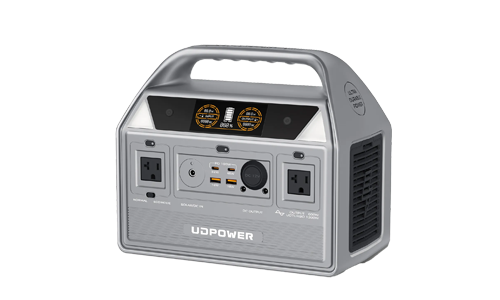
What Can a 500W Power Station Run?
ZacharyWilliamPortable Power Station Guide
Last updated: June 9, 2026 · Reviewed for runtime math, appliance wattage, surge limits, and UDPOWER product specifications.
Quick Answer
A 500W portable power station can usually run phones, laptops, Wi-Fi routers, LED lights, fans, CPAP machines, camera gear, many small TVs, portable monitors, and some compact coolers or mini fridges. It is not the right size for most microwaves, electric kettles, coffee makers, air fryers, hair dryers, toaster ovens, or space heaters.
The simplest rule: 500W tells you how much power the inverter can supply at one time. Battery capacity in watt-hours tells you how long it will run. For a realistic estimate, use:
Estimated runtime = battery watt-hours × 0.90 ÷ device watts
For unknown brands or older batteries, use 0.85–0.90 as a planning range. For UDPOWER runtime examples in this guide, we use 90% as the planning efficiency.

What 500W Actually Means
A 500W power station is often misunderstood because “500W” sounds like battery size. It is not. In most product names, 500W refers to the continuous AC output limit—the maximum steady power the inverter can provide while your device is running.
Three specs matter before you plug anything in
Watts The real-time power your device uses.
Watt-hours The battery “fuel tank” that determines runtime.
Surge watts The short startup spike needed by motors, compressors, pumps, and some tools.
For example, a laptop that draws 60W may run for hours. A 500W small appliance may run for less than one hour on a 500Wh-class battery. A mini fridge may look safe at 70W while running, but still fail if the compressor needs a high startup surge.
The safest habit is to check the device label, power adapter, or user manual. The U.S. Department of Energy also recommends using the actual nameplate wattage whenever possible because real appliance wattage varies by model, age, and settings. See the DOE guide to estimating appliance energy use.
What a 500W Power Station Can Run
A 500W power station is best for efficient electronics, small backup essentials, and one moderate load at a time. It can also run multiple small devices together if their combined wattage stays below the output limit.
| Device or Appliance | Typical Running Watts | Can a 500W Station Run It? | What to Check First | Best Connection |
|---|---|---|---|---|
| Smartphone charging | 5–20W | Yes | Use USB when possible to reduce AC inverter loss. | USB-A / USB-C |
| Tablet charging | 10–30W | Yes | Fast charging may draw more for short periods. | USB-C |
| Laptop | 45–100W | Yes | Gaming laptops can draw much more under load. | USB-C PD or AC |
| Wi-Fi router + modem | 10–25W | Yes | One of the best outage uses for this size. | AC or DC adapter |
| LED lights / lanterns | 5–30W | Yes | Excellent runtime per watt. | USB / DC / AC |
| Small fan / box fan | 20–75W | Yes | Higher speeds draw more power. | AC |
| CPAP without heated humidifier | 30–60W | Usually yes | Turn off heated humidity and heated tubing for longer runtime. | DC if supported; otherwise AC |
| CPAP with heated humidifier | 70–120W+ | Maybe | Battery capacity becomes more important than output wattage. | AC |
| Small LED TV | 50–120W | Usually yes | Screen size, brightness, and sound output affect draw. | AC |
| TV + streaming stick | 70–150W | Usually yes | Add both devices together, not just the TV. | AC + USB |
| Portable monitor | 10–25W | Yes | Great for remote work and field setups. | USB-C |
| Camera battery charger | 10–40W | Yes | Easy load for photographers and video crews. | USB-C or AC |
| Drone battery charger | 50–120W | Usually yes | Multi-battery charging docks may draw more. | AC or USB-C |
| Bluetooth speaker | 10–50W | Yes | Best charged directly instead of running constantly on AC. | USB |
| 12V compressor cooler | 40–70W average | Usually yes | DC operation is often more efficient than AC. | 12V DC |
| Mini fridge | 60–100W running | Sometimes | Startup surge is the key risk, not running watts. | AC |
| Full-size refrigerator | 100–250W running, higher surge | Sometimes, but not ideal | A 500W station may start some efficient fridges but has limited runtime and surge headroom. | AC |
| Small blender | 300–500W+ | Maybe | Use alone; startup surge may overload some units. | AC |
| Low-power tool charger | 80–150W | Yes | Good for charging battery packs, not heavy corded tools. | AC |
| Small drill / driver | 300–500W running | Maybe | Motor startup and stall load can exceed the rating. | AC |
| Electric blanket | 60–120W | Usually yes | Much better battery value than a space heater. | AC |
| Rice cooker, small | 300–500W | Maybe | Possible with no other major loads, but runtime is short. | AC |
| Coffee maker | 800–1200W | Usually no | Most drip coffee makers exceed the 500W class. | Not recommended |
| Microwave | 900–1500W+ input | No | Input draw is much higher than the cooking wattage shoppers see on the front label. | Not recommended |
| Hair dryer | 1200–1800W | No | A classic overload load for small power stations. | Not recommended |
| Space heater | 1000–1500W | No | Too much draw and poor battery value. | Not recommended |
| Air fryer / toaster oven | 1000–1800W | No | Heat-producing kitchen appliances are usually outside this class. | Not recommended |
Practical takeaway: a 500W power station is a strong middle ground for electronics, internet backup, CPAP, fans, lights, and compact travel gear. It becomes weak when you ask it to make heat, cook food, or start large motors.
Runtime Chart: 500Wh, C400, C600, and S1200
Runtime depends more on battery capacity than the “500W” output label. The chart below uses this planning formula:
Runtime hours = battery capacity × 0.90 ÷ device watts
| Load | Example Devices | Generic 500Wh Battery | UDPOWER C400 256Wh / 400W |
UDPOWER C600 596Wh / 600W |
UDPOWER S1200 1190Wh / 1200W |
|---|---|---|---|---|---|
| 10W | Router, phone charging, LED light | About 45 hours | About 23 hours | About 53.6 hours | About 107.1 hours |
| 25W | Router + modem, portable monitor, tablet | About 18 hours | About 9.2 hours | About 21.5 hours | About 42.8 hours |
| 40W | CPAP without heat, efficient cooler average | About 11.2 hours | About 5.8 hours | About 13.4 hours | About 26.8 hours |
| 60W | Laptop, CPAP, small fan | About 7.5 hours | About 3.8 hours | About 8.9 hours | About 17.9 hours |
| 100W | TV, fan + lights, work setup | About 4.5 hours | About 2.3 hours | About 5.4 hours | About 10.7 hours |
| 150W | TV + router + laptop charging | About 3 hours | About 1.5 hours | About 3.6 hours | About 7.1 hours |
| 300W | Small appliance, high laptop load + monitor + router | About 1.5 hours | About 0.8 hours | About 1.8 hours | About 3.6 hours |
| 500W | Near-limit appliance load | About 0.9 hours | Not suitable as a 500W load | About 1.1 hours | About 2.1 hours |
Why your real runtime may be different
Fridges and coolers cycle on and off. CPAP machines change draw based on pressure, humidity, and heated tubing. Laptops draw more when gaming, editing video, or charging from a low battery. Cold weather and battery age can also reduce usable energy. Treat runtime charts as planning numbers, then leave margin.
Real-Life Setups: What 500W Looks Like in Practice
Most people do not plug in one device and walk away. They plug in a router, phone, laptop, lights, fan, CPAP, cooler, or TV in different combinations. These examples show how to think about combined loads.
1. Power Outage Internet Setup
Example load: router + modem 20W, laptop 60W, two phones 20W, LED lamp 10W.
Total: about 110W.
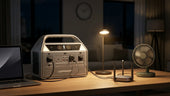
What it means: a 500W power station can run this comfortably. The question is runtime, not output. A UDPOWER C600 is a better fit than a smaller 200Wh–300Wh unit if you need several hours of internet and work time.
2. CPAP Overnight Setup
Example load: CPAP without heated humidifier 30–60W; with heated humidity and heated tubing 70–120W or more.
What it means: a 500W-class station can usually handle the output, but battery capacity decides whether it lasts all night. For one optimized night, the C600 is often a practical match. For two nights or heated settings, step up to S1200.
Related category: CPAP Battery Backup
3. Camping Cooler + Lights + Phones
Example load: 12V compressor cooler averaging 45W, LED string lights 10W, phone charging 10W.
Total: about 65W average.
What it means: this is one of the best use cases for the 500W class. Use DC power for the cooler if your setup supports it, keep the lid closed, pre-chill food before leaving home, and use solar during the day to stretch runtime.
4. Small TV Night
Example load: 80W LED TV, 10W streaming stick, 15W router.
Total: about 105W.
What it means: output is not a problem. A C600 gives a realistic evening session. A smaller C400 can work for shorter sessions, but a larger S1200 gives more comfort if the TV is part of a longer outage plan.
5. Creator or Field Work Kit
Example load: laptop 60W, camera charger 30W, portable monitor 15W, phone 10W.
Total: about 115W.
What it means: a 500W power station is a strong fit. Use USB-C PD where possible because it avoids some AC conversion loss and keeps the setup cleaner.
What a 500W Power Station Usually Will Not Run Well
The fastest way to be disappointed with a 500W power station is to plug in something that creates heat. Heating elements use a lot of power, and batteries drain quickly when asked to produce heat.
| Device | Typical Draw | Why It Is a Poor Match | Better Power Station Class |
|---|---|---|---|
| Microwave | 900–1500W+ input | Most exceed 500W by a wide margin. | 1200W–2400W+ |
| Coffee maker | 800–1200W | Heating water takes too much power for this class. | 1200W+ |
| Electric kettle | 1000–1500W | High continuous heat load. | 1200W–2400W+ |
| Air fryer | 1000–1800W | Usually far beyond a 500W inverter. | 2000W+ |
| Hair dryer | 1200–1800W | Very high draw even on many low settings. | 2000W+ |
| Space heater | 1000–1500W | Drains batteries fast and often overloads small stations. | Not recommended for battery use unless sized very carefully |
| Large power tools | 600–1500W+ with surge | Startup and stall loads can exceed the station rating. | 1200W–2400W+ |
| Sump pump | 800W+ running, much higher surge | Motor surge is usually the problem. | 1200W–2400W+ with tested surge capacity |
If your must-run device appears in this table, do not try to force a 500W power station to do the job. Move up to a larger inverter and larger battery capacity.
Recommended UDPOWER Power Stations for 500W-Class Shoppers
UDPOWER does not need to force every buyer into the same size. A 500W-class shopper usually falls into one of three groups: lightweight backup, practical middle-ground backup, or more serious appliance backup.
Best Match for 500W-Class Buyers: UDPOWER C600

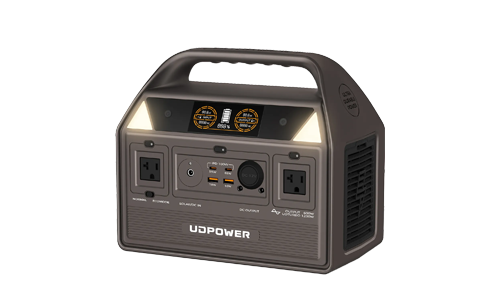
Why it fits: the C600 gives 600W rated output and 596Wh capacity, which makes it a safer choice than a strict 500W unit when your real use includes CPAP, laptop work, fans, compact coolers, small TVs, routers, and occasional moderate loads.
- 596Wh LiFePO4 battery capacity
- 600W rated AC output, 1200W peak
- 2 AC outlets plus USB-C, USB-A, 12V car output, and DC output options
- Solar charging input up to 240W within the supported input range
- Best for camping, road trips, CPAP backup, router backup, small TV use, and medium off-grid loads
Lightweight Option: UDPOWER C400

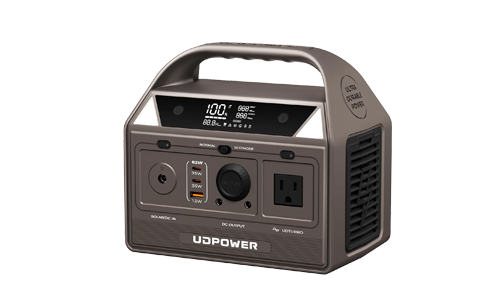
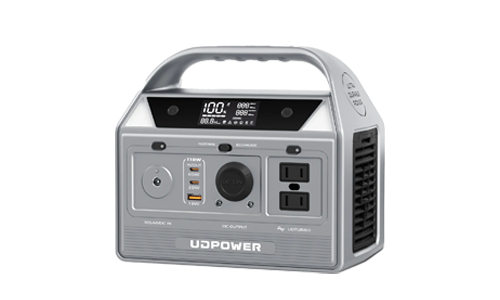
Why it fits: the C400 is not a 500W output station, but it is useful for readers who discover their real needs are actually phones, routers, LED lights, laptop charging, small fans, and short camping backup.
- 256Wh LiFePO4 battery capacity
- 400W AC output, 800W surge
- Compact body for travel, camping, and car kits
- Best for light electronics, short sessions, and portability-first buyers
Step-Up for More Runtime and Appliance Headroom: UDPOWER S1200
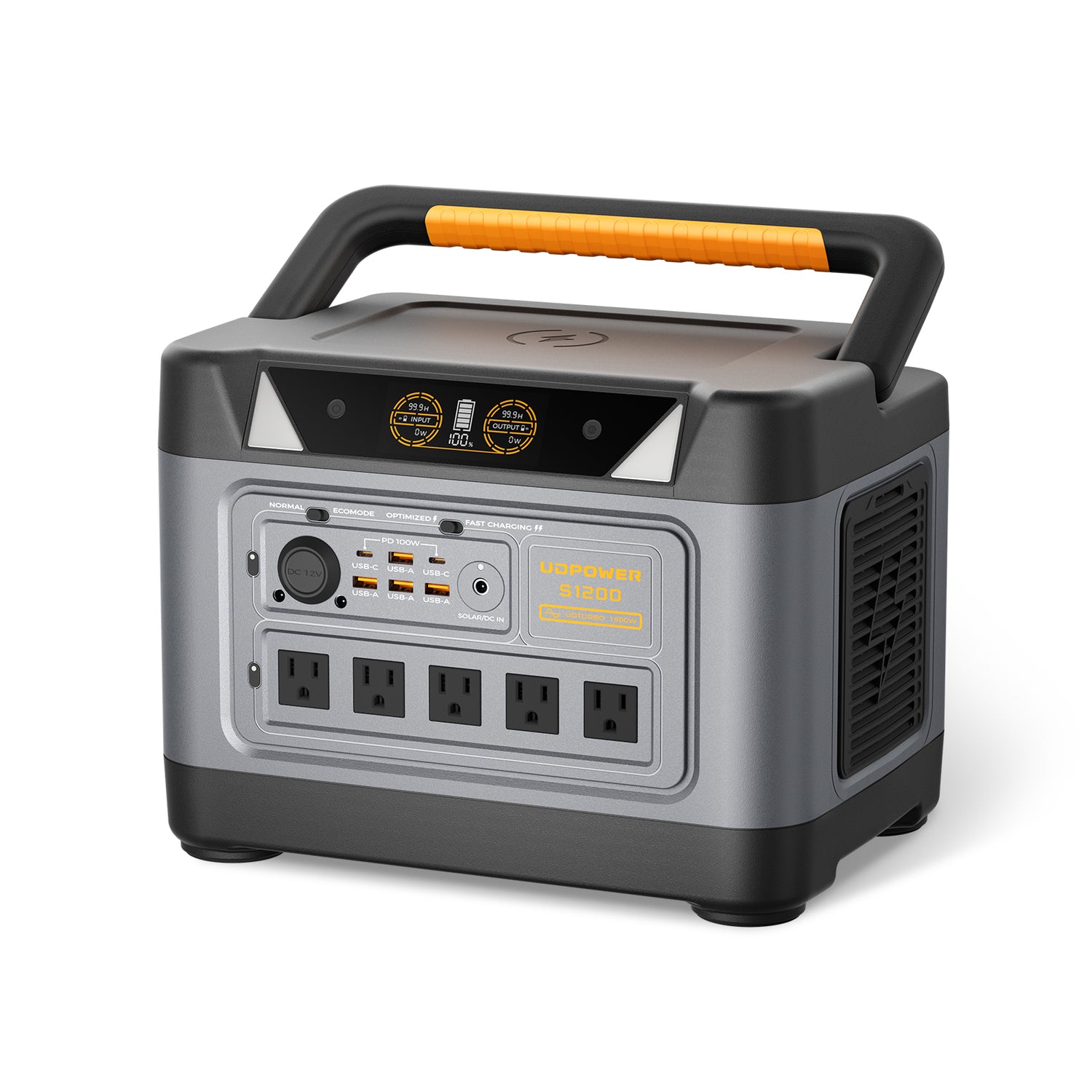
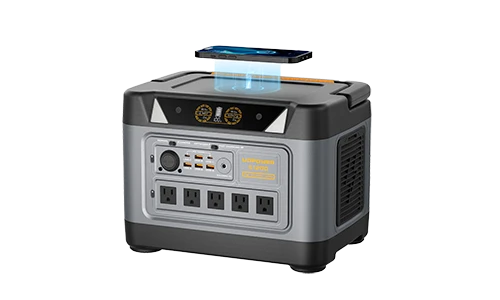
Why it fits: if your 500W shopping list includes a refrigerator, longer CPAP runtime, more AC outlet overlap, or a multi-day outage plan, the S1200 is the more comfortable size.
- 1190Wh capacity
- 1200W rated output, 1800W surge
- More runtime for CPAP, TV, router, laptop, lights, and refrigerator backup
- Stronger option for home backup, RV use, emergency prep, and longer outages
Simple buying recommendation
Choose C400 if your load list is mostly charging, lights, router, and short laptop use. Choose C600 if you want the most practical answer for the 500W class. Choose S1200 if you care about fridge experiments, longer CPAP runtime, or running several essentials at once without constantly watching the watt meter.
Solar Recharging and How to Extend Runtime
Solar does not change what a 500W power station can run at one moment, but it can change how long your setup stays useful over a day or weekend. If your power station is running a 60W load and a panel is adding meaningful input during the day, you are reducing how fast the battery drains.
| Setup | Best Use | Planning Note | UDPOWER Link |
|---|---|---|---|
| C600 + 120W solar panel | Camping, weekend cooler support, device charging | Best for adding power during daylight and reducing overnight battery drain. | 120W Solar Panel |
| C600 + 2 × 120W solar panels | Faster daytime recovery for a 596Wh battery | Stay within the C600 supported solar input range. Do not use incompatible high-voltage panels. | C600 Product Page |
| S1200 + solar panel kit | Longer outages, RV, CPAP backup, fridge backup | More battery capacity makes solar more useful because you have more storage to refill. | Solar Generators |
Tips for getting better solar input
- Place the full panel surface in direct sun. Even partial shade can reduce output sharply.
- Adjust the angle during the day instead of leaving the panel flat.
- Watch the input watts on the power station display and fine-tune placement.
- Keep the panel outside glass when possible; windows reduce solar performance.
- Use only compatible voltage, current, and connector specs. For C600, follow the official C600 solar input requirements and compatible panel guidance.
Related category: UDPOWER Solar Panels
How to Choose the Right Size Before You Buy
The best size is not the one with the biggest number on the box. It is the smallest power station that runs your real devices safely for the hours you need.
- List every device you want to run at the same time. Do not calculate one device at a time if you plan to use them together.
- Find the running watts. Check the label, adapter, or manual. If a device lists volts and amps, multiply volts × amps to estimate watts.
- Check startup surge. This matters for refrigerators, coolers, pumps, and power tools.
- Add a margin. Try not to run a power station at its absolute limit for long periods.
- Calculate runtime from watt-hours. Output watts tell you what can run; battery capacity tells you how long.
- Use DC or USB when practical. Running through AC can waste more energy than USB-C or 12V DC.
- Plan how you will recharge. Wall charging, car charging, and solar charging all matter if your trip or outage lasts more than one battery cycle.
| Your Main Use | Better Size Class | Why | Related Guide |
|---|---|---|---|
| Phones, lights, router, camera batteries | 200W–400W | Light loads do not need a large inverter. | 200W guide |
| Laptop, CPAP, router, fan, small TV | 500W–600W | Good middle ground for portable backup. | 600W guide |
| Mini fridge, more device overlap, longer CPAP runtime | 800W–1200W | More surge margin and more battery capacity. | 800W guide |
| Home backup, refrigerator, multiple essentials | 1000W–1200W+ | Better for longer outages and appliance uncertainty. | 1000W guide |
| Microwave, air fryer, power tools, heavier appliances | 2000W+ | Heat and motor loads need more inverter headroom. | Start with 1200W guide |
FAQ
What can a 500W power station run?
A 500W power station can usually run phones, laptops, routers, LED lights, small fans, camera chargers, CPAP machines, small TVs, portable monitors, and some compact coolers or mini fridges. It is not a good fit for most microwaves, coffee makers, air fryers, space heaters, hair dryers, or electric kettles.
How long will a 500W power station last?
It depends on battery capacity and the watts your device uses. A simple planning formula is battery watt-hours × 0.90 ÷ device watts. A 500Wh battery running a 100W load may last about 4.5 hours, while a 60W load may last about 7.5 hours.
Can a 500W power station run a refrigerator?
Sometimes, but it depends on the refrigerator. Many fridges run below 500W after startup, but the compressor may need a higher surge to start. A 500W station is more realistic for a mini fridge or efficient compact refrigerator than for a full-size refrigerator during a long outage.
Can a 500W power station run a CPAP overnight?
In many cases, yes. A CPAP without heated humidity often draws around 30–60W, which is a comfortable output load for a 500W-class station. Heated humidifiers and heated tubing can greatly increase power use, so battery capacity becomes the deciding factor.
Can a 500W power station run a coffee maker?
Usually no. Most drip coffee makers draw around 800–1200W, which is above the comfort zone of a 500W power station. A low-watt travel coffee setup may work only if its rated power stays within the station’s continuous output limit.
Is 500W the same as 500Wh?
No. 500W is output power, which tells you what the station can run at one time. 500Wh is battery capacity, which tells you how much energy is stored and how long your devices may run.
Can I run a TV and laptop at the same time?
Usually yes, as long as their combined draw stays below the power station’s continuous output limit. For example, an 80W TV plus a 60W laptop is about 140W, which is well below 500W. Runtime still depends on battery capacity.
Is a 500W power station enough for camping?
Yes, for many camping setups. It is a strong fit for phones, lights, fans, laptops, camera gear, speakers, routers, and efficient coolers. It is not meant to replace a high-power campsite kitchen setup.
What should I avoid plugging into a 500W power station?
Avoid high-heat appliances and large motor loads unless the label clearly fits within the power station’s continuous and surge limits. Common poor matches include microwaves, hair dryers, space heaters, air fryers, electric kettles, toaster ovens, and many coffee makers.
Should I choose UDPOWER C600 or S1200?
Choose C600 if your needs are mostly 500W-class loads such as laptop work, router backup, CPAP, small TV, fans, and compact camping gear. Choose S1200 if you want more runtime, stronger appliance headroom, refrigerator backup, or a more comfortable outage setup.
Need Help Choosing a Power Station?
If your load list includes CPAP, a refrigerator, internet backup, camping gear, or a small TV, compare the C600 and S1200 first. The C600 is the practical 500W-class step-up. The S1200 is the better choice when runtime and appliance headroom matter more than compact size.
View Portable Power Stations View UDPOWER C600 View UDPOWER S1200