What Appliances Cannot Be Used With Solar Power?
ZacharyWilliamQuick answer: Small solar generators and portable solar panel setups are usually not suitable for electric dryers, central air conditioners, electric ovens, electric water heaters, hot tubs, large space heaters, Level 2 EV chargers, and many 240V hardwired appliances.
That does not mean these appliances can never run on solar power. A professionally designed rooftop solar system with enough panels, battery storage, inverter capacity, transfer equipment, and selected backup circuits may support some larger appliances. But for a portable solar generator, the safest and most practical loads are essentials: refrigerators, Wi-Fi routers, CPAP machines, phones, laptops, LED lights, fans, TVs, and small kitchen appliances used briefly.
Solar power can run more household devices than many people expect, but the phrase “run on solar” is often too vague. A direct solar panel, a portable power station, and a full rooftop solar-plus-battery system are very different tools. The real question is whether your system can handle the appliance’s voltage, running watts, startup surge, daily watt-hours, and recharge window.
Simple rule: solar power works best for efficient, essential, plug-in devices. It struggles with long-running electric heat, large motors, compressor startup surge, and 240V hardwired loads.

What “Solar Power” Means in This Guide
Solar panels produce DC electricity from sunlight. Most household appliances use stable AC power. That is why a useful home or portable solar setup normally needs more than a panel: it needs the right input, battery, inverter, protection electronics, and output rating.
| Solar setup | What it really is | Good for | Do not expect it to run | Source |
|---|---|---|---|---|
| Direct solar panel only | A panel making variable DC power when sunlight is available. | Charging a compatible battery, controller, or power station input. | Most household AC appliances directly. | Energy.gov PV system basics |
| Portable solar generator | A portable power station charged by compatible solar panels. | Outage essentials, camping, RV use, fridge cycling, Wi-Fi, CPAP, lights, fans, laptop, TV. | Whole-home HVAC, dryers, long electric heating, large 240V hardwired loads. | UDPOWER solar generators |
| Rooftop solar without battery | Grid-tied panels that offset utility use during normal operation. | Lowering daytime energy use and utility bills when the grid is working. | Backup power during an outage unless the system is specifically designed for backup. | EIA solar PV explanation |
| Rooftop solar with battery backup | A larger installed system with panels, inverter, storage, and selected backed-up circuits. | Home backup circuits when professionally sized. | Unlimited whole-home power without load planning. | Energy.gov storage and inverter basics |
Mobile tip: swipe tables sideways to view all columns.
Appliances That Usually Should Not Run on Small Solar Generators
The appliances below are not “bad appliances.” They are simply poor matches for small solar generators because they need high sustained wattage, 240V power, hardwired circuits, large startup surge, or far more battery capacity than most portable systems can reasonably provide.
| Appliance | Typical solar problem | Portable solar generator verdict | Better plan | Source / check method |
|---|---|---|---|---|
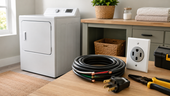
| Electric clothes dryer | Often 240V and high sustained heat load. | Usually no. | Use grid power, gas drying, a heat pump dryer, or a professionally sized home backup system. | Energy.gov: larger appliances may use 240V |
| Central air conditioner | Large compressor load, high startup surge, long runtime, often 240V. | Usually no for portable systems. | Use a professionally designed rooftop solar-plus-battery system with HVAC load calculation. | Energy.gov air conditioning |
| Electric oven or range | High heat load and often 240V. | Usually no. | Use propane/outdoor cooking, a small microwave briefly, or a professionally installed backup circuit. | Energy.gov: check watts and voltage |
| Electric water heater | Long heating cycles consume a large amount of energy. | No for most portable systems. | Use gas, heat pump water heating, or a large installed backup system. | Energy.gov appliance energy use |
| Large space heater | Usually 750W–1,500W continuously. | May turn on, but not practical for long runtime. | Use insulation, lower-watt personal warming, or a non-electric heating plan designed for the space. | Energy.gov kettle example shows how fast 1,500W loads add up |
| Hot tub or spa | Water heating plus pump load. | No. | Use dedicated electrical service and solar offset, not portable backup. | Check appliance nameplate, breaker size, and manual. |
| Level 2 EV charger | Large 240V load and high daily energy demand. | No for practical charging. | Use grid charging or a rooftop solar system sized for annual EV energy offset. | Check charger voltage, amperage, and circuit requirement. |
| Large well pump or large sump pump | Motor startup surge may be much higher than running watts; some pumps are 240V. | Only after verifying voltage and surge. | Use a pump-rated backup solution or electrician-installed transfer equipment. | Check locked-rotor amps, running amps, voltage, and pump manual. |
| Hair dryer, electric kettle, toaster, air fryer | Small physical size but high heat draw. | Sometimes, briefly, on larger models only. | Run one at a time and only if the input watts stay within the AC output rating. | Energy.gov wattage formula |
| Any 240V appliance on a 120V power station | Voltage mismatch. | No. | Use a proper split-phase system and code-compliant installation. | Energy.gov: most U.S. appliances use 120V; larger ones may use 240V |
Do not judge only by appliance name. Always check the label, manual, or a watt meter.
Safety note: Do not backfeed a home outlet or electrical panel with a portable power station. Power devices directly from the station, or use transfer equipment installed by a licensed electrician. Also, never connect solar panels to a port that is not rated for solar input.
Why These Appliances Are Hard for Solar Power
Most weak solar matches fail for one of five reasons. This is where many quick online lists are too simple: the issue is not just “high watts.” It is how those watts behave over time.
| Problem | What it means in real life | Common examples | Why it matters |
|---|---|---|---|
| High sustained load | The appliance keeps drawing a lot of power for a long time. | Space heater, water heater, dryer, oven. | Battery capacity disappears quickly, even if the appliance starts. |
| Startup surge | The appliance needs extra power for a moment when starting. | Fridge compressor, pump, power tool, air conditioner. | A station may trip even if running watts look safe. |
| 240V requirement | The appliance is not a normal 120V plug-in load. | Dryer, electric range, central AC, some well pumps. | A 120V portable station cannot run it directly. |
| Hardwired circuit | The appliance is wired into the home, not plugged into a standard outlet. | Central HVAC, water heater, some pumps. | It needs proper transfer equipment and electrical work. |
| Poor solar recharge match | The appliance uses more daily energy than your panels can replace. | Long heating loads, large AC, EV charging. | You may drain the battery faster than sunlight can refill it. |
The 5-Point Appliance Test Before Plugging In
- Check voltage. Is it a normal 120V plug-in device, a 240V appliance, or a hardwired load?
- Check running watts. Look at the nameplate, adapter label, manual, or EnergyGuide information.
- Check startup surge. Refrigerators, pumps, compressors, and power tools may need much more power at startup.
- Check runtime need. A 1,500W device for 5 minutes is very different from a 1,500W device for 5 hours.
- Check solar recharge limits. Panel voltage, current, and wattage must stay within the power station’s input rating.
For a quick AC runtime estimate, use this planning formula:
Estimated runtime = battery capacity in Wh × 0.9 ÷ appliance watts
For example, a 1,190Wh power station running a 100W load may provide roughly 10.7 hours:
1,190Wh × 0.9 ÷ 100W = 10.7 hours
This is only a planning estimate. Real runtime changes with inverter losses, appliance cycling, temperature, battery condition, and whether other devices are running at the same time. For refrigerators, average watts over time are often more useful than the highest number on the label because the compressor cycles on and off.
Runtime Examples: What High-Watt Appliances Do to a Battery
High-watt heat is the fastest way to drain a portable solar generator. The table below uses a 90% usable AC efficiency estimate for simple planning.
| Load example | Planning watts | UDPOWER C600 596Wh | UDPOWER S1200 1,190Wh | UDPOWER S2400 2,083Wh | Practical takeaway |
|---|---|---|---|---|---|
| Wi-Fi router + modem | 20W | About 26.8 hours | About 53.6 hours | About 93.7 hours | Excellent solar backup load. |
| CPAP without heated humidifier | 40W | About 13.4 hours | About 26.8 hours | About 46.9 hours | Good match when heating features are limited. |
| Refrigerator average draw | 100W | About 5.4 hours continuous equivalent | About 10.7 hours continuous equivalent | About 18.7 hours continuous equivalent | Real fridge runtime may be longer because the compressor cycles. |
| Microwave used continuously | 1,200W | About 0.45 hours | About 0.89 hours | About 1.56 hours | Use briefly, not as a long cooking plan. |
| Space heater | 1,500W | About 0.36 hours | About 0.71 hours | About 1.25 hours | May turn on, but it is a poor battery use. |
These are planning estimates, not guaranteed runtimes. Use your appliance label or a watt meter for real numbers.
Appliances That Usually Work Well With Solar Power
Solar power is most useful when you focus on efficient, essential, plug-in loads. These devices give you the best return on every watt-hour stored in the battery.
| Appliance or device | Solar fit | Best practice | Suggested UDPOWER size | Helpful internal guide |
|---|---|---|---|---|
| Phones, tablets, cameras | Excellent | Use USB-C or USB-A when possible to reduce inverter waste. | C400 or larger | Portable power stations |
| LED lights | Excellent | Use fewer, brighter LED lights instead of lighting the whole home. | C400 or larger | Power priorities during an outage |
| Wi-Fi router and modem | Excellent | Keep internet on a priority outlet and avoid extra devices on the same setup. | C600 or larger | Runtime planning for outages |
| Laptop and monitor | Very good | Use direct USB-C charging if supported. | C600 or larger | Battery powered outlet |
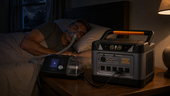
| CPAP machine | Good with proper sizing | Check humidifier and heated hose settings because heating raises power draw. | S1200 or larger for longer backup | CPAP battery backup |
| Refrigerator | Good if startup surge fits | Test fridge alone first, keep doors closed, and use average watts for runtime planning. | S1200 or S2400 | Refrigerator power backup guide |
| TV | Good | Lower brightness and avoid running high-watt loads at the same time. | S1200 or larger | What can a 1200W power station run? |
| Microwave or coffee maker | Possible on larger models | Use briefly, one at a time, and check input watts rather than marketing watts. | S2400 if within rating | What can a 2000W power station run? |
| Fan | Very good | Use the lowest comfortable speed to stretch runtime. | C600 or larger | Camping power stations |
UDPOWER Product Recommendations by Appliance Load
Choose a portable power station by appliance load, not just battery size. Watts decide whether the appliance can run. Watt-hours decide how long it can run. Solar input decides how realistically you can refill the battery during the day.

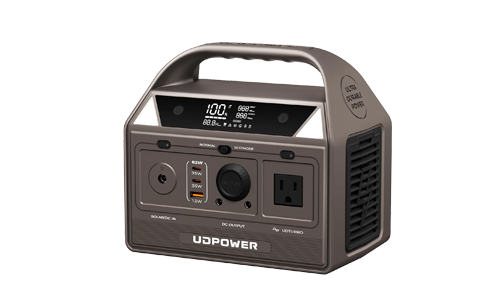
UDPOWER C400 — Small Electronics and Light Camping Loads
Capacity: 256Wh
AC output: 400W
Cycle life: 4,000+ cycles
Solar note: C200–C400 supports up to 150W solar input according to the UDPOWER 120W solar panel page.
Best for: phones, tablets, cameras, LED lights, laptop charging, compact fans, and light camping backup.
Not for: refrigerators, microwaves, space heaters, electric kettles, or motor-heavy appliances.
View UDPOWER C400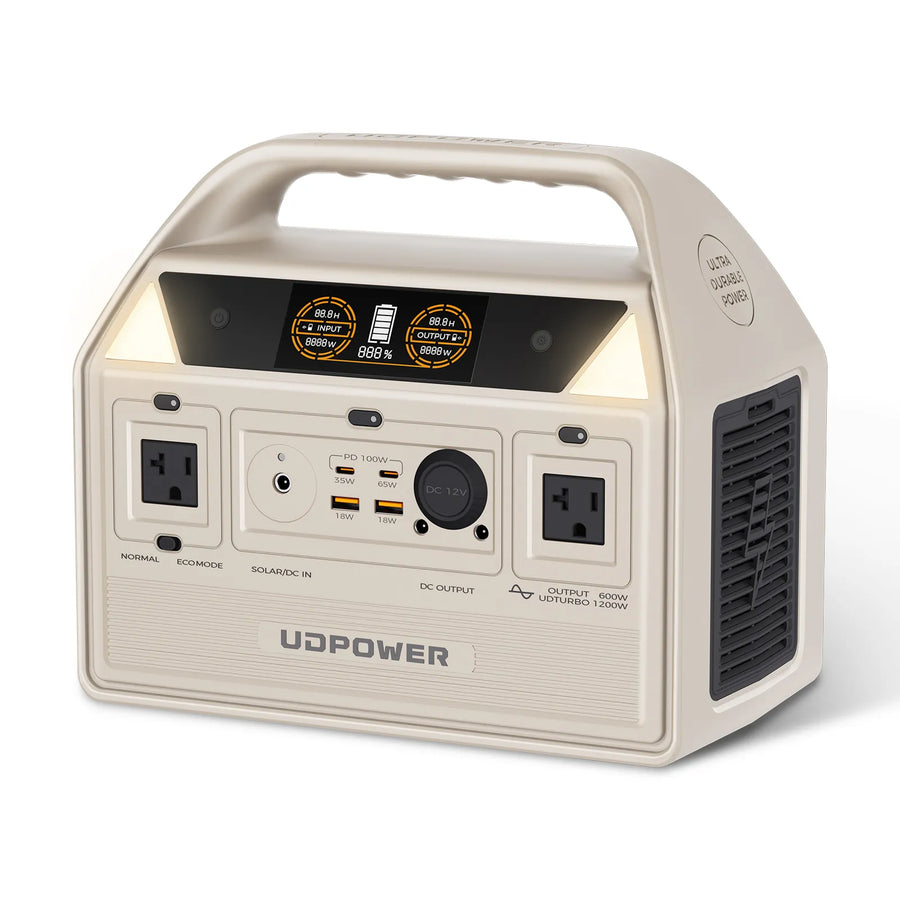
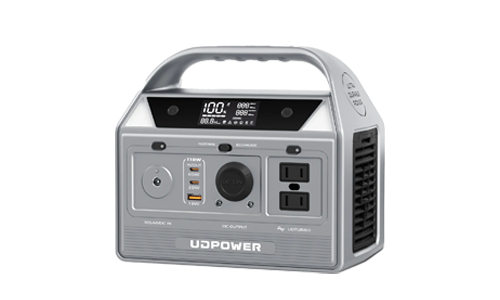
UDPOWER C600 — Camping, Wi-Fi, Fans, and Small Essentials
Capacity: 596Wh
AC output: 600W rated output
Peak output: 1,200W
Battery: LiFePO4, 4,000+ cycles
Solar note: UDPOWER notes that C600 supports 18V solar panels and should not be paired with the 210W solar panel.
Best for: Wi-Fi routers, laptops, lights, fans, cameras, phones, small camping loads, and carefully sized mini-fridge scenarios.
Not for: high-heat appliances, large compressors, electric cooking for long periods, or whole-home loads.
View UDPOWER C600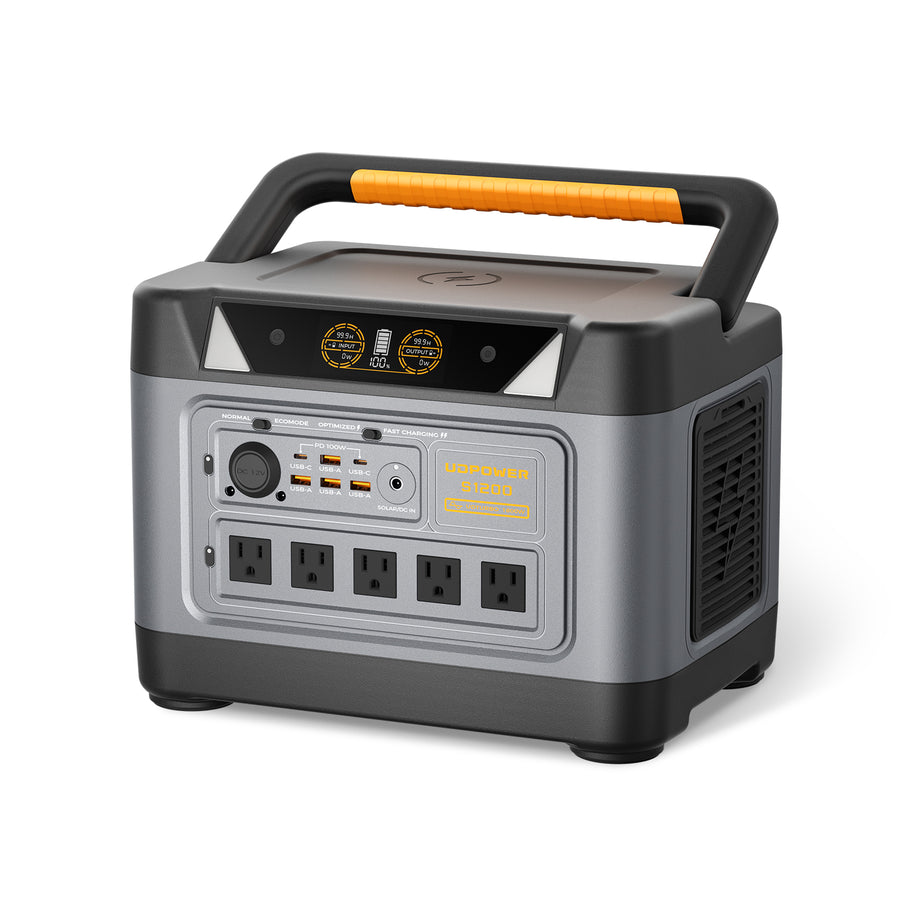
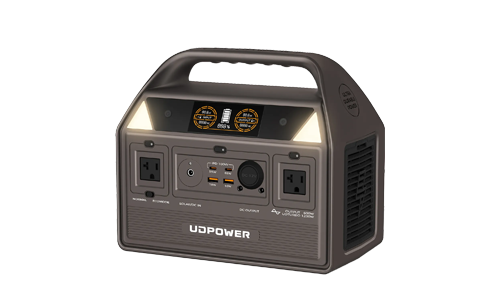
UDPOWER S1200 — Refrigerator, CPAP, Wi-Fi, TV, and Family Essentials
Capacity: 1,190Wh
AC output: 1,200W
Surge: 1,800W with UDTURBO support
Weight: 26.0 lbs
Solar input: up to 400W
Useful official example: A standard refrigerator may run about 10–15 hours on a full charge, depending on real usage.
Best for: practical home backup, refrigerator cycling, router/modem, CPAP, lights, laptop charging, fans, TV, and small appliances used one at a time.
Not for: central AC, electric dryers, long electric heating, water heaters, or 240V circuits.
View UDPOWER S1200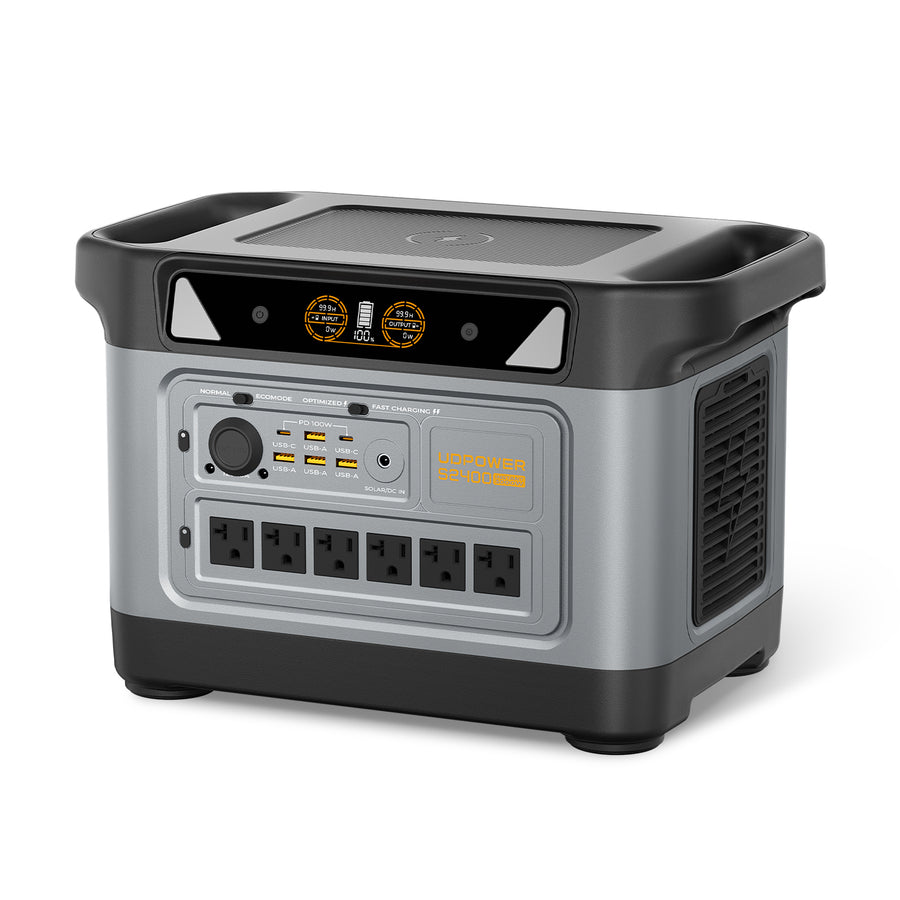
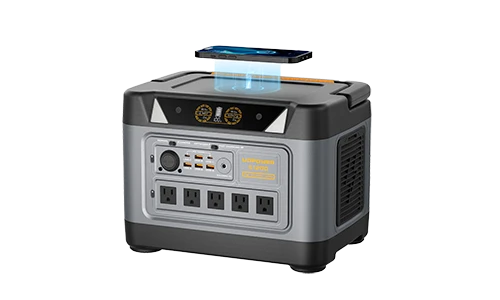
UDPOWER S2400 — Larger Backup Loads and Multi-Device Runtime
Capacity: 2,083Wh
AC output: 2,400W
Surge: up to 3,000W with UDTURBO support
Ports: 6 AC outlets + 10 DC outputs
Solar input: up to 400W
Useful official example: A standard refrigerator may run about 18–30 hours on a full charge, depending on real usage.
Best for: longer refrigerator backup, multiple essentials at once, RV/camping comfort loads, and short use of some high-watt appliances when the appliance stays within the 2,400W output rating.
Not for: central AC, electric dryers, large water heaters, Level 2 EV charging, or hardwired 240V home circuits.
View UDPOWER S2400Quick Product Matching Table
| Use case | Best starting model | Why | Product source |
|---|---|---|---|
| Phones, lights, camera batteries, short laptop charging | C400 | Compact 256Wh capacity with 400W output for light loads. | C400 product page |
| Wi-Fi, fans, laptops, road trips, small camping gear | C600 | 596Wh capacity and 600W output give more room for everyday essentials. | C600 product page |
| Fridge, CPAP, Wi-Fi, TV, laptop, lights | S1200 | 1,190Wh capacity, 1,200W output, and 1,800W surge are a practical home backup range. | S1200 product page |
| Longer fridge backup, RV use, microwave used briefly, multiple essentials | S2400 | 2,083Wh capacity and 2,400W output provide more runtime and more AC headroom. | S2400 product page |
When Rooftop Solar Changes the Answer
A portable solar generator is for selective backup. A rooftop solar-plus-battery system is a building electrical project. This is why one homeowner may say solar can support their air conditioner, while another person with a portable power station should not expect that result.
| Question to ask a solar installer | Why it matters | A useful answer should include |
|---|---|---|
| Which appliances will work during an outage? | Not every solar installation backs up every circuit. | A written essential-loads list. |
| Can the inverter handle my largest startup surge? | Motors and compressors can trip undersized systems. | Continuous output, surge output, and assumptions for each major load. |
| Does the system support 240V loads? | Dryers, central AC, ranges, and some pumps may require split-phase power. | Clear 120V/240V design details and backed-up circuit list. |
| How many battery kWh are usable? | Large appliances may start but not run long. | Usable capacity, not only nameplate battery capacity. |
| How was solar production estimated? | Roof angle, shade, location, and season change output. | A site-specific production estimate, not only panel wattage. |
| Who handles permits and interconnection? | Permanent solar and backup circuits must follow local code and utility rules. | Permit scope, inspection plan, utility approval, and warranty details. |
A trustworthy solar energy company should talk about load calculation, not just panel count. More panels help produce more daily energy, but inverter size and battery output decide whether a large appliance can actually start and run during an outage.
Best Practical Plan: Separate Must-Run Loads From Nice-to-Have Loads
During an outage or off-grid trip, the smartest solar strategy is not to run a normal home day. It is to protect the loads that matter first, then add comfort devices only if you have capacity left.
| Priority | Run first | Run only if you have extra capacity | Avoid on portable solar |
|---|---|---|---|
| Safety | Medical device, phone, LED lighting. | Extra electronics. | High-heat comfort appliances. |
| Food | Refrigerator or freezer in planned cooling cycles. | Small microwave use under rating. | Electric oven, range, or long hot plate use. |
| Communication | Wi-Fi router, modem, laptop. | TV or game console. | Entertainment loads running all day. |
| Comfort | Fan, low-watt personal comfort device. | Short-use small appliance under rating. | Central AC, large space heater, electric fireplace. |
Need Help Choosing the Right Backup Size?
If you only need phones, lights, Wi-Fi, and a laptop, a compact power station may be enough. If you want to keep a refrigerator, CPAP, TV, and several essentials running during an outage, choose a higher-capacity model with enough AC output and surge capacity.
View Portable Power Stations View Solar Generator Kits Get the Runtime Planning GuideRelated UDPOWER Guides and Product Pages
- Portable Power Stations — compare models by capacity, output, solar charging, and use case.
- Solar Generator Kits — portable power stations paired with compatible solar panels.
- Solar Panels — compatible solar panels for UDPOWER charging setups.
- Portable Power Stations for Camping — campsite and RV power planning.
- Portable Power Stations for Outdoor Use — outdoor and emergency power setups.
- Can a Solar Generator Power a House? — explains whole-home vs critical-load backup.
- Power Station Safety Guide — safety checks before buying and using a battery backup.
- Are Foldable Solar Panels Worth It? — when portable solar panels make sense.
- Solar Recharging During a Power Outage — realistic solar output and recharge planning.
- Power Priorities: What to Run First — fridge, medical devices, Wi-Fi, and load planning.
FAQ: Appliances and Solar Power
Can solar panels run appliances directly?
Usually no. Most household appliances need stable AC power, while a solar panel produces variable DC power. In most real setups, you need a battery, charge controller, inverter, or a properly installed grid-tied solar system.
What appliances cannot be used with a small solar generator?
Electric dryers, central air conditioners, electric ovens, electric water heaters, hot tubs, large space heaters, Level 2 EV chargers, and many 240V hardwired appliances are usually not suitable for small solar generators.
Can a solar generator run a refrigerator?
Yes, if the refrigerator’s running watts and startup surge fit the power station. Larger models such as UDPOWER S1200 and S2400 are better starting points for refrigerator backup than small camping-size units.
Can a portable solar generator run central air conditioning?
Usually no. Central air conditioning often needs high startup surge, long runtime, and sometimes 240V power. A professionally designed rooftop solar-plus-battery system may support selected HVAC loads, but a portable solar generator should not be treated as a central AC backup system.
Why are heaters so difficult for solar power?
Electric heaters draw a lot of power continuously. A 1,500W heater can drain a 1,190Wh power station in less than an hour under simple runtime math, so it is usually a poor battery use even when it can turn on.
Can I run a microwave on solar power?
Sometimes. A microwave is a short-use, high-watt appliance. Check the input watts on the appliance label and run it by itself. A larger model such as UDPOWER S2400 is a more realistic choice than a small portable station.
Can 240V appliances run on solar power?
Yes, but only with the right system. A 120V portable power station cannot directly run a 240V appliance. You would need a system designed for 240V output and code-compliant transfer equipment if it connects to home circuits.
Can I use a space heater with a solar generator?
It may turn on if the wattage is within the power station’s output rating, but it is usually not recommended for long runtime. Space heaters consume battery capacity very quickly.
Should I call a solar installer for large appliances?
Yes. If you want solar backup for central AC, a well pump, electric range, dryer, EV charger, water heater, or hardwired circuits, talk with qualified solar installation companies or a licensed electrician before buying equipment.
What UDPOWER model should I choose for home essentials?
For light electronics, consider C400 or C600. For refrigerator, CPAP, Wi-Fi, TV, and longer outage planning, S1200 is a practical starting point. For larger multi-device backup and short high-watt appliance use within rating, S2400 offers more capacity and output.